

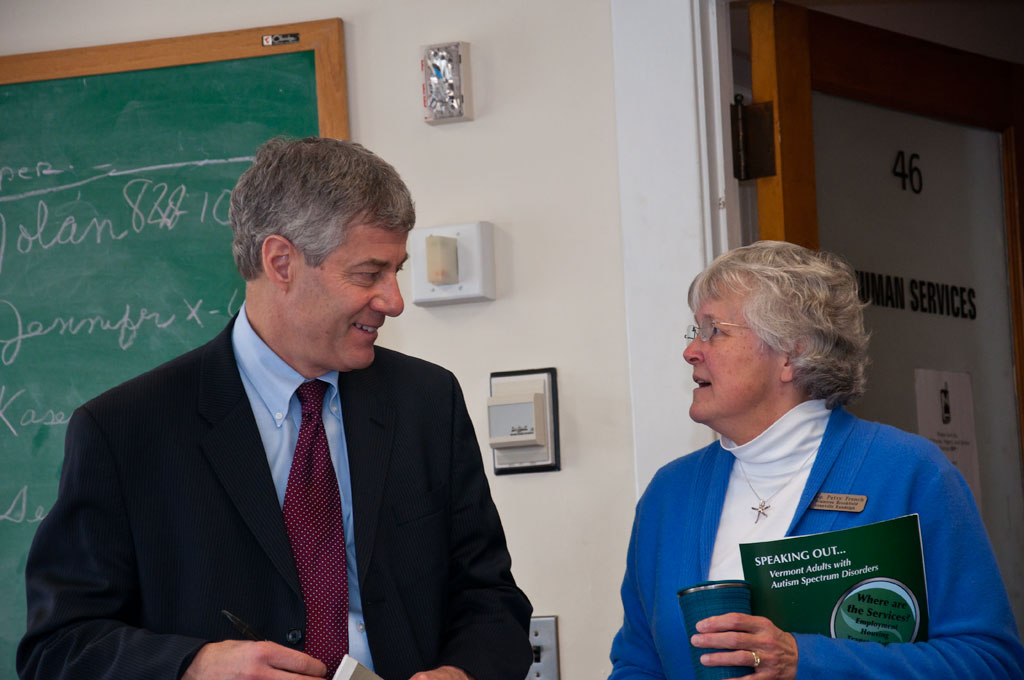
In a grim little ceremony, members of the House Human Services Committee went around the room and took a straw poll on which programs they could live with cutting.
Respite care for seniors? Mental health services for the third year running? Or services for developmentally disabled Vermonters?
The 10 members of the committee couldn’t decide. They were tasked with providing the House Appropriations Committee with a prioritized list, and they did so, but with great reluctance.
There wasn’t much to like in the governor’s budget recommendation, which includes $43.8 million in cuts. The bulk of the money comes from changes to health care programs, including a move to fold Catamount Health into the Vermont Health Access Program (VHAP) and an expansion of health care provider taxes. Gov. Peter Shumlin also banks on $3.3 million in savings due to the long-awaited recertification of the Vermont State Hospital, the facility which treats psychiatric patients who are a danger to themselves or to others. The Douglas administration also counted savings from VSH — for many years running — to no avail. Once the hospital has certification from the Centers for Medicare and Medicaid Services, it will be eligible to receive about $11 million a year in CMS funds.
Often, committee members are assigned homework. In House Appropriations, for example, each member of the committee is asked to research a single topic and then give a presentation to the group. The House Human Services Committee takes a similar tack and, on Tuesday, lawmakers gave presentations about the areas of the budget they had researched, and each one defended his or her conclusion.
One by one, representatives made the case to keep most of the programs they reviewed whole. Though they acknowledged the need to balance the budget, in light of the state’s $176 million hole in fiscal year 2012, they told their chair, Ann Pugh, that they didn’t feel it was their responsibility to cut vital programs that, as Rep. Patsy French, D-Orange-Addison-1, put it, “work against our policy goals.”

Rep. Anne Donahue, R-Northfield, came up with a creative solution for circumventing $1.4 million in cuts to the designated agencies, nonprofits that provide mental health care services. Donahue wants to ensure that mental health is treated equally. Too often, she said, the treatments are not considered to be a part of the health care system. She presented a plan in which the Department of Vermont Health Access would work with the Department of Mental Health to find $1.4 million in savings by integrating mentally ill patients into the health care system through the Blueprint for Health plan and primary care. She said the state could find savings by looking across the board at effective health and mental health expenditures under the state’s federal subsidy program (global commitment).
“Only mental health care access is capped arbitrarily instead of funded in relationship to projected need and use,” Donahue wrote in a report she presented with Rep. Lynn Batchelor, R-Orleans.
Donahue said the governor’s proposed budget cut to mental health comes on the heels of four years of cuts to the designated agencies, and the total amount, including the fiscal year 2012 recommendation from Shumlin, would be 10 percent.
Donahue said the commissioner of the Department of Mental Health, Christine Oliver, didn’t explain where the cuts would come from. “We don’t have different pieces, we have this glob,” Donahue said. “It’s a cut off their heads” approach basically, she said. The department didn’t give the legislature tools to identify the highest priorities or to ensure highest needs are met.
“We’re not accepting a 5 percent cut in mental health agencies,” Donahue said. “We’re saying that amount of savings has to be taken through DMH and DVHA across health care systems.”
Donahue and Batchelor offered “no comment” on the governor’s projected $3.4 million in savings regarding the efficacy of recertifying the Vermont State Hospital, except to say, as Donahue put it: “We go through this every year.”

French said cuts to programs for respite care and individual assistants for elderly Vermonters could result in 52 additional Vermonters seeking nursing home care, rather than at home.
“I cannot in good conscience support any of the cuts,” French said. “These go against our policy goals, which have been here for some time now. Our highest priority is to restore the budget.”
French said.
She said perhaps the state needs to look at rainy day funds, new revenues or tax expenditures to cover the cost of essential programs for vulnerable Vermonters.
Rep. Sandy Haas, P-Rochester, said: “I don’t think it’s wrong to say after three years of cuts we are finding this very very difficult.”
The representatives went around the room in the legislative version of kumbaya and explained why they couldn’t live with one cut over another. In truth, each of them — even the most conservative among them — seemed to recoil from the act of recommending reductions in any form for what they deemed to be essential programs for the elderly, the mentally ill or the developmentally disabled.
Late in the afternoon, they took a straw poll to see if they could prioritize a list of programs they thought should not be cut. In the end, the lawmakers were divided between mental health, which has seen $15 million in cuts, including Medicaid matching funds, over the last three years, and $2.2 million worth of reductions in respite care and other supports that enable elderly Vermonters to stay in their homes and avoid nursing home care. Five members voted for mental health, and five voted for programs for the elderly.
Earlier in the day, members decided to recommend reducing state subsidies for school substance abuse counselors by 75 percent, according to Pugh. The governor had asked for the elimination of the program.
The House Human Services committee will finish its recommendations to House Appropriations in a day or so. HAC is marking up the human services portion of the budget this week.
