


Editor’s note: The video accompanying this story was shot at a rally held on the Statehouse steps on Feb. 24, 2011.
Jim Blair filed his testimony opposing the wind power project on Lowell Mountain earlier this year, and expected to be cross-examined before the Public Service Board.
“Nobody cross-examined me,” he said the other day. “They don’t want to put a public face on it, because if they do, they’re doomed. People will learn about the lives they’re destroying. Nobody knows about us right now.”
Bonnie Day and Don Nelson had the same experience, and the same explanation.


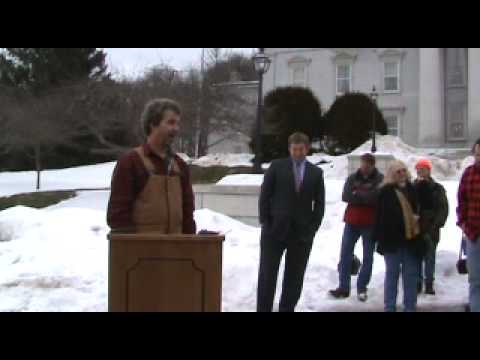

“They had me down on the schedule for cross-examination,” Day said. “But they don’t want a human face on it.” Nelson used the same term.
The “they” Blair, Day, and Nelson are talking about is Green Mountain Power Co., which is seeking a Certificate of Public Good from the Public Service Board so it can erect 21 wind towers, each of them 469 feet high, along four miles of the ridge line atop Lowell Mountain in the Northeast Kingdom.
Their estimation of why GMP didn’t bother to cross-examine them is their own, and can be neither refuted nor confirmed, though presumably GMP decided cross-examination would do its case no good. But their experience illustrates an interesting peculiarity of the Public Service Board’s process for determining whether a proposed project gets that Certificate of Public Good.
A great deal of the testimony — including, at least in this case, most testimony from opponents of the project — is not given in public. It is prepared privately by the witness as “prefiled testimony,” and sent to the PSB.
It isn’t a secret. It’s part of the public record. The three PSB members consider the information in the prefiled testimony before deciding the case. CORRECTION: Though testimony isn’t typically available on the PSB website, the court did upload the material today. Here’s a link.
(For additional resources, go to Green Mountain Power and Energize Vermont.)
But unless those witnesses are cross-examined, their testimony is never dealt with in the public forums the Board holds in the bank building across the street from the Statehouse. The testimony is public, but it is not visible, a practice that in some cases could influence the outcome.
“They read it (the testimony), but that’s not the same as someone getting up on the stand and breaking into tears because everything they value will be destroyed,” said Day, who added she was “on drugs for stress” over her conviction that the wind project will spoil the quiet, rural life she and her husband enjoy in the remote area near the mountain.
And while the PSB members know about the pre-filed testimony, the public does not, or at least it has not so far. Though they should have known, many reporters writing about the Lowell Mountain controversy (including this one) did not know about the statements from the project’s nearest neighbors, assuming that, as in most proceedings, all testimony took place in public.
That’s why the stories from these opponents of the project have received little attention. Had they gotten more, it is conceivable that they might have gotten more support. The PSB is a “quasi-judicial” body, whose members are expected to rule on the evidence, and not be swayed by public opinion. But as noted by Mr. Dooley (Finley Peter Dunne’s fictional bar-tender), “th’ Supreme Coort follows th’ election returns.” Other judges — even “quasi-judges” — have also been known to be swayed by public sentiment.
Not that it is possible to predict how the public might have responded had more attention been paid to the accounts of the project abutters. As Bonnie Day acknowledged, “only a few people’s lives are being ruined.”
There is some dispute as to whether those lives are really being ruined. Dotty Schnure, GMP’s spokeswoman, said experts consulted by the company are convinced that the sound of the turbines will neither keep the neighbors awake nor bother them during the day.
But she acknowledged that “we are proposing a major change” to the surroundings of the people who live closest to the project.
Especially, perhaps, to Jim Blair. It is not simply that Blair, once a champion dog-sledder and motocross driver, is convinced that the sight, sound, and tumult of the wind towers will devastate both of the businesses he runs on his 70 acres in Eden, with a panoramic view of the ridge — dog-sled rides and cabins that attract guests who come precisely for the quiet and solitude. There is also the fear that the project could devastate him, and not just financially.
That’s because of what Blair did not reveal during an interview, but his sister Deborah did the following day: Jim Blair has autism, defined as a neural disorder characterized by impaired social action and communication.
“He came here in 2000 in order to be in a pristine environment, which helps the autism,” said Deborah Blair, who is staying with her brother to help fight the wind powers.
Blair’s passions are motorsports and, especially sled dogs, but, said his sister, sled dogs with a difference.
“We practice ethical dog sledding,” she said. “We don’t chain the dogs. We don’t kill them (if it appears that they won’t be good racers, common practice among many mushers).”

Deborah Blair said she and her brother are in the process of transforming his business into an educational nonprofit, with programs for autistic and other troubled children and adults. His 70 acres, she said, has more than 10 miles of engineered dog-sled trails, which cost $100,000 to create.
Blair now has seven employees. His sister said they envision “10 to 30 more jobs with therapy programs so people can inter-act with these extraordinary dogs.”
That’s probably more people than the wind project will employ full time.
Deborah Blair said the wind project “is going to ruin” her 57-year-old brother, who has been envisioning his new educational project as “something that would go on long after him.”
Blair’s obviously poignant story raises another question: Why does hardly anyone know it? The answer to that question illustrates another rarely discussed aspect of the wind tower debate, not just in Lowell, but statewide.
The anti-wind forces have been politically inept. That’s partly because the politically savvy major environmental groups in Vermont are gung-ho for wind, on the (dubious) assumption that it helps the fight against global warming by burning less coal to generate electricity. The wind opponents are recently formed citizens’ groups, who lack the money or the political expertise needed to get their story across.
That helps explain why they are not confident that they can keep the PSB from granting that Certificate of Public Good. Their fall-back position is delay. Don Nelson said he plans to sue the project developers, arguing that a faulty survey means that some of the towers and one of the roads to them will impinge on his property.
Timing is important in this case because part of GMP’s revenue from the project will come in the form of a 2.5 cent per kilowatt hour payment from the federal government. That money, Schnure said, will go to reduce the electric bill of the customers (theirs and those of Vermont Electric Co-op) who purchase the power.
But the tax subsidy will evaporate if the wind towers are not producing power by December 31, 2012. If they aren’t, the project could be in trouble. If they are, Jim Blair’s dream might be dead.
