

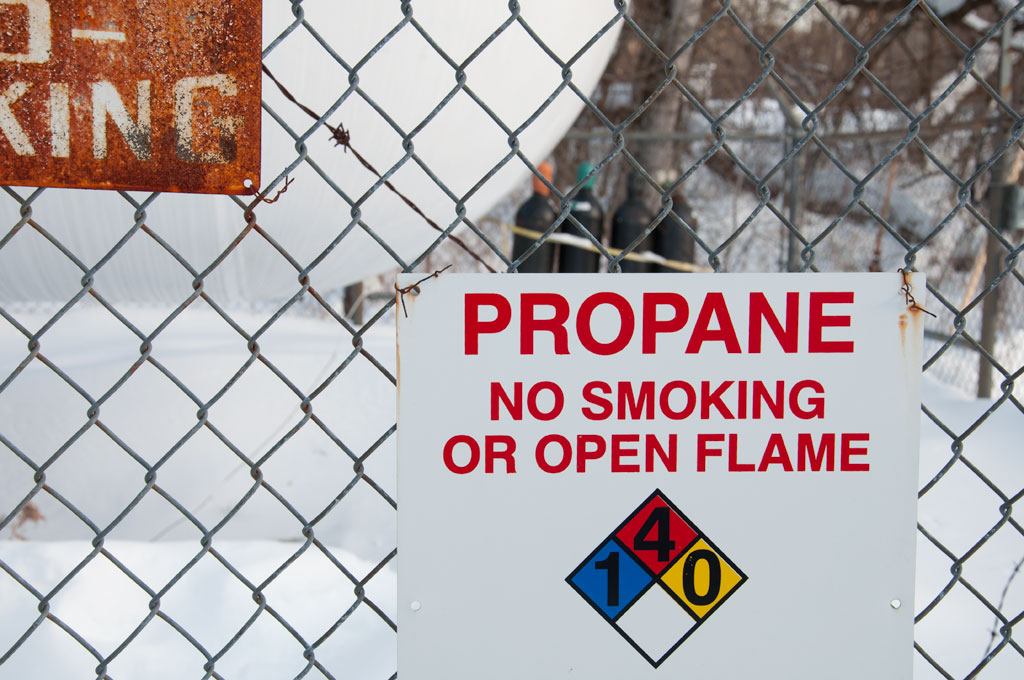
Lawmakers in the House of Representatives have introduced legislation that would change the way propane is regulated and sold in Vermont. Two bills seek to curb the fees propane dealers charge consumers for minimum gas usage and tank rentals. One of the bills would require the propane industry to be regulated by the Department of Public Service. Another would make it mandatory for companies to report prices to the department.
The legislation was introduced in the wake of a brouhaha over fees associated with the delivery of liquid propane. In September, Pyrofax Energy began charging a hefty fee based on propane usage — on top of the cost of the gas itself — to customers in Vermont who used less than one tank of fuel per year. More than 100 Vermonters have filed formal complaints with the Vermont attorney general’s office about the minimum usage fees.
Dig Deeper
Article Navigation
Documents
Links
- Pyrofax press release
- Consumer Assistance Program
- Burlington Free Press: Propane dealer Pyrofax scraps fee for low use
- Pyrofax
- Intergy, L.P.
- U.S. EIA heating oil and propane prices
- Vermont’s weekly “rack,” or wholesale price
Legislation
Steven Gentile of South Burlington was charged a $499.50 minimum usage fee in January — in addition to what he paid for the gas, which cost $148.95, according to the letter he filed with the attorney general’s office.
Pyrofax billed him for the additional amount even though Gentile bought more than $800 worth of gas in 2010.
Maurice Messier of Enosburg said Pyrofax sent him a $69.50 surcharge for gas he didn’t use. Messier said he was being charged $7.50 a gallon for the gas. He called Rep. Michel Consejo, D-Sheldon, to complain. Consejo is the sponsor of a bill that would prohibit minimum usage fees for propane.
“I’m sick and tired of big companies rough-shodding all over us little people,” Messier said in a telephone interview.
In response to the complaints, Pyrofax sent out a press release in January to its Vermont customers pledging to return the fees. The company said in a statement that the fees pay for liability coverage and the cost of maintaining propane tanks. Shawn Shouldice, a lobbyist for the company, said in an interview that since the statement was released in January, Pyrofax has decided to discontinue the minimum usage fees this year.
Rep. Consejo and Rep. Dave Sharpe, D-Bristol, have both proposed bills that would prohibit the practice altogether and limit other charges.
Unlike utilities, which must sell energy at a fixed price set by the state, propane companies can charge whatever they want, as their rates are not regulated. Propane businesses in Vermont, however, are required to abide by consumer fraud Rule 111, which stipulates that companies follow a litany of rules that protect Vermonters from fuel shutoffs in the winter and minimum delivery requirements. It also sets guidelines for propane tank removal, refunds and reimbursements. Rule 111 was recently amended to include disclosure requirements for charges. These rules are monitored by the Consumer Assistance Program, which is part of the Vermont attorney general’s office and serves as a clearinghouse for consumer complaints about propane companies.
We are reviewing the safety and liability issues associated with the provisions in 161 related to sale of tanks and the certificate process set forth; given the provision I would expect the AG office may have a view on those issues, too.”
~ Elizabeth Miller
Department of Public Service
According to a story in the Burlington Free Press Jan. 20, about 4,000 out of a total of 20,000 Pyrofax customers in Vermont were charged the minimum usage fee, based on the difference between a full tank (the amount delivered) and the amount actually used.
Pyrofax, a subsidiary of Inergy, L.P., based in Kansas City, Mo., is the fourth largest propane dealer in the United States. The company has 12 local offices in Vermont.
Pyrofax isn’t the only company, however, that has generated complaints. According to the Consumer Assistance Program, there were 172 complaints filed against 10 companies across the state regarding fees and charges billed to Vermont residents during the period of Nov. 1, 2010 to Feb. 8, 2011. Of those complaints, 100 were in reference to the minimum usage fees imposed by Pyrofax.
Sandi Everitt, director of the program, said in an e-mail that most consumer complaints fall into three areas, including:
- failure to remove tank after discontinuation of service;
- excessive charges for tank removal;
- failure to reimburse consumer for gas in tank; billing issues — failure to receive a bill, bill discrepancies; cash sales and delivery, security deposit charges, and the price of gas.
Everitt said the propane industry has “unique characteristics” because of the safety issues associated with propane use. Companies are liable for propane leaks that can lead to fires and explosions.
Consequently, consumers have more competitive options with other heating fuel industries, such as oil, kerosene and wood pellets, she said. “They can pick and choose, they can check prices and move around more freely,” Everitt said. “With propane it’s more complicated because of safety issues.”
The fee disclosure rules are designed to “even the playing field,” Everitt said. “Even with that, because of the different fees, it’s difficult for people to do these comparisons,” she said. “Our goal is to figure out what will work for consumers.”
Gas companies charge fees for deposits, new tanks, inspections, monthly leases for equipment, early service termination, among others, according to Everitt. Pyrofax, for example, charges about 20 separate fees.
Download the Pyrofax disclosure form.

Matt Cota, the executive director of the Vermont Fuel Dealers Association, said those fees help to pay for the steel tanks gas companies install for consumers. Statewide, he said, about 38,000 Vermonters rely on propane for heating fuel. Each tank, according to Cota, costs the fuel company about $1,000. Asking consumers to help pay for the tanks through rental, deposit and/or maintenance fees is a reasonable expectation, he said.
The minimum usage fees serve a similar function, Cota said. An outlay in equipment that isn’t earning money through the sale of fuel is a financial liability for gas companies.
If the Legislature allows any propane company to fill a tank, “that’s in effect the state passing legislation to give away $40 million in assets,” Cota said. And it doesn’t eliminate the insurance liability related to safety issues, he said.
Competitiveness in the marketplace?
Rep. Paul Ralston, D-Middlebury, a co-sponsor of Consejo’s bill, is the founder of Vermont Coffee Company. Ralston said he purchased propane tanks for his business, and this gives him the flexibility to buy gas at the wholesale commercial rate. Vermonters, Ralston suggested, can also shop around for the best price.
“Well-informed consumers make (good) markets,” Ralston said.
The wholesale price for gas was $1.43 a gallon in January. The residential price on average, nationally, last month was $2.78, according to the U.S. Energy Information Association.
The “weekly “rack,” or wholesale price, in Vermont is similar, though it does not include a listing of tiered residential prices. The rates for gas, Cota said, vary depending on the amount of usage.
Cota argues that the propane industry is competitive. He compares the consumer options for gas to blueberry sales: A pint of berries is cheaper at Costco where fruit is purchased in bulk, than at the co-op.
“You can buy (gas) from whomever you want,” Cota said. The updated consumer fraud rule, he said, makes it possible for consumers to shop around. The attorney general’s office, he said does a good job of regulating fees.
“Propane consumers can switch companies anytime,” he said.
Gas companies accept liability for propane installations, Cota said. When consumers buy their own tanks, Cota said they become responsible for the safety of the installation.
Four bills, new restrictions

Lawmakers are trying to address constituents’ complaints in several bills. Rep. Dave Sharpe, D-Bristol, and the lead sponsor of two bills, said four pieces of legislation have emerged because “there is widespread concern about what propane companies are doing to consumers.”
The bills have been introduced in the House Commerce and Economic Development Committee. Each summary is followed by a response from Elizabeth Miller, the commissioner of the Department of Public Service, which is reviewing the bills.
Rep. Dave Sharpe, D-Bristol:
H.161. Sharpe proposes to prohibit minimum usage fees, require companies that rent tanks to offer them for sale to consumers, require a certificate of installation and require public disclosure of prices and charges. The bill has three sponsors.
Rep. Michel Consejo:
H. 185. Consejo wants to prohibit companies from charging a minimum use fee for propane that is not delivered to consumers. In addition, he wants to prohibit charges for removing tanks that have been in place for more than a year. The bill would also require that propane companies refund consumers for the remaining balance on a closed account within a 20-day period. The bill has 30 sponsors.
Miller’s take:
The commissioner wrote in an e-mail that H.161 and H. 185 enhance consumer protections and take other steps “to ensure that consumers receive fair treatment from the retail suppliers.”
“We are reviewing the safety and liability issues associated with the provisions in 161 related to sale of tanks and the certificate process set forth; given the provision I would expect the AG office may have a view on those issues, too.”
Rep. Dave Sharpe:
H. 221. Sharpe proposes to place the propane industry under the jurisdiction of the Public Service Board and the Department of Public Service. Under his bill, liquefied gas companies would be supervised and regulated by the Department. The bill has five sponsors.
Miller’s take:
The Commissioner said the retail gas industry is “not a monopoly environment.” Consequently, the Department has concerns about the implications of regulating the propane gas industry.
“Regulatory oversight in the utilities arena is meant to provide a proxy for competition, and the protections it creates, in a monopoly environment,” Miller wrote in an e-mail.
“Consumer protection is paramount,” Miller said. “Generally, in a competitive marketplace, consumer protection and consumer fraud laws provide the appropriate legal oversight. However, we will look forward to hearing the committee’s view on the matter.”
Rep. Bill Lippert, D-Hinesburg:
H. 102. Lippert wants to require heating fuel dealers to report the average price per gallon to the Department of Public Service.
Miller’s take:
The Commissioner said the Department has a fuel price reporting system in place already and it is looking at “whether the additional reporting requested poses any obstacles.”
Miller worries that the new requirements could lead to a presentation of inaccurate information because of the fast-paced fluctuations of the market and lag times in reporting.
“Consumers should, of course, have ready access to current pricing comparisons; whether a Department compilation currently meant to track trends and pricing overall rather than to provide dealer by dealer real time comparisons for consumer selection purposes is the right vehicle for this is the question, in my view,” Miller wrote in an e-mail.
