


Editor’s note: This is the fourth article in a series about the Vermont Blue Ribbon Tax Structure Commission Report. In this report we examine its recommendations for income tax reforms.
“Tax reform Part 1: Where policy meets politics” was an overview of the political context for the commission’s recommendations. In our second story in the series, we looked at the impact of the commission’s sales tax proposal,“Tax reform Part 2:Sales tax expansion would hit broad array of services. Our third article, Tax reform part 3: Why the “Amazon tax” is a no-brainer, looked at the commission’s proposed Internet sales tax.
Gov. Peter Shumlin described this year’s budget as “as sobering as it is necessary.” Two-thirds of the speech was devoted to his plan for resolving the state’s $176 million budget gap.
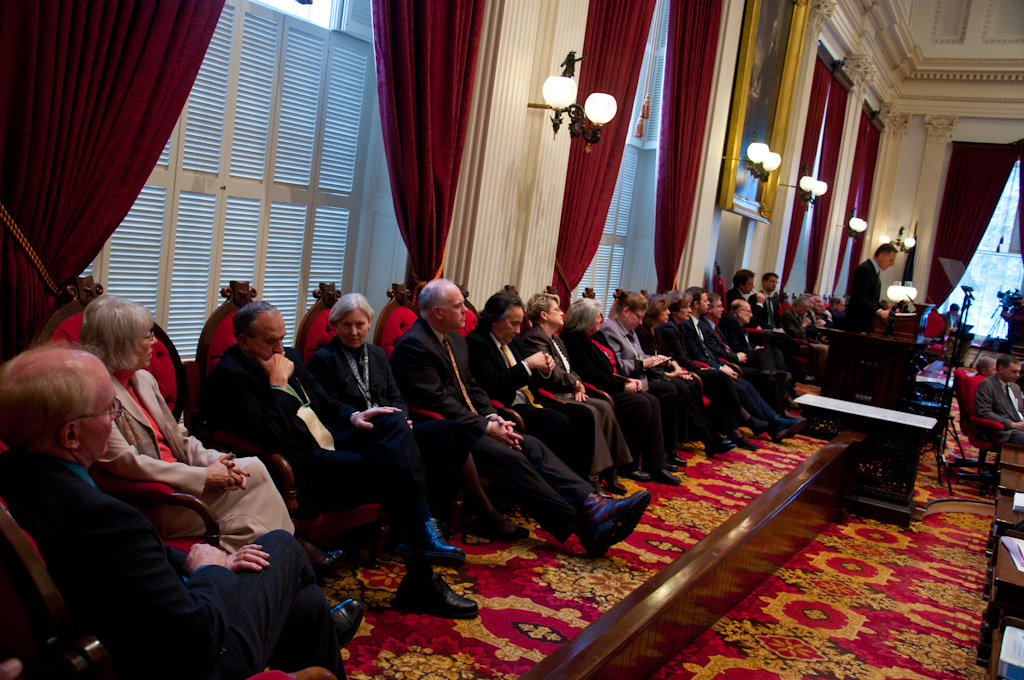
The governor’s budget address, which he delivered to lawmakers in the House Chambers on Jan. 25, was long on budget cuts ($83 million worth) and changes to the state’s burdensome health care system and short on happier thoughts about new programs to improve pre-kindergarten education, energy efficiency, Lake Champlain clean up, broadband deployment and workforce development.
Dig Deeper
Article Navigation
- From TI to AGI
- How the shift from TI to AGI would affect homeownership, nonprofits
- Is the tradeoff worth it?
Documents
- Vermont Blue Ribbon Tax Structure Commission’s report
- Institute on Taxation and Economic Policy: Who Pays
Links
So you may have missed the two-paragraph reference to taxes (which followed one sentence about the $18.6 million in “assessments” on hospitals), in which Shumlin explained why the state cannot raise rates this year to alleviate some of the most difficult cuts to mental health services and programs for developmentally disabled Vermonters.
Shumlin said: “Critics might also ask: Why are we not raising taxes? After all, Illinois recently raised its top income tax rate from 3 percent to 5 percent. But remember: Vermont is not Illinois, and our situation is vastly different. Our top income tax rate is not 5 percent; it is nearly 9 percent.”
Shumlin is right about one thing: Vermont is not Illinois.
After that, the governor’s argument starts to fall apart. That’s because the way rates are applied differs greatly from state to state, making “apples to oranges” comparisons difficult. (Once you add property and sales tax into the mix, those apples and oranges start looking like pineapples and raspberries.)
The amount Vermonters actually pay in income taxes is, on average, on par with Illinois. The average effective rate in Vermont over the last 30 years has held steady at about 3 percent.
The main difference between Illinois and Vermont is how the two states have managed their finances.
Vermont’s budget gap is $176 million, and that figure represents about 13 percent of the fiscal year 2012 General Fund budget, based on figures from the Joint Fiscal Office. Illinois, on the other hand, faces a $13 billion budget gap, about half of the state’s total budget of $26 billion, according to the Chicago Tribune.
Though Shumlin referred to Illinois’ “top income tax rate,” the state in fact has a flat tax for income-earners of all levels, based on adjusted gross income (tax filers can’t take itemized deductions). Until last year, that rate was 3 percent. This year the rate will be 5 percent. (Because of its flat rate structure, Illinois has been ranked among the top 10 states with the most regressive income tax policy, according to the Institute on Taxation and Economic Policy).
Illinois is No. 23 on the Tax Foundation’s business climate index.
In short, our taxes aren’t as high as they appear. The deductions taxpayers claim before they pay state taxes lowers the actual amount they pay significantly.
Before Illinois hiked up rates by two percentage points, the state had higher per capita taxes than Vermont and most other states, according to a 2007 report from ITEP (page 44) — once you add sales and property taxes into the mix. The total effective rate for all taxes varies in Illinois, depending on who you are. It helps to be rich. If you’re poor in Illinois, the actual income, property and sales tax rates are roughly 13 percent; if you happen to be in the top 1 percent, the total effective rate for property, sales and income taxes is about 4 percent.
By comparison, Vermont hits middle income-earners the hardest. The total effective tax rate in 2007 – including property, sales and income taxes – was 9.4 percent for people earning between $34,000 and $54,000, according to ITEP. The top 1 percent of Vermonters (people who make $1 million a year or more) paid 7.5 percent of their incomes on property, sales and income taxes in 2007; the poor were taxed at total effective rate of about 8.2 percent.
Vermont ranks 38th in the Tax Foundation’s business climate survey.
Technically, Shumlin is right. On paper, Vermont’s income tax rates are higher. The rate for Vermonters who earn more than $357,700 a year is 8.95 percent. The effective rate, however, the percentage wealthy taxpayers actually pay on average — is 5.4 percent. The effective rate for people who make less than $100,000 is 2.8 percent or significantly less.
So, what accounts for the large discrepancy between the amount Vermonters actually pay in taxes and the rates? Tax deductions. Unlike Illinois, Vermont taxes income after itemized deductions. We tax individuals on taxable income, after they’ve claimed first, second and third home mortgages, property taxes, donations to charity and extraordinary health care costs.
Middle class and upper income Vermonters take advantage of the deductions, according to information from the Vermont Blue Ribbon Tax Structure Commission. The average Vermont millionaire (out of a pool of 453) claimed about $312,855 in tax breaks in 2006, based on figures from the Vermont Department of Taxes. Of the 832 people who earned between $500,000 and $1 million that year, the average deduction was about $95,437, and deductions for Vermonters in middle class brackets ranged from $15,000 to $30,000.
In short, our taxes aren’t as high as they appear. The deductions taxpayers claim before they pay state taxes lowers the actual amount they pay significantly. As Tom Kavet, the consulting economist for the Legislature, puts it: Vermont has a “PR problem.”
The only way to solve that problem, according to tax analysts and state officials, is to change the state’s income tax structure.
From TI to AGI
The best way to counter the myth that Vermont’s taxes are too high, experts say, is to lower the rates, and that’s precisely what the Vermont Blue Ribbon Tax Structure Commission has recommended.
The commission, which was required to present “revenue neutral” plans to the Legislature, proposes to lower all the rates, compress the five current tax brackets into three and offer a modest residential tax credit for Vermonters in lieu of a mortgage deduction.
How can they do that without turning the system upside down? By eliminating itemized deductions. Instead of charging a percentage rate on taxable income (the amount Vermonters claim after itemized deductions), the commission recommends charging a percentage rate on adjusted gross income (before itemized deductions).
What’s the difference? About $5 billion, according to the commission’s report, which was released last month.
This shift would increase the tax base (the total amount of Vermonters’ income subject to the state tax), from about $10 billion to $15 billion.
By increasing the pool of money the state is allowed to tax, Vermont could reduce income tax rates. Vermonters in the three highest brackets, those who earn $131,450 and up, are currently charged rates ranging from 7.5 to 8.95 percent. The rates in those three upper brackets in the existing tax code would be compressed into one rate, under the commission’s plan, which would be 6.95 percent. Joint filers in Vermont who earn between $50,000 and $150,000 and single filers who earn between $30,000 and $90,000 would be taxed at a rate of 4.5 percent (the current rate is 7.2 percent). The implementation of the change would be phased in. Single income-earners who fall below $30,000 and joint filers who earn less than $50,000 would pay a 3 percent rate.
The tradeoff? Vermonters would no longer be allowed to take standard deductions (claimed by low- and middle-income Vermonters) or itemized deductions (claimed by middle- and upper-income Vermonters) on extraordinary medical expenses, home mortgages, property taxes and charitable donations. The AGI, as it’s called, does include deductions on the front page of the IRS 1040 form — for self-employment tax, alimony, student loan interest, IRA contributions, among others.
In lieu of itemized deductions, income tax filers who earn less than $125,000 would be eligible to claim a $350 tax credit; in addition, there are tax credits of $150 available for a spouse and each child.
The commission’s proposal meets the Golden Rule test of tax reform, according to tax analysts, that is, it broadens the tax base and lowers the rates. (That one-size-fits-all rule applies to sales, income and property taxes, analysts say. When politicians say they don’t want to raise “broad-based” taxes, these are the three main types they’re referring to.)
The income tax reform plan also solves our PR problem. Lowering rates always sounds good. And when you can do it without undercutting tax revenues, so much the better. (The proposal is revenue neutral, that is, it does not change the total amount the state raises in taxes, nor does it raise tax rates.)
Once you take deductions out of the equation, the gap between the published rates (3.55 percent to 8.95 percent) and the effective rates (between 0.3 percent and 5.8 percent) starts to disappear (though the AGI deductions still create some discrepancies). The new rates range between 3 percent and 6.95 percent, depending on income.
Another added benefit? Vermont’s tax rates look like those set by other states. Our New England neighbors, with the exception of New Hampshire, use adjusted gross income for calculating taxes. Vermont is one of 10 states that applies its income tax rates on taxable income. Thirty-three states use adjustable gross income.
Under the commission’s plan, Vermont’s new rates for upper income residents would be higher than rates set in Connecticut (6.5 percent, starting at $500,000 or more; 5 percent above $10,000 in income).
Vermont’s new top rates of 4.5 percent on income between $30,000 and $90,000 and 6.95 percent on income above $90,000 for single filers would be lower than Maine’s 8.5 percent tax on income of $19,450 or more. (Maine attempted to adjust its rates downward in 2009 and broaden its sales tax to include services, but the proposal was revoked by voters in a referendum in 2010.) They would also be lower than New York state’s top rate of 7.85 percent on income above $200,000. Rhode Island charges 5.99 percent on income above $125,001.
How the shift from TI to AGI would affect homeownership, nonprofits
If Vermont eliminated itemized deductions as state tax exemptions, the impact on homeownership and charitable giving would be nominal, according to Jeffrey Fothergill, a founding partner of Fothergill, Segale and Valley, an accounting firm in Montpelier.
That’s because tax filers who take advantage of the deductions benefit most from the federal tax break of 35 percent, according to Fothergill. The state tax deduction saves taxpayers about 4 percent. Lowering the top rates to 4.5 percent and 6.95 percent offsets the elimination of state deductions, he said.
“In the broader picture, we need to try to make rates more competitive,” Fothergill said. “If you let the deductions back in you’re not going to be able to keep the rates low.”
If taxes are too high, Fothergill said, it creates a situation in which there is “too much sticker shock for some people, but few people would be affected in a significant way.”
“Wealthy individuals need to operate in an environment where the workforce and businesses don’t think they’re being harmed by making Vermont their home,” Fothergill said.

Fothergill told the House Ways and Means Committee there will be “pressure” to keep the deductions, but he said that “will only increase rates.”
Pressure, as it happens, is coming from three main stakeholder groups — homebuilders, mortgage lenders and nonprofits.
Joe Sinagra, executive officer of the Homebuilders and Remodelers Association of Vermont, claims that 86 percent of itemized deductions are claimed by Vermonters who earn less than $150,000. (The Vermont Joint Fiscal Office on Tuesday said 93 percent of itemized deductions are claimed by Vermonters who earn less than $150,000.)
“That’s middle class Vermonters,” Sinagra said. “If 86 percent are taking the deduction, that’s a pretty big number.”
Sinagra said eliminating the mortgage deduction would hurt the homebuilding and renovation industries in Vermont. First-time homebuyers, he said, depend on the mortgage deductions to help make ends meet. A 4 percent deduction on an annual mortgage payment of $25,000 is worth about $1,000.
Sinagra drew a correlation between student loan deductions (which are part of the adjusted gross income calculation) and tax breaks for mortgages (itemized deductions). “We as a society would never dream of taking away that tax credit,” Sinagra said.
Sinagra said homeowners often use their tax refunds for remodeling projects. Without those refunds, he said, which are sometimes derived in part from mortgage deductions, Vermonters would have less ability to pay for that third kids’ bedroom, or a more efficient furnace.
“It sounds great on paper, but the reality is how do you fully implement it?” Sinagra said. “I don’t like having a flat credit. I get nervous with communities that need to generate more revenue and you add a percent or half a percent to something.” Taxes don’t usually go down, he said, they go up.
Matt Gardner, executive director of ITEP, said if your goals are to increase home ownership and give more people the dream of owning their home a tax break, the tax code is “designed oddly.”
“It’s incontestably true,” Gardner said. “The way it’s designed now, the mortgage interest deduction is most beneficial to upper income families.”
Gretchen Morse, executive director of the United Way of Chittenden County, told the House Ways and Means Committee, that the elimination of charitable deductions could “disrupt” funding for the nonprofit community.
Morse said taxpayers donate money as a way of contributing to their communities. She sees the charitable deduction as an extension of “a benefit to the community as a whole, rather than to the individual.”
“The point of view from the sector is: Are these partnerships, are these social contracts for services that the state would otherwise have to provide?” Morse said. “Would you have to do something else if that community engagement and donations people give was disrupted?”
Dick Heaps, an independent Vermont-based economist, said he doesn’t expect nonprofits to suffer as a result of the switch from TI to AGI. Like other tax analysts interviewed for this story, he didn’t see the 4 percent deduction swaying many potential donors from contributing.
“In most cases, it’s our higher income people donating money to charities,” Heaps said. “If you look at Vermonters in higher income ranges, the average Vermonters effective income tax rate is around 3 percent; higher income individuals pay 4 percent to 6.95 percent.”
Kail Padgitt of the Tax Foundation said charities tend to worry about state deductions, but he thinks the impact “would be on the margin.”
“It’s no surprise some of the biggest are charity gifts come at end of the year,” Padgitt said. “There’s reason to believe and understand that’s a motive behind people’s choices. (But) I don’t think charities will disappear.”
Is the tradeoff worth it?
Tax analysts say yes.
If the top rate is 8.95 percent, Gardner said, “The reality is, no one is paying 8.95 percent in income taxes.”
“A good goal is to make it clearer what people are paying for and going to AGI makes it easier to understand what rates are,” Gardner said. “Standard deductions, or itemized deductions each … has a legislative rationale. There’s a good reason why they exist.”
The standard deduction, for example, is an anti-poverty tool, he said.
Kail Padgitt of the Tax Foundation says that eliminating deductions and lowering the rates will help the state’s business climate and move Vermont up in the foundation’s annual rankings. “I think it would help the rankings for the state, certainly, even if overall tax rates stay the same if the state lowers the top rate of 9 percent, it would have an effect on business,” Padgitt said.
Politically, the income tax portion of the Commission’s proposal, which also includes changes to the sales tax, has a chance. The House Ways and Means Committee introduced a committee bill based on the recommendations and lawmakers continue to take testimony on the Commission’s report this week.
Shumlin has said he supports “the concept of moving the state toward a simpler income tax system.”
“That makes good sense,” Shumlin said in a statement. “Although we would want to be sure that any rate structure maintains progressivity and that adequate consideration is given to any unintended consequences of such a change.”
Sen. John Campbell, the president of the Senate, said last week that he supports the shift from TI to AGI. “This has gotten us off the couch as far as looking at new ways of things to deal with things,” Campbell said. “Though we may not accept everything (the commission recommended), their work has been extremely important for us.”
House Speaker Shap Smith believes the shift would help the state’s economic development efforts.
“I do think it is appropriate for us to take a look at what other states are doing and acknowledge that there is this concept of tax competition that we should be cognizant of,” Smith said. “I think it’s appropriate for us to ask the question: Should we change our system to be at least perceived as more competitive?”
Editor’s note: Bill Schubart, a member of the Vermont Blue Ribbon Tax Structure Commission, is the president of the Vermont Journalism Trust, the umbrella organization for VTDigger.org.
This story was updated at 9:13 a.m. Feb. 15, 2011.
