

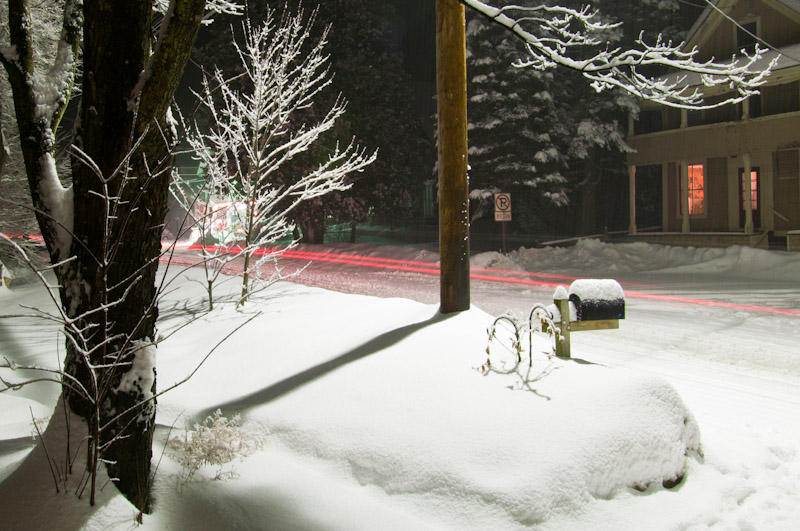
There’s been a lot of snow.
Big deal. It’s winter in Vermont. There’s always a lot of snow.
But usually not quite as much as this year. Burlington has already recorded more than the 80.1 inches it has averaged since the winter of 1884-85, as computed by the National Weather Service. With several snowy weeks left, the city could see more than last year’s 96.5 inches, though perhaps not as much as the 120.2 inches of 2007-8. This year’s snow isn’t likely to break any records.
Except, perhaps, for the amount of time spent talking about it.
In the snows of early last week, several vehicles skidded off the highways. Some of those drivers or passengers, or their significant others who had to help rescue them, called or e-mailed the Agency of Transportation complaining that the roads had not been adequately plowed.
Some of those cars slid off Interstate 89, sometimes not far from Burlington, making it relatively convenient for the local television stations to videotape the accidents and the traffic jams they caused, perhaps inspiring more calls and emails griping about road conditions.
Enter politics. On February 1, several legislators, led by House Minority Leader Don Turner of Milton, held a news conference to declare that the state should abandon its “safe roads at safe speeds” policy in favor of a commitment to plow the highways down to “bare pavement.”
As has been noted elsewhere, especially by Terri Hallenbeck in her Burlington Free Press “VT Buzz” blog, the pro-“bare pavement” caucus consisted of one independent and several Republicans, none of who had complained about the “safe roads” policy while Republican Jim Douglas was governor, which included some snowier years than this one.
In fact, no one seems to have complained since the policy was instituted under Gov. Richard Snelling, also a Republican, in 1981. A legislative minority, especially one as small as the GOP has in both houses in Montpelier, is always on the hunt for something to criticize.
What nobody seems to have wondered elsewhere is whether there was any evidence that plowing down to bare pavement was any safer than leaving a thin layer of snow on some roads, and if so, whether the safety margin would be worth the additional millions it would cost to scrape all the snow off the highways.
The answer to that question appears clear: no.
At least the Federal Highway Administration knows of no such evidence, nor does it make any recommendations to the states.
“We do not have any information that provides the research or addresses whether it’s preferable to leave a little snow on the road versus going all the way to the pavement,” said a spokesman for the agency.

Turner said he did have evidence, and promptly e-mailed two studies, one from Vermont’s own Agency of Transportation, both of which conclude that salt melts snow and ice more effectively than sand.
True, according to Wayne Gammell, the maintenance transportation administrator for Vermont’s Agency of Transportation, but salt is also more damaging to the environment. Even at the current rate of using salt, Gammell said, all the New England states are in danger of ground water contamination.
In fairness, Turner and the other lawmakers did seem to be responding to their constituents, many of whom were late to work, school, or other appointments because of the snow, and thought they might have been on time had the roads been more meticulously plowed. From comments made on the radio, in the Statehouse, and elsewhere, it seemed that many Vermonters thought their state could do better because others did better, especially New Hampshire, reputed to have a policy of plowing to “dry pavement.”
It does not.
According to Gammell, all the neighboring states and Vermont have essentially the same plowing policy, which calls for getting the Interstate highways and other major corridors down to “full width bare pavement as soon as practical” after a storm, but leaving more snow on the less traveled roads, which are considered clean with only a third of the pavement bare.
And indeed New Hampshire does have the same policy according to its website.
Still, its roads are probably clearer. For one thing, it doesn’t snow as much in the Granite State, or at least in the southern third of it where most people live and drive. Concord’s average annual snowfall is a mere 63 inches.
Besides, more of Vermont — “probably half our state,” Gammell said — is traversed by those secondary roads that don’t get the full width bare pavement treatment.
Finally, New Hampshire has more plow-drivers per miles to be plowed. Vermont used to have more drivers, Gammell said, but when the new policy was introduced in 1981, the plowing work force was cut by a third.
Since 1981, highway travel in Vermont and elsewhere has gotten safer. That has less to do with road-plowing than with safer cars, wider seat-belt use, and less drunk driving. But Scott Rogers, the Agency of Transportation’s director of operations said (via email) “winter crashes have decreased from 2007 (7,914) to 2009 (6,606), and winter fatalities have decreased from 2007 (34) to 2009 (31).”
Rogers acknowledged that the agency’s “winter” is from November 1 to April 30, (the months the plow drivers are paid to be on call 24/7) which includes a couple of months with little snow. Still, the trend is downward.
The key to “Safe roads at safe speeds” is that part about the speeds. Gammell said that in Vermont those speeds are 45 mph on the Interstates, 40 on other primary routes, 35 on the secondary roads. Many a driver, he said, goes a lot faster than that. He did not add, but it seems safe to say, that many a driver is convinced that it is his or her right to go faster than that — as fast as the posted maximum.
Common sense would indicate that a total bare pavement policy would enable cars to drive faster and still be safe. But common sense also indicates it would cost a lot more. The Free Press reported that Deputy Transportation Secretary Sue Minter estimated it would cost $55 million to start the switchover to a “bare roads” policy, and $35 million a year thereafter. How she came up with that total wasn’t clear, but obviously it would cost some millions of dollars a year to hire enough drivers and buy enough trucks to do all that plowing.
And it seems a lot of Vermonters would rather drive on a little snow. Gammell said that after Rogers went on the radio the other day to explain the agency’s policies, most of the phone calls and emails to the agency took a different turn.
“We got a big push-back,” he said, “With higher percentage of people saying, we don’t want a bare roads policy. We want Vermont to stay the way it is.”
Editor’s note: After this story was written, Rep. Don Turner, replying to an email, said he thought that because the calcium chloride-brine solution was temperature sensitive, and therefore “less effective or ineffective when the temperature dips below zero,” the state should use more sand which “is readily available and generally less expensive” than salt. If anything, he said, “the increased use of brine has had a negative impact” on safety. He also said he thought the state should examine “the length of the plow routes” in an effort to reach the “bare pavement” goal.”
