

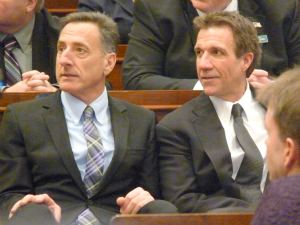
It’s not easy being a Vermont Republican, and it just got harder.
And that’s not even the bad news. The bad news is that it’s likely to get harder yet.
For the last several years, Republicans in the Vermont Legislature, or at least in the House of Representatives, could cling to one comforting reality. There may not have been very many of them, but they had an obvious purpose in life – to uphold a veto by Republican Gov. Jim Douglas.
Just by the numbers, the Republicans didn’t quite have the 50 votes they’d need to keep the 150-member House from overriding a veto. But they were close, and with a couple of GOP-leaning independents and a dissident Democrat or two, a united Republican caucus at least posed the threat of sustaining a veto, a threat the Democratic leaders had to take seriously.
But that was then. This (“this,” in the present context, commencing a few minutes after 2 p.m. Thursday) is now. Now there is no Republican governor whose veto needs to be sustained.
For Republicans, then, just what is the purpose of life?
Not in the cosmic sense for the 48 individual Republican House members, nor the eight in the 30-member Senate. But in the political sense of the GOP caucus as an institution.
“I strongly believe we have a purpose here,” said Rep. Donald Turner, the Milton Republican who just became the House Minority Leader, while acknowledging that “our caucus understands that its roll has changed substantially.”
In other words, no more potential veto-sustaining power. Instead, Turner said, the GOP caucus will work “to make sure the messages of our constituents are heard.”
Especially, he said, when it comes to the key issue of this year’s session – the budget. Republicans would seek to balance that budget, Turner said, “with the least amount of impact on our vulnerable population.”
Unlike Republicans nationally and some conservative activists in Vermont, Turner did not say that one mission of his caucus would be to block any tax increases. Asked whether Republicans might go along with some revenue-raising measures, he said, “I don’t want to get into specifics on the first day of the session.”
From this and other comments heard around the Capitol on the first day of the session, the prudent Vermonter might assume he or she will be seeing slightly (and perhaps temporarily) higher taxes before the year is out.
Reapportionment may be problematic for GOP
Turner did not mention another problem that may beset Republicans this session, the prospect of losing more seats in the 2012 election thanks to reapportionment.
“It’s not that the Democrats are going to try to gerrymander them out of existence, because we really don’t have a tradition of doing that in Vermont,” said Eric Davis, the emeritus political science professor at Middlebury College who has been taking note of Vermont politics for decades. “But the areas of Republican strength, the northeastern counties and Rutland County, are losing population relative to the rest of the state.”
Davis said Caledonia, Essex, Orleans and Rutland Counties are likely to lose seats when the lines are redrawn before the 2012 elections, costing the GOP a few seats “just because of population changes.”
Davis said Caledonia, Essex, Orleans and Rutland Counties are likely to lose seats when the lines are redrawn before the 2012 elections, costing the GOP a few seats “just because of population changes.”
Even with their remap worries and without their veto-sustaining power, Republicans in the Legislature will not be entirely irrelevant this year. Golden Dome conventional wisdom already predicts that incoming Democratic Gov. Peter Shumlin is likely to have to fight off spending proposals from the more liberal wing of his own party. On some spending and budget bills, then, the Democratic administration could be tempted to negotiate for the votes of centrist Republicans.
At least some Republicans appear ready to negotiate, pointing out that they had done so in the past. Howard Crawford of St. Johnsbury, a Republican starting his 18th year in the House, noted that last year the Appropriations Committee, on which he served, reported out one key bill by an 11-0 vote. Republicans went along with majority Democrats, he said, after the Democrats agreed to accept some Republican amendments.
That process, Crawford said, works only if some Republicans are “able to say the word yes,” at some point in the negotiations. The only way they can make any changes in Democratic proposals, he acknowledged, is if they agree to support the proposals as amended.
Crawford’s observation illustrates how different Vermont politics are from the national version in Washington. During last year’s health care debate there, for instance, Republicans in Congress adamantly refused to vote for the bill no matter how many GOP suggestions the Democrats agreed to incorporate.
Only on rare occasions, such as the override of Douglas’ veto of the 2009 budget bill, do Vermont legislative politics become nearly that confrontational. Just consider that though both houses have large Democratic majorities, a few committees in both chambers have Republican chairmen.
One of them, Sen. Vince Illuzzi of Newport, said the state Senate “does operate on a truly bipartisan basis,” even though there are some ideological differences.
Even in Vermont, of course, the parties do not always agree. When compromise cannot be reached, Howard Crawford said, the minority party “can’t just vote no and go home,” but has to be able to explain its opposition to the voters. If Republicans can convince enough voters, Crawford said, they might start winning more elections.
Minority Leader Turner said his caucus would use all the traditional tools – speeches from the floor, press conferences, committee meetings – to make its policy arguments, plus perhaps a few more creative techniques he was not yet ready to make public.
He said Republicans would fight for open government and would try to make sure that Shumlin and the Democrats lived up to their campaign promises.
Then, unbidden, he brought up another possible area of GOP action this year – seeking to create press coverage that would be “more unbiased and clear.” Vermont journalism, he said, at least as it covers political affairs, “seems now not to have a lot of balance.”
Here, too, he did not want to get into the specifics of what Republican legislators might do to alter the coverage, and he acknowledged that any official action might run into constitutional problems. Asked to provide a specific example of unbalanced coverage, he said he did not have one in mind, but he did point out that two reporters recently quit their jobs to go to work for liberal-leaning advocacy groups, raising the question of whether they had been biased while covering the news.
On the other hand, over the last eight years, several reporters quit their jobs to work for the Douglas administration. And, yes, some liberal advocates claimed that this proved they had been biased, pro-Republican, journalists all along.
