

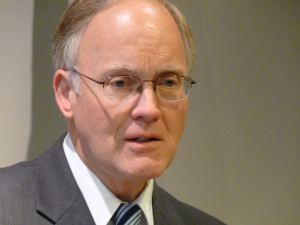
Editor’s note: This is the second story in a two-part series about Gov. Jim Douglas’ eight-year tenure in office. Part 1 examines the political impact the governor had on Vermont; Part 2 is an analysis of his policies.
Gov. Jim Douglas, unlike his predecessor, Gov. Howard Dean, introduced modest proposals rather than bold initiatives, observers say. His policy approach was cautious and incremental, according to lobbyists, state officials and advocates — unless his efforts were aimed at reducing expenditures.
Douglas focused on containing the growth of state government, and he employed fiscally conservative policies that have enabled Vermont to earn recognition at the nadir of the recession as the fourth best managed state in the nation, and the fourth least economically stressed state. Critics say his approach has come at a cost to the environment, education, human services, economic development and broadband expansion.
Douglas accomplished this feat by keeping “a steady hand on the tiller,” as he likes to put it. Over the course of his eight-year tenure he has been a budget hawk in fat and lean times, and consequently, even now, in the middle of the Great Recession, Vermont has one of the strongest bond ratings in the nation.
Critics say Douglas has missed opportunities to improve the state’s economic outlook by aggressively banking on Vermont’s cachet.
Over a three-year period in which tax revenues have plummeted, Douglas has balanced the budget, while other states have faced enormous deficits. In addition, the governor has avoided dipping into the stabilization (rainy day) funds. Last year, he insisted that the Legislature repeal capital gains and estate taxes, and he largely prevailed in a compromise deal.
His ability to keep the fiscal ship afloat in the stormy seas of the worst economic downturn since the Great Depression is, perhaps, his greatest gift to the state, observers say. (It helped that the state was the beneficiary of roughly $400 million in stimulus funds to support the General Fund budget alone over the last three years, though Douglas saw the funding as one-time money and consistently urged lawmakers to address the state’s structural budget gap by making more dramatic cuts in services.)
Douglas’ health care, environmental and economic development policies were often incremental in nature and pragmatic, but when he was interested in finding ways to save money, he proposed sweeping changes. For example, he repeatedly pushed for consolidation of the state’s more than 300 school districts into 60 or so regional supervisory unions because he said the move would save administrative costs. He suggested that the state cut the VPharm program for elderly Vermonters, reduce payments to the state’s nonprofit mental health system, cut benefits for Medicaid patients, and consolidate the regional planning commissions and regional development corporations.
In his budget addresses, Douglas often pitched initiatives with catchy marketing slogans like “Clean and Clear,” the Lake Champlain cleanup program; “Green Valley,” an initiative to create a Vermont version of the Silicon Valley; “PursueVT,” a program to lure back young Vermonters who have left the state; “Urban Homestead,” a plan to create affordable housing located in apartments above downtown storefronts, and so on – often without later reporting tangible results.
Critics say Douglas has missed opportunities to improve the state’s economic outlook by aggressively banking on Vermont’s cachet, its high-performing school system and its high rankings on quality of life indicators, including the “healthiest” and the “greenest” state. They characterize Douglas as a “caretaker” governor who undermined the state’s ability to attract new businesses by overstating Vermont’s tax burden in public comments.
Here is a catalog of the shortcomings they point out:
Economic development. Despite his campaign slogan Jim=Jobs, the state had the lowest job creation rate since 1939, according to the Public Assets Institute.
Broadband infrastructure. The state’s e-state initiative was supposed to be in place this year, but private companies solicited for the project weren’t interested in making the investment, consequently many areas in the state still have inadequate Internet access.
Renewable energy. Douglas put a moratorium on wind development. He had an opportunity to buy the Connecticut River dams, but bid too low.
Environmental protection. The state has dragged its feet on regulatory enforcement, particularly for phosphorous pollution leaching into Lake Champlain.
Land conservation. Douglas has repeatedly attempted to significantly reduce funding for the Vermont Housing and Conservation Board.
“They’re just expecting everyone to provide the same services with fewer resources, and that just doesn’t work,” Hoffman said. “You can’t give someone 75 or 85 percent of what they need to get the job done and expect them to do a decent job.”
Jack Hoffman, a policy analyst with the non-partisan Public Assets Institute, said: “This administration was more interested in reducing the size of state government than in seeing that it functions well. I think the result has been, especially after the layoff of 700-800 state employees over the last couple of years, a state government that doesn’t really have enough resources to get the job done.”
Hoffman said the Douglas administration didn’t scale back the mission of state government. “They’re just expecting everyone to provide the same services with fewer resources, and that just doesn’t work,” Hoffman said. “You can’t give someone 75 or 85 percent of what they need to get the job done and expect them to do a decent job.”
Though Douglas is often criticized for initiatives that would have cut social programs, under his tenure the food stamps program nearly doubled in size, reaching 86,000 Vermonters. He also supported Choices for Care, a program that provides services to elderly Vermonters so that they can stay in their homes.
Douglas also backed a number of health care initiatives, including: Catamount Health, a program for uninsured Vermonters; global commitment, a federal Medicaid block grant system Vermont pioneered that has helped the state manage its federal Medicaid money more effectively; and the Blueprint for Health, a plan that seeks to contain costs by providing intensive services for patients with chronic diseases like diabetes and asthma. Critics say Catamount, which provides sliding scale insurance plans for Vermonters through commercial insurers, is expensive; the Blueprint has yet to realize savings.
Paul Burns, the executive director of Vermont Public Interest Research Group, and a proponent of the program, said the governor “was forced to respond to health care reform because the Legislature put it on his desk.” His approach, Burns said, was to temper the ambitious Catamount program, which he ultimately endorsed.
“If the Legislature had not been so ambitious in their attempts to pass health care reforms, I don’t expect we would have heard much at all from Douglas,” Burns said.
When Vermont was named the healthiest state in America by United Health Group last month, Douglas cited the Blueprint, global commitment and the Choices for Care programs as examples of programs that have helped the state gain recognition, but he gave most of the credit to Vermonters.
“It is the people of Vermont who have taken responsibility for their health that deserve credit for this distinction,” Douglas said.
What follows is an analysis of the governor’s key policies.
Fiscal restraint
“Capping growth in state spending at this level is a responsible way to ensure our appropriations do not exceed the ability of taxpayers to foot the bill.”
~Douglas, 2007 budget address
In his eight budget addresses, in good times and bad, the governor reiterated his belief that the state must exercise fiscal restraint, and in practice, he tried to reduce spending wherever possible.
Douglas also often attempted to shift funding from one program to another. For example, he proposed shifting $100,000 from the Vermont Sustainable Jobs Fund to the Farm-to-Plate program last year. In an earlier effort, he tried to increase spending on affordable housing programs at the expense of land conservation. During the Challenges for Change process, his administration forced nonprofit mental health agencies to absorb cuts and hoped (but failed) to consolidate regional development corporations and regional planning commissions in order to save money.
Overall though, Douglas succeeded in his attempts to curb spending. His first General Fund budget proposal in 2003 was $893 million. As the recession kicked in and revenues spiraled downward in 2008, the governor and the Legislature began a three-year budget cutting cycle. Even so, a sizable structural, or ongoing, gap between what the state spends and what it banks in revenues began to form.
In fiscal year 2009, the Douglas administration and lawmakers made reductions and adjustments of $43.2 million. In fiscal year 2010, they agreed to cut the state workforce, eliminating 660 employees. Budget adjustments and reductions for that period, including a 5 percent pay cut for exempt employees, totaled $105.7 million, according Vermont Joint Fiscal Office figures.
Read the Vermont GF FY09-11 Actions.
In 2010, as the recession continued to depress revenues, Douglas proposed reducing the state’s budget by $125 million, for a total General Fund budget of $1.12 billion. In addition to the governor’s proposed cuts, the Vermont State Employees Association agreed to a 3 percent pay reduction in 2010. State officials also negotiated a deal with the Vermont-NEA to lower the state’s annual contribution to the pension system by $15.3 million last year. The total reductions and adjustments in the $1.148 billion budget passed by the Legislature were $97.5 million.
Overall spending continued to increase over the three-year period, however, thanks to federal stimulus funds. The actual General Fund spending, including American Recovery and Reinvestment Act money, totaled roughly $1.3 billion in each of the fiscal years 2010 and 2011. Much of the money was spent on programs for Vermonters who were hit hardest by the recession.
Douglas warned in his budget address last year that lawmakers shouldn’t bank on one-time monies from the federal government: “We must make sustainable reductions to break free from the dangerous cycle of managing deficits year on end.”
The state faces a $150 million structural budget gap — a discrepancy between revenues and expenditures — in fiscal year 2012.
See the gap analysis graph from the Vermont Joint Fiscal Office.
Gov.-elect Peter Shumlin recently praised Douglas’ money management practices in an interview with Kristin Carlson on WCAX.
“Douglas has worked hard to make sure Vermont is on a sound fiscal path for the future,” Shumlin said. “He didn’t spend irresponsibly; he tried very hard to put Vermont on a fiscally responsible path. With the exception of the sales tax, he kept his pledge not to raise taxes. Those are the things we have in common.”
Hoffman, the policy analyst with PAI, said the recession has been tough on everyone, but the Douglas administration has used the downturn “to further this goal of reducing state government.”
Hoffman said in stark contrast, Gov. Richard Snelling temporarily raised taxes in the recession of the early 1990s as demand for services increased. “Snelling recognized there was a role for government, and government was the last resort in times of recession,” Hoffman said. “He raised taxes. His approach was, when the economy improved, demand for services would go down and you could roll back some of the taxes. I didn’t see any of that kind of thinking or leadership with this administration.”
Economic development
“My administration has worked very hard to be more responsive to employers and send the unmistakable message that Vermont is open for business.”
~Douglas, 2005 budget address
Douglas ran on a Jim=Jobs platform, but his economic development programs have been piecemeal, observers say. Despite investments in business incentives ($16 million in Vermont Employment Growth Incentives between 2007 and 2010), the number of available jobs has declined. In the seven years before the recession, job growth was about 3.2 percent, according to the Public Assets Institute, and between 1940 and 2000, the state’s job growth rate ranged from 11 percent to 37 percent. Roughly 10,000 jobs have been lost over the last 10 years, according to Hoffman.
“The report shows this was the worst decade — before the recession hit — for job creation since the state’s been keeping records,” Hoffman said.
Tom Torti, executive director of the Lake Champlain Regional Chamber of Commerce, said critics tend to forget that projects take time and “things don’t happen in two-year election cycles.”
Torti gives the Douglas administration credit for a number of recent successes. He points to projects that wouldn’t have happened without a concerted effort by the Agency of Commerce and Community Development, such as: Commonwealth Dairy, a yogurt plant in Brattleboro; the Albany College of Pharmacology and Health Sciences in Colchester; Dealer.com, a web design firm in Burlington; and Weidmann Electrical Technology, Inc., in St. Johnsbury.

“The governor has been strategic in the use of the Vermont Employment Growth Incentive program to grow jobs,” Torti said. “There’s a lot that’s been done. The only negative is there’s been a lack of a cohesive economic development plan for the state.”
Andrea Cohen, executive director of Vermont Businesses for Social Responsibility, describes the last eight years as “an era of lost opportunity.”
“The outgoing administration did not embrace Vermont’s assets and in many ways ended up undermining our own economic success,” Cohen said. “Instead of shying away from our green reputation, we should have been building on it. With strong policy and leadership, we could have created many more good-paying jobs in the environmental and energy sectors. The green brand was ours to lose, and we have fallen behind.”
She also said instead of marketing the state’s strengths — its good schools, clean and safe communities and topnotch workforce — the Douglas administration has pushed too much rhetoric about how bad Vermont is for business. “We have often been our own worst promoter,” Cohen said.
“The nation’s first e-state”
“This is an unprecedented opportunity to leap far ahead of the leading telecommunications systems available today. This is no time for mediocrity. If we’re serious about making Vermont a leader in the 21st Century economy, we must act now.”
~Douglas, 2007 budget address
Douglas formed the Vermont Telecommunications Authority in 2007 and promised Vermont would become the nation’s first “e-state” — that is, the first to offer “universal access to broadband and wireless technology” — by 2010.
Though Douglas invested $1.25 million in VTA and made $40 million available in state bonds for willing corporate partners, the private market didn’t respond, and 2010 came and went without the promised broadband infrastructure in place.
Read the VTA’s 2009 annual report.

Tom Evslin, chief technology officer for the Douglas administration, said: “We thought with $40 million, we could get the private sector to step up, and they would choose to build in Vermont because of the revenue bonding available.”
Once the recession started, the credit market disappeared, and Fairpoint, the state’s biggest phone carrier, for example, was in financial hot water.
“We had a good plan, but we didn’t have a good investor,” Evslin said. “The investment ended up coming as part of the stimulus.”
The Vermont Telecommunications Authority’s plan made the state’s grant applications attractive to the feds, Evslin said, and this year, the state garnered $150 million in federal assistance for private companies to embark on an extensive broadband buildout. Other states didn’t qualify for funding because they hadn’t developed comprehensive proposals, he said.
“Even though we didn’t reach his stated goal of broadband everywhere by 2010, that initiative turned out to be important,” Evslin said. “We ended up having all the information and plans we needed, which was the reason we did so well getting the stimulus funds to move forward.”
Hoffman of the Public Assets Institute, who is the former executive director of the Vermont Broadband Council, said the state has lost a lot of momentum.
“They didn’t strong-arm Fairpoint,” Hoffman said. “It goes to this idea that they’re (the Douglas administration) driven by ideology to a certain extent. The administration didn’t think there was much of a role for government in developing the broadband infrastructure. Fundamentally, they believe this is something the private sector should do, even after we had adequate evidence the private sector wasn’t interested in doing it in this state.”
Education
“At the beginning of each of the last two legislative sessions, I offered numerous proposals to bend the trend of education spending increases. I again offer my ideas with the expectation that we take immediate steps, and with the understanding that my ideas are not the only ones. The centerpiece of my proposal is a property tax cap that makes our investments in public education sustainable.”
~Douglas, 2007 budget address
Douglas made numerous unsuccessful attempts to reform Vermont’s education system. He tried to mandate school district consolidation several times (remember former Education Commissioner Richard Cate’s 2006 white paper on the subject?), and he attempted spending caps. (Though the Legislature approved a two-vote system that replicates some aspects of Douglas’ spending cap plan, the bill is widely viewed as complicated and ineffectual.) In 2009, his administration sent letters to school boards asking them to voluntarily reduce spending by 2 percent (which they did).
Finally, last year he pushed a mandatory student-teacher ratio proposal. None of these tacks worked.
Barring wholesale change, Douglas used his bully pulpit to advocate for reductions in spending. At his weekly press conferences, the high cost of education in Vermont and increases in property tax rates were a constant refrain. He pointed out the drastic declines in student enrollment (from 102,000 at the high-water mark to 85,000 in a few years), and the increasing cost of education.

“It is hard to understand how we have seen a 22 percent increase in the number of staff at the same time that there has been a 10 percent decrease in student enrollment,” he wrote in his 2008 budget address. “Not reducing costs is one thing – substantially increasing them is quite another.”
Douglas railed so vehemently and so often against the cost of the state’s schools that education professionals representing the state teachers’ union, school boards, principals and superintendents remarked on the dramatic shift in tone as Gov.-elect Shumlin defended the educational system at a recent press conference, in which he said he would distribute $19 million in federal funds directly to schools, giving them a pass on meeting $23.2 million in Challenges reductions in fiscal year 2012. (Douglas had proposed imposing the cuts and using the federal money to pay down the state’s teacher pension obligations.)
Jeff Francis, executive director of the Vermont Superintendents Association, said Shumlin’s approach is “refreshing.”
“We have committed local officials, who in my view, act in the best interests of their communities,” Francis said. “At the policy level, we have policymakers who are striving to contain costs and contend with all the challenging issues that we face. I think working together we will do better with those issues than we would working apart.”
Evslin, who was Douglas’ point person on the education Challenges component, counters that as a state “we haven’t faced the problem squarely.” He said teachers haven’t had to make the same kind of concessions in the recession that state employees have had to make.
“We’re digging ourselves into an enormous hole,” Evslin said. “Property tax increases are crowding out other expenditures. … Douglas is right to point out we haven’t had success, it remains a land mine, and it’s going to be a big problem for the next governor, and the problem is going to be harder to solve because we’ve put it off so long.”
Hoffman disagrees. “I think that it was really unfortunate that his whole criticism of education spending really became an attack on education,” he said. “The data we’ve looked at doesn’t support his contention that education spending is out of control. We might be able to argue whether spending could be lower because we have fewer students, but the picture he’s been painting is that somehow recently our spending has taken off and is growing by leaps and bounds, and it’s going to consume our whole budget if we’re not careful. If we compare education spending with the state’s economy as a percentage of gross state product we’re spending the same today as we were 15 years ago.”
Douglas stood on both sides of environmental issues
Douglas has a mixed environmental legacy, according to advocates and activists. They give him credit for stopping International Paper from burning tires at its plant at Fort Ticonderoga, N.Y., just across the border, and they say his willingness to fight for state clean car emission standards was valiant. But they give him low marks for his stances on pollution control and land protection.
International Paper Co.
Douglas opposed the burning of tires to generate electricity at the IP plant in Ticonderoga, unless the company installed pollution control equipment that would prevent the wind from carrying heavy metal emissions from the plant eastward into Vermont.
In 2006, he threatened to sue the company and submitted public comments opposing the plan.
Douglas told Bob Kinzel of Vermont Public Radio in 2007: “Unless they install an electrostatic precipitator, the state-of-the-art pollution control equipment that I’ve always believed is essential for safe burn … then I expect Vermont will continue to resist it.”
Anthony Iarrapino, staff attorney for the Conservation Law Foundation, said Douglas was on the right side of the IP issue. “(But) if a source of pollution was an out-of-state polluter or an out-of-state moneyed interest, there was a willingness to be tough about it,” Iarrapino said. “When it comes to pollution created within the borders of Vermont, the results were disappointing. There was an unwillingness to regulate and enforce the law.”
Clean and Clear Water Action Plan
“I reject the notion that jobs come at the expense of the environment, and that environmental protection must be compromised in order to have economic progress. We must have both in order to realize the true promise of Vermont.”
Douglas,
Since 2003, Douglas has invested $100 million in federal and state money into the cleanup of Lake Champlain. Over decades, phosphorous from stormwater runoff, farms and sewage treatment plants had flowed into the big lake and polluted the water, causing algae blooms in the Mississquoi Bay and other parts of Vermont’s largest body of water. In 2003, Douglas announced the Clean and Clear Water Action Plan, which he hailed as “one of the most significant water quality initiatives Vermont has ever undertaken.”
Originally, the deadline for the cleanup was 2016. Douglas moved the timeline up to 2009 for the Lake Champlain Quadricentennial.
Phosphorous loads, particularly from farm fertilizers, have not been adequately reduced, however, in the years since, and the Environmental Protection Agency has intervened. Just last week, the EPA asked the state to rewrite its Clean and Clear plan to account for increased precipitation levels due to global warming.

The Conservation Law Foundation has filed a petition with the EPA to force the state to take corrective action in the way it administers the program. Alternatively, CLF is pushing for EPA to regulate the pollution emissions under the federal Clean Water Act.
“The Agency of Natural Resources under Douglas’ leadership was not following the law regulating pollution sources to Lake Champlain,” Iarrapino said. “We were compelled a number of times to go to court to get them to enforce the law as it’s written.”
According to a 2008 audit of the program, there were no significant reductions in overall phosphorous loads to the lake as a result of the state and federal programs, “although individual programs are responsible for some probable reductions.”
The audit found that the programs, which incentivized businesses and farms to reduce emissions, didn’t track phosphorous reductions, and, in general, Clean and Clear lacked clear objectives for specific environmental improvements, according to the audit. In addition, the programs weren’t well coordinated, auditors concluded.
Douglas championed clean car rule
In 2007, Douglas announced that Vermont would join California in a lawsuit to force the EPA to require automakers to manufacture vehicles with cleaner emissions. California’s standards are stricter than federal regulations.
Vermont, along with 13 other states, adopted the California standards in 2006, but it needed a waiver from the EPA to force automakers to comply.
Douglas said in a press release at the time: “We stand with our friends in California who recognize the significant role that vehicle emissions play in climate change. Vermonters are proud of their leadership position as America’s greenest state. We know these tougher standards will help reduce our carbon footprint even more.”
Eventually, the U.S. Supreme Court ruled that greenhouse gases, including auto emissions, should be regulated because they pose a threat to human health. The Obama administration in April of last year announced tighter fuel emissions standards, similar to those adopted by Vermont and California.
Emissions from vehicles accounted for about 45 percent of Vermont’s carbon dioxide pollution in 2007, according to the Governor’s Commission on Climate Change.
“We would tip our hat to Gov. Douglas for his position on clean cars which resulted in the state being sued by auto manufacturers,” Iarrapino, the CLF lawyer said. “The decision Douglas had to make was: Is it a global warming issue? He was on the right side of that one.”
Paul Burns, executive director of VPIRG, agrees with this assessment: “He allowed the Department of Environmental Conservation to be real leaders in that effort among the 14 states.”
Land conservation not a priority
Gov. Howard Dean made land conservation his personal legacy project and invested millions of dollars in the effort; Douglas cut support for protection of the working landscape and wilderness areas.
Douglas consistently reduced the budget for the Vermont Housing and Conservation Board. Over the course of his tenure, he diverted $30 million from the program, which is funded by the property transfer tax, according to information from the Vermont Housing and Conservation Coalition.
His decision to shift resources from VHCB resulted, Annes said, in “the loss of hundreds of affordable housing units and thousands of acres of conserved land” that will never be made up.
Elise Annes, vice president for community relations at the Vermont Land Trust, said Douglas’ position on conservation was “a radical shift away from Vermont’s very successful effort over more than two decades to provide affordable housing to low-income Vermonters, and to invest in the farm enterprises, and the protection of our ecological and recreational resources.”
His decision to shift resources from VHCB resulted, Annes said, in “the loss of hundreds of affordable housing units and thousands of acres of conserved land” that will never be made up.
“Replacing the lost units and acres will be even more expensive, and there is a backlog of landowners and communities interested in protecting their land that are waiting their turn,” Annes wrote in an e-mail. “Vermont’s continuation of lean budget years will mean that many will continue to have to wait.”
Douglas also opposed a set-aside of an additional 42,000 acres of wilderness in the Green Mountain National Forest in 2006. He sidestepped Vermont’s congressional delegation and sought out a conservative Republican in the U.S. House, Richard Pombo, R-Calif., for assistance in fighting the designation. Logging and motorized vehicles are not allowed in wilderness areas.
The designation went through anyway, and, at the time, Douglas told the Rutland Herald the final bill was a compromise that achieved “the middle ground.”
