

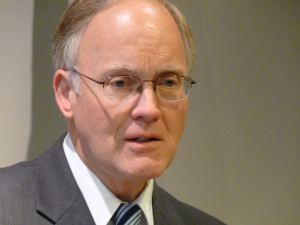
The big good-bye
Gov. Jim Douglas will hold his last press conference on Wednesday, Dec. 22 at his Fifth Floor offices. His final farewell will be his address in the well of the House on Jan. 5.
Douglas has been widely lauded for his graciousness at the end of his eight-year run as governor. Members of the transition team and the incoming Shumlin administration have repeatedly said that the governor and his staff have “bent over backwards” to help them hit the ground running in January.
As political pundit Eric Davis put it: “(Douglas) certainly took seriously the idea of maintaining the integrity and prestige of the governor’s office. Peter Shumlin was not his choice in November. My sense is, Douglas is working cooperatively with Shumlin. The message Douglas is conveying at this time in state government is we are responsible to the will of voters and to the integrity of the positions we hold to pass on (those roles) as smoothly as we can.”
Douglas’ legacy will live on in the form of key policies he forged with the Legislature, including state school financing changes under Act 68, Catamount Health, the Blueprint for Health and the Clean and Clear Initiative. His last two years in office were marked by the recession and growing discord with the Democratic majority in the Statehouse. In 2009, the General Assembly overrode two of his vetoes, over the budget bill and gay marriage legislation. It was the first time in the state’s history that more than one gubernatorial veto had been overruled by the General Assembly in one session.
Thanks to painter Kate Gridley, Douglas will be looking over the shoulder of every lawmaker, lobbyist, advocate and journalist who walks past his very life-like portrait in the hallway just outside the governor’s ceremonial office in the Statehouse. (Don’t be surprised if his eyes swivel now and again.)
The history of Douglas’ tenure will also live on in the form of documents tucked away in the state archives. Douglas’ administration is working closely with Susanne Young, the governor’s legal counsel, to make sure that his papers are properly collected under public records law. The paper shuffle is on between now and Jan. 7, when boxes of documents will be put in long-term storage.
The big challenge? Making sure there aren’t duplicate copies kicking around, according to David Coriell, the governor’s spokesman.
“Part of it is going through and making sure we know where the main copy is on file,” Coriell said. “Those documents are part of the record, and they’re important to the history of the governor’s tenure.”
Transition near the finish line
Though Gov.-elect Shumlin announced last week that he won’t be holding any more press conferences to name the remaining members of his administration, there are a number of positions still vacant.
In all, the governor-elect and his transition team had a total of 60 exempt positions to fill, including deputy secretaries.
At this juncture, Shumlin has appointed all six Cabinet secretaries and 10 commissioners. Eight commissioners have yet to be identified.

Here’s the running list of departments looking for leaders: Forests, Parks and Recreation; Fish and Wildlife; Mental Health; Corrections; Disabilities, Aging and Independent Living; Information and Innovation; Libraries; Buildings and General Services.
As is standard procedure, all members of the Douglas administration were asked to submit their resignations and to inform the transition team if they had a desire to serve under Shumlin.
In addition, there are a number of other “exempt” employees who serve at the whim of the administration, and among them are department lawyers.
Alex MacLean, Shumlin’s spokeswoman, said the transition team and the governor-elect left it up to the commissioners to decide whether they want to ask lawyers to tender their resignations. So far, two commissioners have gone this route: Steve Kimbell, the incoming commissioner of the Department of BISHCA, and Keith Flynn, who was named commissioner of the Department of Public Safety. In all, 11 attorneys from the two departments could find themselves looking for new employment.
Comings and goings
A lot of other people are leaving state government, too, and a handful have landed in local businesses and nonprofits, but the majority of Douglas’ staff and department and agency leaders are in resume-polishing mode at the moment.
Here is where members of the Douglas team have landed so far:
Bruce Hyde, commissioner of Tourism and Marketing, is going back to his business, The Hyde Away Inn;
Mike Bertrand, commissioner of the Banking, Insurance, Securities and Health Care Administration, will dust off his law degree and set up a practice and public relations firm in downtown Montpelier;
David Tucker, commissioner of the Department of Information and Innovation, has been named executive director of the Vermont E9-1-1 Board, which oversees the state’s emergency communications system;
Steve Dale, commissioner of the Department of Children and Families, moves on to become the executive director of the Vermont School Boards Association come January (John Nelson, the current ED, is retiring);
Tom Evslin, chief technology officer and federal stimulus czar for the Douglas administration, retired (again) in the fall;
Roger Allbee, secretary of the Agency of Agriculture, is also retiring. Allbee plans to write a history of Vermont agriculture.
Heidi Tringe, deputy chief of staff, took a job with the lobbying firm of MacLean, Meehan and Rice last summer.
And then there’s the carryover:
Patricia Moulton Powden, former commissioner of the Department of Labor, will be the deputy secretary of the Agency of Commerce and Community Development;
Jim Reardon, commissioner of the Department of Finance and Management, has been asked to stay.
Patrick Flood will continue on as deputy secretary for the Agency of Human Services;
Rob Ide has been reinstated as commissioner of the Department of Motor Vehicles;
Susan Besio will remain commissioner of the Department of Vermont Health Access, which administers the state’s Medicaid-subsidized programs under the global commitment waiver: Catamount Health, Dr. Dynasaur and the Vermont Health Access Plan.
The executive code
Gov.-elect Peter Shumlin has borrowed a page from Gov. Jim Douglas: He will issue his own executive code of ethics once he takes office.
Democratic Gov. Howard Dean started the tradition; Republican Douglas also promulgated a code of ethics for his appointees to sign (in September of 2003).
All members of Team Shumlin will be required to sign the ethics agreement before they take office.
“The governor-elect is committed to transparent, fair and open government,” Alex MacLean, Shumlin’s spokeswoman, said. “All of his appointees will follow that direction.”
Douglas’ code, which MacLean sent as a sample, includes standard guidelines regarding the appearance of a conflict of interest. Appointees may not, for example, give “preferential treatment to any private interest on the basis of unfair considerations”; use “public office for the advancement of personal interest” or to “secure special privileges or exemptions.”
Why is all this necessary? After all, Vermont’s Legislature and state government operations are squeaky clean. Just take a look over the border at Massachusetts, for example, where in 2009, the speaker of the House and three associates were indicted on corruption charges. Vermont, with its low-paid, virtually perk-free citizen legislature doesn’t have those kinds of ethical problems.

That said, the Green Mountain State has does have a revolving door issue and the appearance of a conflict of interest comes up from time to time. Lobbyists, journalists and advocates often become part of the bureaucracy, and questions sometimes arise about perceived conflict of interest, especially given Vermont’s small size.
Shumlin has hired three respected officials with a background in lobbying: lawyer Steve Kimbell, who recently retired from Kimbell Sherman Ellis, the prominent public affairs firm he co-founded; Jennifer Hollar, who has been a lobbyist for Downs Rachlin Martin and who has deep experience with housing issues, will be deputy commissioner of the Agency of Commerce and Community Development; and David Yacovone who will serve as commissioner of the Department of Children and Families, is currently lobbying for the Vermont Association of Hospitals and Health Systems.
“The governor-elect’s main priority in appointing people is finding experts in various areas of interest,” MacLean said. “It’s not surprising that there’s going to be some kind of connection.”
According to information from the secretary of state’s Web site, Kimbell represented 33 different businesses and organizations in 2010, including a handful of medical industry interests: Rutland Regional Medical Center, Express Scripts, Inc., IMS Health Inc., America’s Health Insurance Plans and Blue Cross and Blue Shield of Vermont.
Hollar represented Vermont Yankee, FairPoint Communications, Inc., TransCanada, American Insurance Assn., IBM Corp. and the Vermont Chamber of Commerce, among 24 entities in all, according to the secretary of state’s Web site.
On the other side of the street, Heidi Tringe, deputy chief of staff under Douglas, recently took a job as a lobbyist for MacLean, Meehan and Rice, a major firm that also represents a wide range of interests at the Statehouse. Tringe works for the Beverage Association of Vermont, DISH Network, Satellite Broadcasting and Communications, RAI Services Co. (Reynolds America) and Pomerleau Real Estate.
Eric Davis, a retired Middlebury College political science professor, said a distinction should be made between lobbyists who represent a singular interest and people like Kimbell and Hollar who represented a large number of clients before the Legislature.
“I think the more serious question is not people coming in, but people going out,” Davis said.
Last week, reporters questioned Shumlin about one of his picks – lawyer Steve Kimbell as commissioner of the Department of Banking, Insurance, Securities and Health Care Administration – and his connections to the health care industry. Kimbell, who recently retired from the public affairs firm he co-founded, has represented a local hospital, a pharmaceutical company and several health insurers. (Kimbell is highly regarded — several hundred notables of all political stripes turned out for his retirement party in June.)
Kimbell told reporters at a recent press conference that he doesn’t have to build an extensive firewall within BISHCA because “the nature of my business was to work on discrete (legislative) issues.”
“BISHCA’s got enough infrastructure that if I have to step out of a matter, there will be somebody there to handle it,” Kimbell said. “I’ll be as transparent as I can be.”
In an interview, Kimbell said there aren’t many instances in which there will be conflicts regarding specific regulatory matters, because he didn’t represent BlueCross BlueShield, for example, directly before BISHCA as a lawyer.
“If it’s a broader question about how can you be a strategic adviser for any of those organizations one year and turn around the next year and regulate them — that’s what professionals do,” Kimbell said. “We don’t have career civil servants all the way to the top. In our form of democracy, there is a layer of bureaucracy that turns over when the governor turns over.
“It’s the way our system works,” Kimbell said. “I need to avoid conflicts on specific regulatory matters, but I don’t think there are many of those. I know the people, and I think that will help me do my job. If people have that concern, they need to press me to be transparent.”
MacLean said Kimbell’s connections provide him with an important advantage, given the difficult nature of the governor-elect’s single-payer health care system agenda. “It’s not an easy lift,” MacLean said. “Who better to move it forward than someone who has a good relationship (with people in the industry)?”
Is single payer doable?
Dr. William Hsiao was in town last week to give the Vermont Health Care Commission an update on his design of three different health care reform plans. His recommendations for a single payer, a public option (a multi-payer plan with the government acting as one of the health care insurers) and lastly, an optional, or “viable and practical,” solution, will come out in mid-January. After a public comment and response period, lawmakers will consider the information and decide whether to present legislation.
Hsiao said full implementation of a health care reform plan could take as long as 12 years. He also hinted that a “pure” single-payer plan that would provide universal access to health care for all Vermonters and give patients comprehensive coverage – ambulatory, hospital, preventive and nursing home care – could be expensive.
“When you look at your dreams and you want your dreams to come true, in that process the rubber meets the road,” Hsiao said. “I’m confident our report won’t please everyone. I hope it will please most people.”
Hsiao took pains, in his presentation to the commission, to avoid offering details about the direction his work was taking. In an interview with Russell Mokhiber of Counterpunch, Hsiao was more candid.
Hsiao told Mokhiber the pure single-payer plan option set forth under Vermont law “ignored reality,” including “legal barriers,” such as the Employee Retirement Income Security Act of 1974, which allows employers to set up self-insured plans. The law bars states from passing legislation that is “related to” an employee benefits plan. Hsiao described ERISA as a major obstacle – no other state in the country has managed to get a waiver. In an interview last week, Shumlin acknowledged it would take an act of Congress for the state to sidestep the federal law.
“We met with Dr. Hsiao. What he said to us was, single payer was absolutely possible in Vermont,” MacLean said. “We found that encouraging. It’s not surprising it’s going to take time.

“I think Dr. Hsiao made it clear that there are a few different forms of single payer,” MacLean said. “People understand single payer differently, and I think that the governor-elect’s goal has been quality universal coverage that contains costs and is affordable.”
Read the Stateline.org story about Vermont’s health care reform efforts.
Dr. Deb Richter, a physician from Montpelier who has long advocated for a single-payer system in Vermont, said the state would have to seek waivers for regulations under Medicare, Medicaid, ERISA, and the Affordable Care Act. She said, “It makes sense to construct the best system possible, then worry about those waivers later.”
In general, Richter said the plan generally is going in a “direction I like.” “It’s hard for me to have any kind of positive or negative reaction until I see the details,” Richter said.
“I have to wait and see what comes out,” Richter said. “He’s releasing three drafts. We (single-payer advocates) hope to heavily influence the drafts … we will demonstrate broad support for a publicly financed single-payer health care system.”
Richter said a uniform, universal public payment system with a private delivery mechanism is the best way to rein in costs and cover all Vermonters. She envisions a public agency managing the public financing. Insurance companies, in her view, are obsolete because they no longer serve their primary service, which was to protect people from bankruptcy and to ensure adequate financing for hospitals.
“They (insurance companies) evolved because people needed to protect their assets,” Richter said. “Now, even people who are insured go bankrupt.”
In the interview with Counterpunch, Hsiao said Vermont’s plan could be modeled after Germany’s system in which hundreds of small nonprofits provide insurance, but a single-payer system is used to reimburse providers.
Richter predicts that Hsiao will present a universal health insurance model that offers a uniform benefit system in which providers receive the same reimbursement for the same treatments, much like the “single spigot” German system.
She said a “multi-payer” approach like Germany’s would cost more money than a single-payer plan, but it would be a step in the right direction.
Hospitals now bill about twice as much as they expect to collect in order to break even, Richter said. That’s because of the cost to provide care for uninsured patients and for low reimbursement rates for Medicare and Medicaid patients.
In Germany, a colonscopy is reimbursed at the same rate regardless of who the insurer is. If Vermont adopted a similar approach, MVP and BlueCross Blue Shield would pay the same reimbursement fee for the same procedure for every hospital. There would be no discrepancies between providers or insurers — the payment would be guaranteed, Richter says.
“That reduces that unknown,” Richter said. “The good thing about a guaranteed payment is, you roughly know what patient (and revenue) flow is. It allows you to (offer the service) and not mine for patients. That’s sometimes what happens now. If you have an empty bed, you’re going to find a way to fill it. When you have a predictable income, that kind of behavior lessens.”
Under such a system, insurers would be highly regulated, Richter said. The entities would be told what the benefit packages would be, what they have to provide and how much they have to pay to providers, Ricther said, and procedures for denying care would no longer be an option for insurers.
In the Counterpunch interview, Hsiao was pressed on how the system would be paid for, and he alluded to income taxes as an option.
Richter said an income tax would be politically unpalatable. She said a 10 percent payroll tax on income earners would be more progressive, and would cost most families less than current premiums.
Bubbling up
Battle lines are being drawn on the sugar-sweetened beverage front.
Several weeks ago, an array of advocates from health care organizations, including the American Cancer Society and the Vermont Chapter of the American Academy of Pediatrics, made their pitch for placing a penny-per-ounce excise tax on sugary drinks, including teas and sports drinks. They said that a tax would deter Vermonters from consuming the non-nutritive beverages and lead to a lower rate of obesity, especially among children.
Since then, Attorney General William Sorrell, who began the SSB tax debate when he unveiled a study on the impact of the beverages on Vermonters’ health, has been back to the Statehouse, this time to persuade the Vermont Blue Ribbon Tax Commission to take up the cause. (They are more likely to propose a sales tax on all non-nutritive beverages, including diet sodas.)
Meanwhile, the anti-tax forces, which include grocers and the Beverage Association of Vermont, have begun to pick up momentum on the Internet. A Web site has been launched: Stop the Beverage Tax, and a Facebook page posted on the site has more than 3,000 fans.
Jim Harrison, president of Vermont Grocers Association, which represents 700 stores statewide, said the business groups will be organizing a petition drive over the next several weeks. (A petition that began surfacing at a few stores around the state got a good response – now Harrison says they want to make a more concerted effort.)
“Clearly, there’s a lot of anxiety about it and interest in the issue,” Harrison said. “A few stores overwhelmed by response from customers. Harrison said the convenience and grocery stores he represents are concerned that selectively taxing food, which isn’t subject to the sales tax now, sets a dangerous precedent.
In some cases, the excise tax represents a 20 percent increase on sugar sweetened beverages. “Do we send more customers out of state where those products are not taxed?” Harrison asked. “No other state has an excise tax.”
The 6 percent sales tax already has a dramatic impact on retail sales, Harrison said. Many questions remain unanswered, he said. “What will be the impact on food shopping? What does that mean in terms of stores, especially smaller stores that sell a lot of beverages?”
Harrison said he anticipates a “discussion come January” with the Legislature. “We appreciate the gov.-elect’s position on the issue,” Harrison said.
Shumlin has said he opposes an excise tax on sugar-sweetened beverages.
