

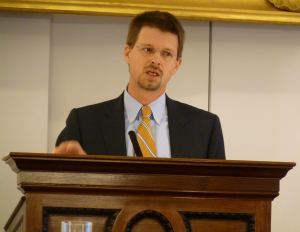
Shap Smith, in his first term as Democratic speaker of the Vermont House, led the Legislature in two historic veto overrides in the 2009 legislative session, and last year he led an effort to salvage the bankrupt Unemployment Insurance Trust Fund. Anne Galloway recently interviewed Smith about the major issues the House confronts in the next session. Smith talks about the budget, Challenges for Change, new tax policies and the politics of negotiation.
Q. What shape is the session going to take?
Smith: Well, you know, we’re trying to figure that out right now. I think, clearly, we still are in a place where much of the work we’re doing is defined by our fiscal situation, and I think we’re starting to see the light at the end of that tunnel, but clearly this is going to be a year that finalizes the three-year cycle we’ve been in, and in some ways this may be the most difficult year that we have.
We will have a better understanding of what the structural financial difficulties are. Closing that structural gap is really what is going to be the essence of our budgetary work this year.
I feel optimistic when I look at other states. Our size and our scale is one of our strengths; our problems tend to be more manageable than those of New York, California or Florida.
Q. That structural gap – what is it exactly? How would you describe it to the public?
Smith: Well a structural gap is when you think about (the fact that) we’ve just been through one of the most dramatic financial challenges in our lifetime. In fact, for many of us, it’s the most dramatic challenge we’ve ever faced. Because of outside forces and the overall economic disaster, our revenues have been completely out of whack.
At this point and time with the economy really starting to recover, I think we have a better sense of what the trend line will be for our revenues, and we have a better sense of what the trend line is for our expenses because when you have an economic disruption that is as severe as what we just had, you are going to have incredible pressures on your state budget, and those are unique to that moment, and to understand what our ongoing expenditures would be, we need to be out of that huge economic disruption.
Q. Do you know where we are with demand for state assistance? Are more Vermonters falling into a permanent state of poverty?
Smith: I don’t have a sense of that, other than anecdotally. I do think that there still is significant pressure for people who are at the lower end of the economic spectrum. Even for people who are getting back into the workforce, it is a difficult time, and while you look at the overall inflation numbers, they’re not too bad, but the things you need to survive, like fuel and food, their prices are going up so people are feeling the pressure on their basic needs budget, and I think that’s a problem.
Q. But this becomes part of the structure of the budget, doesn’t it?
Smith: It does to the extent that it’s state dollars, yes.
Q. So what are the ways in which you’re going to change the structure of the expenditures?
Smith: You know, I don’t think any of us have the answers to those questions. The whole concept around the Challenges for Change last year was to sort of rethink how we were going to redeploy services, and it was really colored by the fact that we were doing it in such a difficult budget environment.
It was also colored by the fact that in many instances there was a breakdown in the communication between those served, those providing services and their government partners.
I think the overall notion that we want to be better at providing what people need, and we want people to judge us by some sort of objective standards, is a notion that we ought to incorporate into our state government so that could be part of what we do.
It is clear that the label of Challenges for Change has really poisoned the well with regard to that notion. I think we need to think about how we can revive the need to be more effective with what we’re doing, without having the political baggage that comes with the label.
I also think we need to understand what people need, and maybe we need to give some real thought to what it is that we as a government can provide to people to help make them successful.
Q. Though some structural changes were achieved (through Challenges for Change), and there will be ongoing savings, there were some areas where success wasn’t as immediate. Where do you go from there, whether you call it Challenges for Change or not? You’re sort of committed to moving on with the process, right? Are you going to move on with that process?
Smith: Part of it will be defined by what the new administration wants to do.
Q. Peter Shumlin says he wants as governor to continue with Challenges for Change, right?

Smith: I think that he recognizes that in many respects the way that it all unfolded was problematic, but in many respects it went better than could be expected.
We did set a target for $38 million. We only got to $30 million, but you can also look at the idea that the glass is half full, or much more than half full.
I think that the one thing that we could do is try to divorce the Challenges process from the notion that it is a budget-cutting process. I think that really muddies the waters.
Q. What do you think of the modernization process (for applications for food stamps, general assistance and the state’s subsidized health care programs)?
Smith: I don’t think you can describe it any other way than as deeply troubling.
My understanding is, they are trying to figure out what went wrong and how you can make it successful. It’s important for us to make it successful and look at what went wrong and try to figure out why, so that we don’t run into this problem again.
When I try a case or file a motion and I get a result, win or lose, I first try to understand what the result was, but then I try to understand why we got that result. And I think we really need to understand that, in this instance, we need to say OK, what was the result and try and fix it, but then we really need to go back and take a look at why this happened.
Was it the people managing it? Was it the process that was set up?
We know we’re in this technological revolution – and we are going to have to integrate that technological revolution of services we’re providing at this point in time. We better learn how to do it, and we better learn from our failures.
This had a real impact on people, and that’s simply unacceptable.
Q. What do you think about the Vermont Blue Ribbon Tax Commission’s work?
Smith: The tax commission is something I’ve always been very interested in. I spent four years on the Ways and Means Committee; I am very interested in tax policy – it’s my own peculiar illness.
I think there are two things that are going to emerge from the tax commission. I think the work that they’ve done around educating people about the current state of our tax system and some of the myths that surround it and some of the realities has been very useful.
I appreciate the work they’ve done, and I think it will continue on as they publish their work.
I do think it is appropriate for us to take a look at what other states are doing and acknowledge that there is this concept of tax competition that we should be cognizant of. I think it’s appropriate for us to ask the question: Should we change our system to be at least perceived as more competitive?
My hope is they will propose some ideas that will allow us to have that discussion. My general philosophy (regarding) revenue systems in general and taxes in particular is, I like a broader base with a more simplistic tax base with lower rates, and I think they will propose those things. I also think we don’t live in a goods-based economy anymore. Or as much of a goods-based economy as we once had, and our tax system doesn’t necessarily acknowledge that, and I think it’s appropriate for us to broaden our sales tax base to include services, particularly if it would allow us to lower the rates (on the sales tax).
I would encourage them to think more broadly about the services and lower the rate even more. I’ve suggested a 3 (percent sales tax).
Q. Back to the income tax scenario — you’re going from taxable income to adjusted gross income and from a tax base of $10 billion to $15 billion, but as I understand it there’s a bit of a rift forming between the parties involved because the progressivity portion of the proposal may include eliminating itemized deductions. What do you think about that?
Smith: So if you’re going to go to adjusted gross income, it really kind of requires you to get rid of itemized deductions. I think it’s appropriate for us to look at going to adjusted gross income. (AGI) is the base that most other states actually use for their income tax system. By using taxable income as the base for our income tax, it requires us to have higher rates, and that means when people are comparing our tax rates with those of other states, particularly our neighboring states, it’s not an apples-to-apples comparison, and it makes us look like we have higher income taxes than we do in comparison to other states.
Q. If we were taxing at AGI, what kind of rates would you like to see?
Smith: I’d like to see them get the rates as low as possible. I do think it’s a good idea to collapse the brackets.
I would like to retain enough brackets so that you retain progressivity, but I don’t have specific targets I’ve suggested to the tax commission with regard to the tax rates.
I’ve said that would be part of the discussion when it (the report) came back here.
Q. What about the sugar-sweetened beverage tax?
Smith: From my perspective I think that it’s appropriate to let the discussion play out. The one concern I have with the sugar-sweetened beverage tax as a revenue source for health care programs is that it is in part being adopted to discourage people from drinking beverages with sugar in them. If that is your goal, what you’re doing is, you’re hoping for a declining revenue source, and I don’t really like to build programs on declining revenue sources.
If your goal with a sugar-sweetened beverage tax is to change behavior, what is it that you’re doing? Are you raising revenue or are you actually changing behavior? And if you’re changing behavior, you probably are going to have declining revenue, or at least that would be the hope if that was your goal.
Q. Can you tick off a list of things we might see this session?
Smith: I expect we’re going to look at the right-to-know laws and the exemptions. We will be looking at campaign finance. I think that we will continue to look at energy issues. We are eagerly awaiting the governor-elect’s plan on broadband, and we would take that up. The Hsiao report (Dr. William Hsiao has been hired to present three proposals for health care reform to the Legislature) will also be on the list. Those things will be front and center. I think that we’ll be talking about issues around jobs and retraining. Clearly, even though the pressure is relieved on the education challenges, I believe that we need to immediately start a conversation with the administration and with school boards and superintendents to discuss the pressures we’re facing within our education system, and not just the financial pressures.
I believe the education system is fundamental not only for a civil society but also (for our ability) to compete. We need to be one of the top states in the country.
Q. Will you run again in two years?
Smith: I think it’s too early to say. I love being speaker. I’m looking forward to working with the governor-elect and with (incoming Senate president pro tem) Sen. John Campbell. I’ll make a decision in two years.
With Peter Shumlin in the office of president pro tem of the Senate, he was such a veteran of the Statehouse, and he was someone who was clearly on track to be running for statewide office, and that gave me an opportunity to grow at my own pace.
I’m a grizzled veteran now after two years. I’ll be playing a different role. Peter Shumlin and I had disagreements about things, and we were able to establish a process to work through those.
I do feel a different sense of responsibility than the one I felt when I stepped into this role two years ago.
When I have time to reflect, I’m very proud of the work we did for the last two years. I’m proud of the House. I’m proud of how much I’ve learned in dealing with experienced leadership in the Senate and the governor’s office, learning how to work through disagreements.
Q. How do you work through disagreements?
Smith: My job outside the Legislature (as a lawyer) is one where I am constantly faced with disagreements and constantly faced with opportunities to resolve those disagreements. I try to actively listen and to engage in the discussion where I can find areas of agreement in order to reach a broader of agreement.
You try to see if there’s any common ground. That’s the most important thing in working with someone where there are disagreements. Once you can find common ground, it becomes easier.
The governor-elect is very effective at doing that.
I do think we learned how to (find common ground) between the Legislature and the administration in the last year.
It helps to get to know people on the other side, to get to know where the non-negotiable areas are. If you go to those things early in the discussion, they’re going to harden their position. You have to learn to avoid doing that.
