

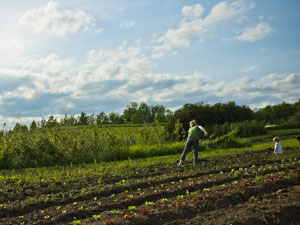
On the face of it, the 300 or so Vermonters who gathered at the Statehouse on Friday didn’t have much in common. They represented disparate interests — state and local land trusts, environmental groups, cheese manufacturers, dairy farms, organic vegetable farms, the tourism industry, timber companies, foundations, the ski industry, state agencies and state lawmakers – but they shared one abiding interest: protecting Vermont’s natural beauty.
But that beauty isn’t necessarily “natural” in the purest sense. Vermont’s landscape is shaped by people. It’s developed, logged, farmed and skied. In a few instances, it’s left completely alone — in a rare state of “wilderness.”
The assembled notables at the Vermont Council on Rural Development conference, “The Future of Vermont’s Working Landscape,” were not present to discuss the latter. Though they often sentimentally described the “working” landscape, the state’s farms and timberlands, as the “soul” of Vermont, they also touted it as the state’s biggest economic driver.
While the landscape draws tourists to the state, lures people to move here and helps the state sell agricultural products, the panelists who spoke on Friday reiterated that the farmers and loggers who help to maintain Vermont’s working landscape are struggling financially because of national and global economic factors. The protection of the land, in their view, is tied to the preservation of a way of life that is disappearing. Farms and forestlands have been vulnerable to development pressures over the last 40 years because Vermonters haven’t been able to earn a steady living working the land.
At the daylong summit on “The Future of Vermont’s Working Landscape,” panelists discussed what practical steps the state can take to support Vermont’s loggers, farmers and agricultural entrepreneurs. (The event was dominated by the latter — conventional dairy farmers and loggers were in the minority.)
Paul Costello, executive director of VCRD, presented five action steps at the conference – including the creation of an Agriculture and Forest Products Development Corporation and a voluntary “working landscape” designation that would set up incentives for conserving land and penalties for development.
In opening remarks, Gov.-elect Peter Shumlin and the Speaker of the House Shap Smith both expressed support for funding the Vermont Housing and Conservation Board, which has been under siege for a few years. (The Douglas administration had proposed zeroing out the VHCB budget in 2009.) Since its inception in 1988, VHCB has funded $260 million in affordable housing and land conservation projects through a property transfer tax.
“There are more young farmers who want to succeed than we’ve seen in a long time that’s such good news,” Shumlin said. “What are we going to do for them, well, by God, let’s stop slashing VHCB and start rebuilding VHCB.”
Shumlin’s 14-minute speech largely focused on the environment, specifically climate change and the impact of acid rain from coal burning plants in the Midwest on Vermont. He tied these two issues to Vermont’s “bright ag future,” in which he envisions the state supplying more food to the nation, as climate change dries up water supplies and makes irrigated farming in other parts of the country untenable.
“We have to recognize how quickly the landscape is changing and why,” Shumlin said.
Smith described the working landscape as “part of the fiber of Vermont’s leadership.” (Smith’s family raised 200 sheep, cut 15,000 Christmas trees and maintained 1,500 maple taps on their farm in Morristown in the 1970s.)
Smith said he believes the state needs to continue to invest in land preservation in order to protect the state’s economic base.
“It is a competitive advantage to us for every other aspect of our economy,” Smith said. “It allows us to be marketable when we are not competitive on other issues.”
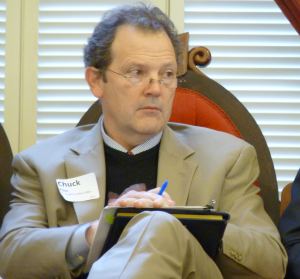
That competitive advantage could be lost if Vermont doesn’t take action to prevent residential sprawl, according to Chuck Ross, Shumlin’s designated Agency of Agriculture secretary.
Ross put it this way: “The landscape matters to Vermonters,” Ross said. “We’re all here because we love it. … But we may be loving it to death as we all try to take a part of it.”
A five-point plan, with a tax attached
Paul Costello, the executive director of VCRD and the conference organizer, unveiled a five-point “action plan.”
The plan, developed by VCRD’s Vermont Working Landscape Steering Committee, includes:
A marketing campaign. “We have an historic opportunity to lay claim to leadership in food products and forestry for an expanded brand identity,” the committee report notes.
The creation of a new Agriculture and Forest Products Development Corporation that would offer grants, loans and support services for startups; financial packages for a small number of “high growth” enterprises; and infrastructure investments in product development, production, marketing and distribution.
A “working lands” designation for farm or forest operations. Designated lands would have a priority status for easements, financial incentives and regulatory relief. They would also be subject to a “aggressive penalties” should they be developed. Some of the benefits would include a 10-year tax abatement for new facilities and better access to state and federal funding.
$15 million to $20 million for an annual state appropriation to support an Agriculture and Forest Products Development Corporation. Costello said: “It’s time for public investment again.” He suggested the money could come from a percentage increase in sales taxes or rooms and meals taxes.
Into the nitty gritty
A group of entrepreneurs who are exploring new agricultural niche markets told participants at the conference that they need concrete support from the state. Buying or leasing land to farm is the biggest initial financial hurdle – several of the panelists said purchasing property to farm is prohibitively expensive.
Christa Alexander, of Jericho Settlers farm, said it would be helpful if there were processing hubs for vegetable farmers who need to find a use for “seconds” that could be made available for schools and other institutions.
Meat processing continues to be an issue. The farmers said they could make more money by raising meat animals, but there aren’t enough slaughterhouses and butchers in the state to make the effort remunerative.
They said strengthening the “localvore” movement would help them expand their markets in Vermont and help them reach the 19 million consumers in the region, including people who live in Boston, Montreal and New York.
Bill Suhr, who runs Champlain Orchards, which grosses $2.5 million a year, said in addition to running the core operations of his business, he has a trucking company, he manages a community supported agriculture program and he exports apples. In his view, farmers and foresters and loggers run increasingly complex businesses, and they need financial and information technology training.
