

Wholesalers look to set certification standards for farmers.
Editor’s note: This story by Olga Peters first appeared in The Commons.
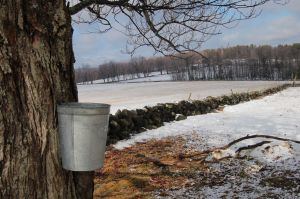
The iconic Vermont maple sugaring image is of a farmer collecting sap from wooden buckets in a snow-covered grove graces postcards, maple syrup containers, state marketing materials and even the back of the Vermont state quarter.
But Vermont’s maple industry has come a long way since the bucket era. Metal sap buckets replaced wooden ones decades ago, and more recently food-grade tubing snaking from tree to tree has almost rendered buckets obsolete.
Now there is a yet another new development in the industry. This time, though, the change could make life difficult for small, independent producers.
The Vermont Maple Industry Council, an association of maple packers who buy syrup from wholesalers, is spearheading a proposed set of certification standards for producers.
Members of the Windham County Sugar Makers unveiled the standards at their annual meeting last month. There is no deadline for activating the program, but Arnold Coombs, a seventh-generation maple farmer and a member of VMIC, said within the year, most packers will stop purchasing syrup from uncertified farmers.
Within the year, most packers will stop purchasing syrup from uncertified farmers, Coombs said.
Recent food-contamination scares, like the E.Coli-tainted spinach a couple of years ago, helped push the decision to develop criteria even though maple syrup is not as susceptible to contamination compared to other food products., Coombs said.
Coombs, who works as director of sales and marketing for Bascom Maple Farms, of Brattleboro and Alstead, N.H., a leading bulk maple company, said it’s not the packers’ intent to force certification, but he said it’s also “not our intent to hire [quality assurance] staff.”
Vermont’s maple industry includes a wide range of producers from household sugarers to producers with over 25,000 taps supplying syrup to an international market.
Vermont sugarmakers produced 890,000 gallons of syrup in 2010, or about 1.43 gallons for each Vermonter – the highest per capita production in the United States, according to data collected by Coombs.
Outside pressures
Coombs said times are changing for the maple sugar industry.
“It’s a CYA world,” said Coombs.
Luckily for Vermont producers, he said, the state stands at the forefront of quality control.
He describes the 1½ pages of proposed criteria as a “pre-emptive strike” against future, less achievable, criteria imposed by agencies without a grasp of sugarmaking. He said it will ensure farmers produce a better product, not change how they make the syrup.
He said maple syrup is bottled at 180 degrees Fahrenheit, a temperature that pasteurizes and kills bacteria.
But Coombs is concerned Vermont’s sugar industry will get tarred and feathered if one producer’s pump leaks chemicals into the sap lines or a producer uses peanut oil as a “defoamer,” potentially turning the product deadly for someone with allergies.
Defoamers are oils used during the evaporation process to keep sap from boiling over. Producers are expected to stay away from fats containing dairy or nut oils like peanut that contribute to common allergic reactions.
If such mistakes are made, consumers will point fingers at “Vermont sugarmakers” not “John Doe operators,” said Coombs.
“We’re trying to protect the industry from the one or two bad [maple sugar] operators out there,” said Coombs.
Developing certification criteria for producers has ranked as a top issue since the 1990s.
According to Coombs, approximately 50 industry members first tackled the issue at a two-day retreat in Burlington. At the time, there had been problems with one company’s tubing used by sugarmakers to carry sap from trees to a collection tank and, without a central certification system, the industry lacked “a good way to contact all producers.”
Coombs said the industry waited for the state to take the lead.
It has not.
According to Tim Wilmot, University of Vermont Extension’s maple specialist, the push is coming primarily from the packing companies in the state that sell large quantities.
Wilmot said a number of buyers, like General Foods, unfamiliar with the sterilization methods for maple products, expect farmer certification because they’re used to the certification of any foodstuff they buy.
Developing standards
The writers of the proposed certification based their recommendations on Ontario’s and Québec’s guidelines.
Coombs said not all of the Canadian requirements (Ontario’s booklet has 200 pages worth) are necessary for quality. Vermont’s 1½ pages of proposed certification focuses on quality control.
Wilmot said the proposed standards protect farmers and Vermont’s reputation as an industry leader. Vermont, for example, advocated for the use of food grade materials in all aspects of maple production before other states.
“It’s a matter of keeping the strong image Vermont has of quality and safety,” said Wilmot.
Wilmot chaired the five-member committee of the VMIC charged with developing and proposing the certification standards currently circulating among producers.
Industry professionals Jacques Couture, Richard Green, Haven King, and Elissa Valentine also served on the certification of maple operators committee.
Wilmot said the committee would like to see the process in the hands of sugarmakers who understand and can realistically appraise their own industry.
The committee, said Wilmot, developed the standards working from “tree to product” and based the standards on how most sugarmakers produce their wares. He said the majority of Vermont sugarmakers should already qualify under the proposed standards without any, or a few minor, changes.
Wilmot has not heard individual consumers express food-safety fears about maple syrup, but buyers, like grocery stores, are applying pressure to the packers.
The packers informed the certification standards, Wilmot said, by suggesting producers incorporate some of the packers’ best practices like adding shatterproof coverings over light fixtures.
The committee also proposed an education program on cleaning agent safety, said Wilmot. Some of the cleaning chemicals used on equipment like the evaporator or reverse osmosis machine need to be properly flushed from the machinery before use and then safely stored or disposed of afterwards.
Wilmot said the proposed certification is not a license.
Wilmot said the committee doesn’t want to dictate standards, leaving it up to the packers to initially discuss the process with producers and buyers.
“It’s a process we feel it’s time to move along,” said Wilmot.
Wilmot also feels present and general food safety worries have pushed the desire for certification standards.
For example, organic maple syrup is no different in quality, he said, from regular maple syrup, but some people feel buying organic is necessary.
Wilmot has not heard individual consumers express food-safety fears about maple syrup, but buyers, like grocery stores, are applying pressure to the packers.
“This isn’t going to happen overnight,” said Wilmot.
At this point many of the details – such as who will conduct the farm inspections, how they’ll be paid for and how often they’ll be conducted – remain to be determined.
Wilmot feels certification will be less of a cultural shift for farmers than expected. Some farmers have already gone through certification processes through the Northeast Organic Farming Association or the Vermont seal of quality program, which was discontinued in March.
Packers have told Wilmot that they want maple producers of all sizes to obtain certification because they want to retain current customers and not simply purchase from the big growers.
The next step will be communicating with sugarmakers and helping them understand the necessity for certification.
“We’re not trying to hit them over the head with anything,” said Coombs.
If farmers choose not to become certified, they could still sell syrup directly to consumers but, ultimately, packers won’t want to buy from uncertified farmers, said Coombs.
From tree to table
Broadly speaking, maple syrup must pass through three levels to get to consumers.
In the first stage, farms collect and boil 40 gallons of sap for every gallon of syrup.
Then maple-sugar companies like Bascom, Maple Grove or Butternut Mountain Farm, called packers, buy the syrup in bulk, bottle it, and sell it (and other maple products) to retailers.
In the third stage, grocers and other merchants buy maple products from packers to sell to consumers either directly, or to use as ingredients in other food products.
Large grocery stores, said Coombs, already inspect packers and refuse to buy from uncertified companies. As a result, maple syrup products come with pedigree-worthy allotment numbers, providing a tracking system for each bottle in the event of contamination.
“It’s only a matter of time” before the grocery chains stop accepting maple products that originate from uncertified farmers, Coombs said.
Coombs said so far, grocery chains have accepted sugarmakers’ lack of certification. But, he said, “it’s only a matter of time” before the grocery chains stop accepting maple products that originate from uncertified farmers.
“Because that store won’t put themselves on the line for some farmer in Vermont. We don’t want to be caught blindsided,” Coombs said.
Internationally, standards are tough for maple syrup. Coombs is working on a deal with an Australian grocery chain with so many quality-control requirements that it employs 50 people.
“Try reasoning with a lawyer,” said Coombs.
Currently, UVM Extension and the Vermont Maple Sugar Association, founded in 1893, offer three yearly sugarmaking seminars, but Vermont has no requirements for sugarmakers looking to make and sell syrup.
And Coombs feels this lack of certification shows in less-than-stellar products on the market. He points to the International Maple Sugar Institute, based in Ontario, which disqualifies 40 percent of the syrup entered into its annual competition.
“And that’s supposedly the best of the best,” said Coombs.
Moving too fast?
Coombs estimates two to three years before the certification process is up and running. But, some industry professionals say, “Slow down.”
Bruce Bascom, the head of Bascom Maple Farms, hopes the industry will move slowly on the certification standards, allowing the process to evolve over years.

Maple syrup, said Bascom, is one of the few food products falling under state jurisdiction, not federal Food and Drug Administration inspections, because it tends to be viewed as a cottage-industry product.
People are unlikely to get ill from maple products, said Bascom. The boiling process sterilizes syrup and anything that could fall into it, like wood chips from the boiler, he said. The filtration process removes these foreign objects and, even after the syrup has sat stored in bulk containers, it is heat-packed and thus sterilized again.
If syrup should ever ferment, a re-boil and filter will put it right again.
“The beauty of maple is even if you do it wrong, it still doesn’t harm you despite your incompetence,” said Bascom.
Bascom understands the move is a pre-emptive one to keep the industry out of the federal jurisdiction. Still, he has concerns about what will happen “if this thing is pushed through without thought.”
Bascom said questions need to be answered. Who will conduct inspections? What about the micro-producers? Most inspectors with strapped resources don’t feel the small guys are worth the effort. Bascom predicts that only the levying of fees against the farmers will compensate inspectors.
Bascom described the program as well intended but one that “needs to get thrashed out,” pointing to Vermont’s five-year phase-out of galvanized storage barrels as a good process.
Vermont may risk isolating its producers if the program is forced through because it will be easier to buy from New York, New Hampshire, Maine or Canadian producers, said Bascom.
Right now, he said, Bascom Maple Farms requires producers to sign a statement saying they’ve met certain requirements in a self-certification process.
U.S. Customs agents recently locked down a load of Maine syrup sent to Bascom’s, he said, because the truck passed through Canada on its way from Maine to New Hampshire. The customs office in Boston sent a fish inspector to check the syrup barrels.
Bascom showed the inspector how to open and test the syrup and then waited a month before customs released the load.
If Vermont or New Hampshire had sent an agricultural inspector familiar with maple products, things would have gone more smoothly, said Bascom.
Coombs said certification will create one more selling advantage over uncertified states, because it signals buyers “we take care” of maple products.
“It will be a big positive [in the end],” said Coombs.
Coombs said there’s no denying that previously autonomous farmers will need to make a culture shift. For the industry to continue expanding, said Coombs, farmers will need to continue to modernize.
But the maple industry has grown to where farmers can focus on one product and make a living — something unheard of 40 years ago, Coombs said. He hopes a certification process will allow more farmers to thrive economically and the program will protect everyone.
“We don’t want to force heavy rules on any sugarmaker,” said Coombs.
The certification standards may change as the project moves forward, said Wilmot. Prior to January’s Maple Congresses, Coombs will write a piece for the industry newsletter explaining the issue to farmers and listing the certification standards.
“A lot of this is a matter of getting people comfortable with and understanding why certification may be necessary,” said Wilmot.
