

Editor’s note: This story first appeared in the Barton Chronicle.
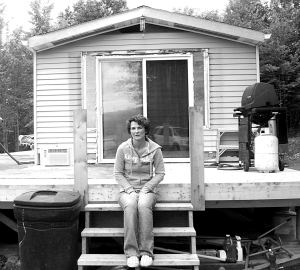
TROY – It was a chilly morning in September and Leslie Patenaude was slowly getting her trailer warmed up with a space heater. She and her husband, Paul, had no heating system yet in the little blue trailer. They did have electricity, running water, and a toilet – a marked improvement from when they first moved in.
That was in July, shortly after a sheriff served them with papers saying they were being foreclosed on and would have to leave their home.
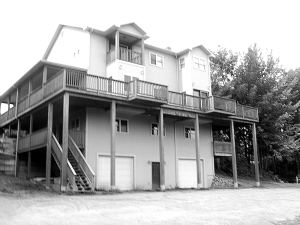
A few hundred feet away is their old home – a four-story, 5,000-square-foot house that Mr. Patenaude, a carpenter, built seven years ago as a spec house.
About a year and a half ago, Mr. Patenaude, owner of P&L Construction, started seeing his work radically decline as the economy went into recession. The construction company had employed ten to 15 people, Ms. Patenaude said. They were all laid off, and she and her husband were reduced to working on projects themselves — what projects they could find.
“We were smoking with work, then boom,” Ms. Patenaude said. “We went from good to bad within a couple of months. For seven years, we made our payments on that house and everything else, so you know we made good money.”
They’d had perfect credit ratings of 740 and had always paid their bills, she said. But as they watched the steady failure of the economy, and the housing industry in particular, they figured they were in for trouble.
So they went to see their mortgage holder, Community National Bank, about their $2,000-a-month house payment. “Paul ran out of work,” Ms. Patenaude said. “We hadn’t missed a payment yet, but we could see what was coming.”
The loan officer they spoke to said they could skip the mortgage payment for three months, she said. At the end of that time, they could resume regular payments and pay back the three months they’d missed.
“It was kind of silly,” Ms. Patenaude said. “If we couldn’t pay $2,000, how could we pay back more?” Also, she was skeptical that the contracting business would rebound within three months. “But that was our only option at the time, so we took it.”
The construction industry did not revive in three months, and the Patenaudes found themselves still unable to come up with the hefty payment. They returned to the bank. “We’d been doing business with Community for 20 years,” Ms. Patenaude said. She said they’d had numerous loans, both personal and business, and they had all been paid. Until then.
She said a loan officer told them they had to come up with their full payment, or the bank would start foreclosure proceedings. “She said, what you should have been doing is not make your other payments.”
How do you choose what not to pay? Ms. Patenaude said. If they hadn’t paid the loans on their vehicles, they would have lost them and not been able to work at all. “It put us in a predicament.”
She said they had equity in the house, about $200,000 at the time. “It’s not like we were upside down,” she said referring to situations where the mortgage is higher than the home’s value.
In the end, Ms. Patenaude said, Community National said they could apply for a loan where they would repay the payments they had missed. They would have had to pay an additional $500 a month above the $2,000 they already owed, she said.
“Who could do that when they can’t make the normal payment?” Ms. Patenaude wondered.
Meanwhile, she said, creditors were informed the mortgage payments were delinquent. The Patenaudes’ credit score plummeted, and their credit card interest rates skyrocketed to 30 percent, or they were dumped entirely. Credit was vital to continued operation of the business, such as it was, because Mr. Patenaude had to buy supplies in order to continue carpentering.
Ms. Patenaude is a trim and articulate woman who is in her 40s but looks considerably younger. As she talked in her tiny, crowded trailer – which was given to them by a friend – she seemed baffled, overwhelmed and angry.
“Look where I’m living now,” she said. “It’s a dump. But we were basically homeless. We never expected to be kicked out in July. It was a year and a half from start to finish. For seven years, we lived in that home. We gave them $80,000 in interest. We came here. There was no toilet. Nothing, except for this thing,” she said, waving her arm around at the little trailer. “It leaked like a sieve. They didn’t care. They had no heart at all.”
She said she understands that if you can’t pay your mortgage, you lose the house. But she remains upset that, after a long history of paying bills on time, the bank was not more accommodating when they hit hard times.
“I don’t have a problem with foreclosure per se,” she said. “It was how it was handled. It eats at me. We asked them if there were any government programs, and they said no government program was available to us. We thought there would be something. Everyone is under the misconception that their bank will help them out.”
She shrugged. “At this point, I figure we don’t have a lot left to lose. It’s weird for us because for so long we lived well and had good credit. Now it’s a nightmare. We don’t know what’s coming. We’re scared. Paul doesn’t know if he’s going to be working from day to day. We made $17,000 last year.
“If that’s what’s happening to people across America, then no fricking wonder. How many people are losing their homes? The government doesn’t want to have to take care of all those people. Twenty grand would have kept us in our house. You can’t work with $20,000 to help someone?
Sometimes you can, and sometimes you can’t
It’s up to the lender what happens when people start having trouble with their mortgage payments, said Tom Candon, Vermont Deputy Commissioner for Banking and Securities. There are no rules governing how banks deal with delinquent mortgage holders.
“It all depends on the lender’s determination of the individual’s ability to repay,” Mr. Candon said. “There are a lot of sad cases where people are calling in desperately looking for help. They’ve exhausted their credit cards, their 401Ks. It may be that the lender has discovered that the individual absolutely can’t make a monthly payment.”
Sometimes the borrower simply no longer has the income to warrant enrollment in a loan modification program. Even at a lower interest rate, the payment would be unaffordable.
Vermont has never suffered from the spate of foreclosures that some states have. “I think we were fortunate that we didn’t see the predatory lending,” Mr. Candon said. “This state has been very fortunate with foreclosures when compared to other areas.”
In some states – Florida, Arizona, New Mexico, Nevada and California – a large number of foreclosures can be attributed to people buying homes that were above their means, Mr. Candon said. Michigan and Ohio are in trouble because of the auto industry, he added.
In Vermont, the story has been different. In most cases, people are threatened with foreclosure for economic reasons.
“In Vermont, we’ve been having a mortgage assistance program since April of 2008, and we’ve been keeping track of those who’ve called,” Mr. Candon said. “We’ve had over 1,200 people call, and 60 percent attributed their problems to loss of a job or income. We’ve been fortunate to be at the bottom, or near, as far as the numbers of foreclosure filings go, but that doesn’t mean there aren’t people hurting.”
He said divorce and medical bills are the other big reasons for foreclosure in Vermont.
“In general, foreclosure doesn’t happen overnight,” said Steve Marsh, president of Community National Bank. “We don’t want to own anyone’s house. We don’t make money. We are not in the business of buying and selling property.”
He said any lender takes a hard look at the mortgage holder’s ability to pay. “We talk to them first,” he said. “We try to figure out a plan of attack and see if there isn’t something to be done to help, and we come up with an agreement on how to proceed. We work with people all the time trying to get things reconciled.”
But in the end, if the agreement doesn’t work out, the bank will foreclose.
“It’s our job to foreclose on some people because we have to, because it’s not our money,” Mr. Marsh said. “We’re basically out there trying to collect our bills.”
He said he’s spent 37 years in the banking business and has not seen anything like the current problem with people being unable to make their mortgage payments. “The recession is deep and cutting deeper,” he said. “I think people have worked really hard to stay afloat. But it’s been a long time now. People had nest eggs they could turn to, and they’ve gone through.”
According to Realty Trac, which records foreclosure information nationally, Orleans, Essex and Washington counties currently have the highest rates of foreclosure in the state.
Sparsely populated Essex County has the top rate with a foreclosure on one in every 4,891 housing units. Orleans is second with a rate of one in every 5,264 housing units. The rate in Windham County is one in every 28,380, according to Realty Trac. In Chittenden, it’s one in 21,083.
Compare those rates to national ones, and Vermont’s low rate is striking. A high rate of foreclosure nationally is one in 84 housing units, in Nevada, according to Realty Trac, while a low is one in 17,764. Florida’s high rate is one in every 155, California is one in 194.
There are federal programs to help those who are facing foreclosure. The first, which has not been particularly successful, was called the Home Affordable Mortgage program, or HAMP. “That program has had many, many problems and restarts,” Mr. Candon said.
Basically, it’s a modification program where lender and homeowner work together to lower the interest rate and monthly payment and come to something affordable for the borrower and acceptable to the lender. But it’s had relatively small enrollment and rescued just a fraction of the people it was intended to help.
One of the greatest problems with it was the huge volume of people who were delinquent on mortgage payments, Mr. Candon said. “The servicers couldn’t keep up with working with the individuals and the consolidation in the industry. All these huge lenders were merging. It was overwhelming.”
After two years, lenders are now getting the volume under control and are proceeding. “They’ve been slow to do that because they couldn’t keep up with the volume,” Mr. Candon said. “Or they allowed modifications that didn’t work out.”
According to recent reports, some of those lenders were actually hasty in their foreclosure proceedings, and a new foreclosure mess is emerging with calls for a moratorium on foreclosures nationwide until matters get sorted out.
But even a good modification program won’t work if borrowers don’t have the money to make a reasonable payment, Mr. Candon said. “We do see the heart-wrenching stories of someone who’s unemployed and has no income at all.”
There was a spike in Vermont foreclosures in March when the number hit 207, up from 159 in February. Since then the numbers have been declining. But Mr. Candom isn’t all optimistic that they’ll stay that way.
“I’m hoping that’s the direction, but I’m not totally convinced that it is,” he said.
In July of this year, Vermont law H.590 took effect. It establishes a mediation program in foreclosure proceedings. “Under the act, the court is the compliance officer for the mediation program,” the measure says.
Basically, the measure establishes a program to “assure the availability of mediation and application of the federal Home Affordable Modification Program (HAMP) requirements in actions for foreclosure of a mortgage on any dwelling of four units or less that is occupied by the owners as a principal residence.”
In Vermont, at least, the courts are helping by recommending mediation between bank and borrower, Mr. Candon said. “Even before the new mediation law was adopted, we’ve seen some judges recommend that people try mediation. The courts have taken an active role.”
Mr. Candon believes that the mediation bill is a good step forward. He said that those who find themselves in trouble should call their lender, or call the Department of Banking, Insurance, Securities and Health Care Administration and ask about the mortgage assistance program.
Meanwhile, he worries that paperwork required by state and federal programs have merely slowed pending foreclosures.
“The downward trend was probably caused by some of the lenders preparing paperwork,” he said.
If you’re writing about foreclosures, you’ll probably be busy for a while yet, he said.
