

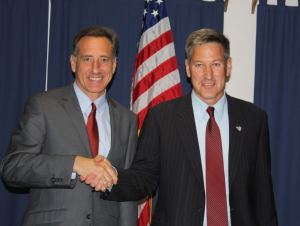
Nose to nose on the numbers game
Rasmussen Reports issued a poll on Sunday that puts Sen. Peter Shumlin, the Democrat, ahead of Lt. Gov. Brian Dubie, the Republican — though not by much. Fifty percent of respondents said they would vote for Shumlin; 45 percent would back Dubie. The margin of error for the survey, which was conducted late last week, is 4 percent.
A second aggregated poll analysis, just released by Nate Silver of fivethirtyeight.com for The New York Times, also has Shumlin increasing his narrow lead.
Rasmussen declared that the Shumlin-Dubie race is no longer a toss-up; the pollster says the election is leaning Democrat. Political analysts say the pollster trends conservative. See related story.
Of the 750 likely voters polled, 3 percent were undecided; 1 percent said they would vote for independent candidates.
Shumlin leads Dubie in early balloting, 56 percent to 38 percent. According to Bob Kinzel of Vermont Public Radio, a quarter of eligible voters have already cast early ballots.
In the last Rasmussen poll, taken after the primary in September, Shumlin had a 49 percent to 46 percent advantage over Dubie.
Both candidates have rallied their bases. Dubie has the support of 88 percent of Republicans polled; Shumlin has attracted 83 percent of Democrats. Among independents, the candidates are tied.
Nate Silver of fivethirtyeight.com gives Shumlin 51.1 percent of the vote and Dubie 47 percent in his Oct. 31 aggregated analysis and model, his latest. There is a huge disparity, however in the percent chance of winning for each candidate: Silver gives Shumlin 77.7 percent and Dubie 22.3 percent.
Middlebury College professor emeritus of political science Eric Davis agrees with Silver’s assessment of the vote totals, but disagrees with Silver’s conclusions about percentages for who is most likely to win.
“I admire the work he’s done it’s most valuable in the US House districts,” Davis said.) “But he doesn’t look at the politics on the ground. In the U.S. Senate and governor’s races, where facts on ground matter more, you need contextual knowledge as well.”
On Oct. 11, a Mason-Dixon Polling and Research poll also indicated that Shumlin and Dubie were a hair’s breadth apart.
Forty-four percent of respondents said they would vote for Dubie; 43 percent would cast ballots for Shumlin. The poll, commissioned by VPR, showed that 8 percent of those polled were undecided. The margin of error is 4 percentage points.
In any event, come Tuesday night, the results will be in. If either candidate wins more than 50 percent of the vote, he will have a clear path to victory. If Dubie or Shumlin both receive less than 50 percent, the Legislature will determine the winner. That’s because under the Vermont Constitution, if candidates for governor receive less than 50 percent of the vote, lawmakers must choose the victor by secret ballot. Of course, there’s also the possibility that there could be a recount.
Davis has come up with his own four potential outcomes for the race. He said there is a 40 percent chance Shumlin will get more than 50 percent of the vote and a 15 percent chance Shumlin will win a plurality but not win outright. Davis gives Dubie a 30 percent chance of garnering more than 50 percent; and a 15 percent chance of winning the plurality of the vote, but not getting enough votes to avoid sending the results to the Legislature.
“I think at this point it is coming down to turnout — who has the better ground game organization and who can get out more voters,” Davis said.
Both Dubie and Shumlin campaigned in their base counties, the Northeast Kingdom and Chittenden County respectively on Sunday. Davis says this is a sign they are working hard on their ground strategies.
Chris Graff, former chief of the Vermont bureau of the Associated Press and now an executive with the insurer, National Life, says election night will be a late one.
“The truth is that there is still a high level of uncertainty,” Graff said. “I am continually amazed at news articles in which people are quoted and are uncertain about who they will support. At this is the point in the campaign and for about a week or two now. it’s just like the shuttle getting ready for takeoff. At certain point there’s nothing you can do. It’s a matter nobody knows the outcome of this race just like no one knew the outcome of the Democratic primary.”
“I think it’s been a given for a year that the odds favor Peter Shumlin or the Democratic candidate in Vermont,” Graff said. “Brian Dubie has beaten the odds so far. He should have been toast by now, but he’s done it on his own. I won’t be surprised by any outcome.”
Last week, Davis predicted Dubie and Shumlin will each get between 48 percent 49.5 percent of the vote. Typically, he said, the independent candidates together siphon off between 1.5 percent and 2 percent of the ballots cast. Two of the four independent candidates, Ben Mitchell, who was on the Liberty Union ticket, and Em Peyton dropped out of the race last week and gave their support to Shumlin.
Davis also cautioned that the VPR polling results could be slightly off target because only Vermonters with landlines were polled. Cell phone users, which typically trend younger and more Democratic, were not included in the survey. According to the Pew Research Center’s People and the Press, this missed demographic can skew polls away from Dems nationally by 4 percent to 6 percent. Though in Vermont the number of cell phone users isn’t as high, Davis said the Mason-Dixon poll could be slightly depressing Shumlin’s numbers.
Art Woolf, a professor of economics at the University of Vermont and a frequent commenter on the Web blog Vermont Tiger, concluded that voters under 40 are probably under-represented.
Graff said even if neither candidate gets 50 percent of the votes, there will be a great deal of pressure on the Legislature to certify the winner of the plurality.
It has been 34 years since the last time a “non-plurality winner” was selected, according to the Vermont Secretary of State’s Web site. In the 1976 lieutenant governor’s race, lawmakers chose T. Garry Buckley, the Republican, over John Alden, the Democrat. (John Franco also ran as an independent.) The two top vote-getters were 2,854 ballots apart. Alden held the majority, with 48.4 percent; Buckley had 47.6 percent of the vote; Franco 4 percent.
Buckley, according to Graff, lobbied the Legislature and said his phone bill was $2,000 the month before lawmakers cast secret ballots and elected him. The vote in the House was 90 to 87 in the House. “All those phone calls paid off,” Graff said, at least initially. But in 1978, Buckley lost his seat in the primary to Peter Smith, Graff said, because the “GOP feared a backlash … because Buckley usurped the will of the voters.”
Davis said if Dubie has a 1,000-vote lead over Shumlin, it would be hard for the Legislature not to vote for Dubie, but if he is ahead by one-tenth of 1 percent of the votes (between 200 and 300), it would be a free choice for the Legislature. If Dubie is ahead by 700-800 votes, Davis doesn’t know how the Democratic Legislature will vote.
“If Dubie narrowly wins the plurality, he isn’t going to have much good will because of the tone of his ads,” Davis said.
Davis estimates the turnout will be about 60 percent of registered voters, or roughly 275,000 Vermonters. A 1,000-vote difference, or half a percentage point gap between the victor and the loser, would likely trigger a recount, Davis said. The Democratic gubernatorial primary recount went very quickly – the time of the election to the recount was 17 days. A recount could be completed by around Thanksgiving, Davis said.
A recount or an ensuing vote certification in the Legislature would be problematic, Graff said.
“Imagine if it’s up in the air, neither candidate could attract a cabinet … it would paralyze the state when we need a governor-elect planning a budget,” Graff said.
The hearsay department
On Thursday morning, Geoff Norman, the publisher of Vermont Tiger, put up a blog post “Deal Us In” alleging that Dick Mazza held a “secret meeting” with Shumlin and a group of 10 or so business leaders in Colchester.
At the gathering in Mazza’s garage, Shumlin supposedly equivocated on his long-held belief that Vermont Yankee should be shut down. Vermont Tiger is a conservative blog that supports the relicensing of the nuclear power plant in Vernon.
Norman’s claim came from an anonymous source.
Just hours later, WPTZ and WCAX ran stories based on the blog post; the reporters – Stewart Ledbetter and Kristin Carlson – couldn’t find anyone who attended the meeting to speak on the record.
http://www.wptz.com/video/25557953/detail.html
http://www.wcax.com/Global/story.asp?S=13410171
Shay Totten of Seven Days, and Terri Hallenbeck of the Burlington Free Press, also tried to substantiate the claims and came up empty. They reported that Glen Wright and David R. Coates, both retired accountants, were at the meeting, according to Shumlin.
When VTdigger.org reached Glen Wright on Sunday and asked if he would be willing to talk about what he heard Shumlin say that day shortly after the primary in September, he said: “I don’t want to” and hung up the phone.
The only people who have been willing to talk have been: Mazza, who doesn’t recall Yankee coming up in conversation; Dubie, who is now using the allegation in his stump speeches; and Shumlin, who denies he said anything of the sort.
Dubie told supporters in Barre on Saturday: “This campaign is defined by two issues. It’s jobs and it’s trust, and Vermonters want to elect a governor they can trust. And when my opponent puts forth a plan that says he’s going to for the whole campaign (sic), his whole campaign is about closing down Vermont Yankee, and then we hear reports about a closed-door secret meeting, where to a business group there’s another commitment, and then we hear on Vermont Public Radio there’s another message that’s given, Vermonters are wondering which message to trust.”
In an interview, Shumlin said the meeting wasn’t secret – he said it was no different than the visits he’s made with other small groups around the state during the campaign.
The topic of Yankee didn’t come up, he insisted. “It was just like the last thing I was going talk about at Dick Mazza’s garage party, sitting around with 8-10 people getting to know me, was Vermont Yankee,” Shumlin said. “It’s the one thing we (Shumlin and Mazza) disagree on, (so) why would I bring it up? It’s like going to your grandmother’s house who’s a Republican and talking about George Bush. You just avoid it.
“That’s why I kept saying: you guys in the mainstream press, just tell me who said this, who is it?” Shumlin said. “They just pointed to the blog. I said, I know it’s Halloween, I’m chasing after a Dubie ghost here, who is it?”
Shumlin said WCAX has run a string of stories based on press releases from Corry Bliss, Dubie’s campaign manager. Recently, the station ran a piece about Shumlin campaigning at the funeral of Anthony Rosa, a Marine who died in Afghanistan. The story cited one named source who said she thought it was inappropriate of Shumlin, who had been standing next to her, to introduce himself.
http://www.wcax.com/Global/story.asp?S=13391631
Shumlin pointed to the speeding ticket brouhaha as another example.
“It’s WCAX, and when they play it, then everybody does. I mean this is incredible. I got a speeding ticket. I pleaded guilty. I paid it. The headline should be, the only legislator who doesn’t let state cops fix a speeding ticket for him, everyone else gets theirs fixed. Gimme a break. I’m the only one dumb enough to let them do it.”
“Every night it’s a new nontruth, and this one they (WCAX) put on (the Vermont Tiger story) was extraordinary,” Shumlin says. “What are they going to have me doing tomorrow, repealing marriage equality?
Rhetorically, Shumlin asked: “How can anyone question where I stand on Vermont Yankee? I risked my whole career to shut this whole thing down. … I didn’t do it for politics, I did it because it was right. I’ve got to hand it to the Dubie folks; they’re extraordinarily successful at putting up things on blogs that, first of all, never happened and, secondly, that the mainstream press picks up. I’ve never seen anything like it.”
Professor emeritus of political science Eric Davis said the Vermont Tiger blog post fell in the realm of hearsay. He said Geoff Norman is not a journalist, and his blog, like the liberal equivalent, Green Mountain Daily, reflects the interests of his conservative political community.
“The post on Vermont Tiger illustrates the distinction between blogging and professional journalism,” Davis said. “A quote-unquote mainstream news organization would not have published it unless sources were willing to go public with what they heard Peter say.”
Davis said the post was “purely political” and “reflected what Geoff Norman, who would like to see Brian Dubie elected, get another story up there about flipflopping or to get Green activists wondering what is Shumlin really up to.”
Davis said Shumlin didn’t help himself with his responses on TV. Here’s a transcript of the exchange between Carlson and Shumlin on WCAX:
Shumlin: “I think Vermont Yankee should be shut down on schedule in 2012.”
Carlson: “Did you ever tell anyone at any point that if there was a new owner you might be able to support the plant?”Shumlin: “Not to my knowledge.”
Carlson: “So if you are elected governor we won’t be having a conversation at some point about you thinking Yankee should be relicensed with a new owner?”
Shumlin: “It will be highly unlikely.”
Carlson: “So highly unlikely, but that is not a yes or a no?”
Shumlin: “You know I’m not trying to be evasive. What you have to understand about governors is you have to lead, and you have to deal with the facts we have before us. All the facts before me right now show me Vermont Yankee should be shut down in 2012.”
Davis said sometime later next year Shumlin might have to answer that question if circumstances change. “It’s possible that Shumlin, if elected, would face an offer from a new company,” Davis said.
Energy Daily reported in August that Exelon Corp. and NRG Energy Inc. were potential buyers. (Exelon owns Oyster Creek Generating Station in New Jersey and Braidwood Generating Station in Illinois, both of which have had significant leaks of tritium, a radioactive isotope of hydrogen.)
SGAM, a British business Web site, reported on Oct. 22 that Entergy has “put its 650 MW Vermont Yankee nuclear plant for sale, according to sources. Morgan Stanley has been chosen to run the process, which could fetch about USD 2bln ($2 billion U.S. dollars).”
David O’Brien, commissioner of the Vermont Department of Public Service, told John Dillon, of Vermont Public Radio, new owners could open the door to relicensure of the plant.
“The question then becomes for leadership in Vermont, if there were a sale, and/or a power deal, or the very least these sort of game changers occurring, that could be a great deal for the state. Provided that we’ve satisfied ourselves on safety, is that enough to satisfy Vermont that we can look at Vermont Yankee differently?”
Davis speculated that if a company came back with a rate offer that was less than the 6-cent price for electricity offered by Hydro-Quebec, and promised to fully fund the decommissioning costs, lawmakers and the new governor could authorize relicensure next spring.
“If those things all happened, are there circumstances under which Peter Shumlin would support relicensure for a 10-year period?” Davis asked. “I don’t know.” He said if Shumlin had a new commissioner of DSP who was willing to ride herd on a new owner regarding safety issues, that might make a difference.
In addition to deciding to keep O’Brien on or select a new commissioner, the governor would be responsible for finding a replacement for the chair of the Public Service Board, James Volz, whose term expires on March 1.
How do I sue thee? Let me count the ways
The lawyers had a field day last week. Five gubernatorial campaign-related lawsuits were filed in state and federal courts in just five days – starting on Oct. 26.
First the Vermont Attorney General William Sorrell sued two 527 nonprofit organizations — the Republican Governors Association and Green Mountain Future – for failing to register with the secretary of state’s office and report campaign finance reports (the RGA was also sued for accepting donations over the limit set by Vermont law — $2,000). Both groups have run hundreds of thousands of dollars worth of TV advertisements in Vermont on behalf their candidates – Republican Lt. Gov. Brian Dubie (RGA) and Democrat Sen. Peter Shumlin (GMF).
In response, the RGA filed a countersuit, arguing that the AG was attempting to abridge its First Amendment rights.
http://vtdigger.org/2010/10/27/sorrell-527s-act-like-pacs-in-vermont/
Two days later, David Blittersdorf, the CEO of AllEarth Turbines, lodged a libel suit against Lt. Gov. Brian Dubie and his campaign manager for allegedly impugning his character in a press report that appeared in the Burlington Free Press and on a Web site, www.shumlinethics.com.
http://vtdigger.org/2010/10/28/blittersdorf-sues-dubie-and-his-campaign/
The week ended with more litigation from the Dubie camp. According to the Free Press, a lawyer for the lieutenant governor sought an injunction to prevent Attorney General William Sorrell from “raiding” the Dubie campaign headquarters. Sorrell said agents were scheduled to arrive at the offices at 10 a.m. on Friday to retrieve documents for an investigation into alleged collusion between the Dubie campaign and the RGA. The Vermont Democratic Party had filed a complaint with the AG’s office the previous week, asking Sorrell to probe an expenditure for a shared poll. It is illegal under Vermont’s campaign finance law for candidates to coordinate efforts with outside organizations that contribute more than $3,000 to a campaign.
http://www.burlingtonfreepress.com/article/20101029/NEWS03/101029016/AG-disputes-Dubie-s-claims
Sorrell filed a “petition to compel” in Chittenden County Court on Friday. The order directs the Friends of Brian Dubie to comply with a “civil investigation demand.”
Dubie’s attorney, Michael P. Kenney, filed a complaint for injunctive relief with the U.S. District Court in Burlington that alleges Sorrell is acting in a partisan fashion because the Attorney General is on the Democratic ticket along with Shumlin, Dubie’s rival.
“The Defendant bears a heightened burden of justifying his invasion of a political campaign committee’s private associational records,” Kenney wrote. The lawyer deemed the civil investigation demand “vexatious, over broad and a misuse of public resources.” He also called the order “fishing expedition” and claimed it violates Dubie’s First Amendment and due process rights.
http://vermont-elections.org/elections1/campaign_finance_newlimits.html
Will the flurry of lawsuits impact the election? Probably not, according to Eric Davis, professor emeritus of political science of Middlebury College. He doesn’t think most voters will care.
“None (of the lawsuits) are going be resolved until well after Election Day,” Davis said. “I think these lawsuits are inside baseball and of interest only to the political community – the campaigns, political
junkies and the press.”
