


MIDDLEBURY – Vermont’s lush pastures and iconic black-and-white cows belie a harsh reality: 23,000 children – nearly 18 percent – live in homes where money is so tight that sometimes there’s not enough food to meet basic needs. They are what the federal government calls “food insecure.”
There’s worse news: 5.7 percent of all Vermont households are now considered to have a very low food security, which means that at least one person in the household actually suffered from hunger at some point during the year. That makes Vermont the sixth-hungriest state in the union.
Thursday evening, Joel Berg told an audience of Middlebury College students that hunger is not inevitable, but rather is the outcome of specific government policies.
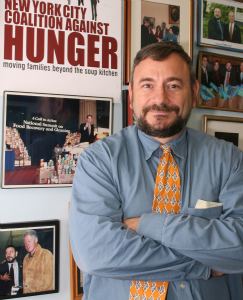
Berg served for eight years as a Clinton appointee in various senior positions in the U.S. Department of Agriculture and is currently the executive director of the New York City Coalition Against Hunger, a nonprofit organization that represents 1,200 soup kitchens and food pantries.
His talk introduced Middlebury’s fall student symposium, “American Poverty in Context.” The symposium, which includes presentations on various aspects of poverty, runs from Oct. 21-29.
Berg’s address – “Yes, We Can End Hunger and Poverty in the United States” – focused on debunking the claims that poverty and hunger are intractable and that volunteerism and charity are effective responses. Using humor and a barrage of historical examples, Berg launched an attack on the claim that government is an “evil, horrible, occupying force … (an) alien entity that does nothing but steal our hard-earned tax dollars and spend it on those evil other people.”
He examined how yellow fever, cholera and malaria – diseases that kill millions of people in other countries of the world – were eliminated in the United States. “Government wiped them out,” he declared. “Government built wastewater systems.” In New York, government also built an aqueduct system to bring clean drinking water to city residents from up to 125 miles away. “There is no way private or nonprofit entities could have done such a thing, to serve 8 million people with fresh, safe water. Only government could have done it.”
The relevance of these public health examples is that “the same false beliefs we had then about diseases are the same false beliefs we have today about poverty and hunger” – that poverty and hunger are natural, that they are the fault of the poor and that “charities are the only response to this problem, instead of the systematized, government-led response that helps everyone.”
Berg countered what he called “the right-wing myth that nothing ever worked in fighting poverty” by outlining the rise and fall of anti-poverty programs in the United States. (The history is described in detail in his 2008 book, “All You Can Eat: How Hungry is America?”)
From 1960-1973, he said, the U.S. poverty rate was cut in half. It plummeted and then went back up when government policies were changed. “The War on Poverty was working,” Berg said. “We just stopped fighting it.”
The nation’s anti-hunger programs followed a similar trajectory.
In 1968, CBS ran a 50-minute special – Hunger in America – produced by Edward R. Murrow that showed a baby dying of malnutrition. The same year, Richard Nixon ran for president, denying there was a hunger problem in America. But within a year, he held the first – and so far only – White House conference on hunger.
The conference resulted in the creation of the Women Infants and Children program, laid the groundwork for expanding Food Stamps and created the first USDA agency charged with fighting hunger. Nixon’s turnaround, Berg claimed, was a response to political pressure – to network news coverage and to people camped out on the Washington Mall.
In the 1970s, two farm-state senators, Bob Dole, a Kansas Republican, and George McGovern, a liberal Democrat from South Dakota, cooperated in passing legislation that created the nutrition safety net, most notably the Food Stamp Act of 1977. The programs “almost entirely eliminated hunger in America,” Berg said. “How do we know?” In the late 1960s, teams of doctors had documented severe malnutrition in the Mississippi Delta. In 1979, they returned to the area and found little evidence of malnutrition.
“By the late 1970s, because we had higher-wage jobs, we had manufacturing jobs where people were paid a living wage, enough to have a middle-class existence, they were paid lifetime benefits and health care, and we had a serious anti-hunger safety net, we almost ended hunger entirely in America,” Berg declared. “We didn’t end hunger. We’ve gone backwards since then.”
Relying on local volunteer efforts to deal with hunger is like opting for a return to bucket brigades to put out urban conflagrations, Berg said. Before the invention of fire trucks, American cities depended on bucket brigades, and “city after city burnt to a crisp” – New York, Chicago, Seattle, San Francisco. Why hasn’t this happened in our lifetimes, he asked? Governments passed fire safety regulations, hired building inspectors and created professional fire departments.
Berg has been surprised repeatedly by his research, which shows “how effective these government programs have been … we used to have third-world style conditions in America.”
Equally surprising was the role that racism has played in America’s view of social welfare programs. The research for his book revealed that much of the opposition to federal nutrition programs sprang from the belief that it was “other people” (that is, non-white people) who were getting the money “from us.” That has never been true, he said. The majority of people receiving food stamps have always been white.
It was also surprising to discover while traveling around the country that so many people had never heard that charity can’t change poverty and hunger. “They have no clue that local government and charity is a drop in the bucket. There’s a total disconnect,” he said.
Another disconnect that surprised him was the gap between many public officials’ “stated intentions and concrete actions.”
No elected officials in America would claim to be pro-hunger, he said, but he can find evidence in voting records of actions that have resulted in children becoming hungry. “I think they’ve even washed away their own understanding of that. It’s not like they go out and say, ‘I’m going to vote to make children hungry today,’ but when they vote for tax cuts for the mega-rich that will then result in social services cuts, they’re increasing hunger whether they want to admit it to themselves or not.”
That self-delusion and the political resistance to fixing things that have a known solution and are in everyone’s collective self-interest to fix are among his greatest frustrations.
Berg calculates the cost of ending hunger to be about $30 billion a year. Although hunger costs the economy around $120 billion a year, some lawmakers resist paying to staunch the hemorrhaging.
“You see over and over again these patterns repeated,” Berg said. “In New York state, mostly because the legislature refused to raise taxes on anyone, including the billionaires, they cut funding for pantries and kitchens and food banks. In New York City because they refused to raise taxes on the billionaires, they reduced the number of free school meals to all kids. I argue in most states – particularly New York where there is so much wealth – the term ‘budget crisis’ is really a misnomer. I would argue it’s a revenue crisis.”
In an interview before his presentation, Berg noted that young progressives seldom focus on poverty, and he praised the Middlebury students for finding a place for it on today’s slate of urgent issues.
The symposium was organized by seniors Veronica Muoio and Dan Murphy, and Yuan Lim, a junior. All three volunteer at the Charter House, a Middlebury Community Care Coalition project that provides temporary housing for families during the winter months.
Muoio, sociology major from New York City, and Murphy, a psychology major, cited the Charter house experience as the source of their motivation for organizing the symposium.
“My experience there made me realize that the opportunities for low-income families in rural areas are very different than they are in urban areas like New York,” said Muoio, “and I wanted to learn more about that, and I thought if I wanted to learn about it, other students would want to as well.” Muoio submitted the winning proposal to the student symposium committee and invited Berg.
Berg left the members of his audience with several “annoying messages.” While acknowledging that volunteering makes people feel good, he urged them to focus their hunger-fighting efforts on actions that will be the most effective – especially calling members of Congress. “Five minutes contacting your elected officials can do more to feed people than five months of serving soup.”
People who prefer to volunteer should donate their skills – making a spreadsheet, editing grant applications, creating a website, helping with graphic design or bookkeeping – rather than ladling soup, he said. And he pointed out that it’s more helpful to donate money to a food shelf than hams: For every dollar’s worth of food you buy, the food shelf can get a lot more food.
“My other annoying message for people is everything you’ve been told is good — is bad. Volunteerism may not help. Food drives are not the most effective way,” he declared. “My pitch is that people should act both with their heart and with their head.”
Citing marketing materials for volunteer programs that say things like “I got more out of this than the homeless person,” Berg advised thinking about whether the opportunities are designed to be effective or to make the volunteers feel good. He noted, “Some of the ways we deal with hunger in our society really reflect the hypernarcissim of our time.”
VERMONT HUNGER FACTS*
• 87,000 Vermonters receive 3SquaresVT (food stamps)
• 12.1 percent of all Vermont households are “food insecure”
• 23,000 children (17.8 percent) live in food insecure households
• 3SquaresVT brings $10,800,000 a month in federal money into the state
*Source: The Vermont Campaign to End Childhood Hunger, www.vtnohunger.org
