

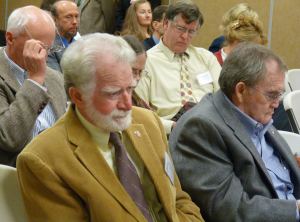
Sen. Peter Shumlin, the Democratic candidate for governor, went solo Thursday morning at the forum for the Vermont League of Cities and Towns at the Essex Fairgrounds. Republican Brian Dubie was a no show.
Kate Duffy, Dubie’s campaign communications officer, said the lieutenant governor had a conflict – he attended an InventVermont event instead. She said the League forum wasn’t one of Dubie’s 13 originally scheduled joint appearances with Shumlin. Three forums remain. See the VTGube ’10 calendar for details.
The League contacted the Shumlin campaign shortly after the primary to schedule the event, according to Alex MacLean, Shumlin’s campaign manager. She said Dubie’s campaign organizers won’t deviate from the set schedule. MacLean says Dubie has also declined debates sponsored by Fair Haven Union High School, Windham County Democrat and Republican Committees, and the National Lawyers Guild and Vermont Law School.
The Vermont League of Cities and Towns forum was part of the nonprofit group’s annual conference for municipal officials. Steve Jeffrey, executive director, declined to comment.
This is the second recent candidates’ event the lieutenant governor has skipped. Last Friday, he missed the forum at Williston Central School, which is located about three and a half miles from his campaign office. Duffy said Dubie had a meeting with the Community of Vermont Elders that day.
The League gave Shumlin 10 general questions, and there were nearly as many follow-up queries. Short clips follow: The questions are in writing and the answers are on video (some are as short as a minute; none exceed 4 minutes.)
The League’s questions pertain to issues that affect municipalities across the state: education property taxes, corrections, the state budget, health insurance costs, energy, school and municipal government consolidation, water pollution, transportation and land use.
1. Corrections
The Challenges for change legislation passed last session requires that the Department of Corrections strive to reduce the number of offenders incarcerated to 1,800 or fewer by July 1, 2014. As governor, how will you ensure that offenders living in our communities do not become a public safety concern?
2. State budget
All signs point to the next state budget being $112 million short of being in balance. What will you do as governor to assure that the current fiscal shortfalls facing the state budget do not end up being shifted into Vermonters’ property tax bills?
3. Health care
Employee health insurance costs have become the second largest line item in most of our municipal budgets in Vermont. What will you do as governor to assure that those employees and their families receive the health care they need without draining the municipal treasuries and property taxpayers’ wallets?
4. Energy.
The discussion of how and where to invest in energy to secure a sustainable future for Vermont has never been more heated. You have indicated that Vermonters need to have a voice in making those decisions. Given that the legislature recently constrained local government authority to decide the siting of renewable energy projects, how will you insure that local decisions are given weight in the siting process?
5. Vermont Governance for the 21st Century.
There is substantial debate over the consolidation of schools and school districts as a way to contain school costs. Do you believe we have too many municipal governments? If so, how do you propose to reduce that number? If not, how do you propose to make the municipal governments we have more efficient and better able to meet the needs of their constituents in the 21st century?
6. Stormwater.
Non-point sources account for approximately 90% of phosphorous discharges to lake Chmaplain and phosphorus is the lake’s pollutant of most concern. Nitrogen, a pollutant whose treatment has not been regulated in the past, is of most concern for the lower Connecticut River and Long Island Sound. Removing both of these pollutants will costs millions of dollars, and it seems the obligation will fall mainly to municipalities. What will you do to insure that funding is available to pay for their removal?
7. Transportation.
Local governments are responsible for 80% of the state’s more than 14,000 miles of road. As state environmental requirements on road construction intensify, thereby increasing the cost of maintenance, how will you help cities and towns pay for their transportation and infrastructure needs?
8. Land Use.
Historically, land use decisions have been made locally through planning and zoning. While some recent legislation enhances this authority by providing for growth centers, designated downtowns and new neighborhoods, other legislation pre-empts it, most notably with respect to telecommunication towers and renewable energy facilities. How will you balance the authority to make decisions locally with the need for facilities that will serve more than the local population?
QUESTIONS FROM THE AUDIENCE
9. Do you support local option taxes?
10. What are your views on current use?
11. Would you allow municipalities to make decisions apart from the legislative process?
12. Doesn’t the federal Affordable Care Act prohibit applications for single payer system waivers until 2017?
13. How will you keep power prices from increasing dramatically?
14. Will universal pre-K create a tax burden shift on property taxes?
