

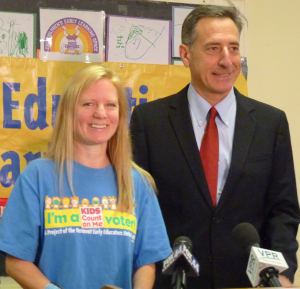
At a press conference in Waterbury Wednesday, Sen. Peter Shumlin, the Democrat running for governor, decried his opponent’s plan to cap state spending at 2 percent in order to fund $250 million in tax breaks over a three-year period. Shumlin says Vermont’s wealthiest taxpayers would be the major beneficiaries of Dubie’s proposal “Pure Vermont.”
Shumlin alleges that the lid on inflationary increases will lead to cuts in the Dr. Dynasaur program. He estimates 2,500 children could lose services by fiscal year 2015 under Republican Lt. Gov. Brian Dubie’s economic development plan, “Pure Vermont.”
“It’s extraordinary to me to give tax cuts to the wealthiest Vermonters and throw 2,500 children off Dr. Dynasaur,” Shumlin said. “That’s reckless and irresponsible.
“You can’t cap spending and give the 1,400 wealthiest Vermonters a $250 million tax break without consequences,” Shumlin said. “It’s Brian’s responsibility to explain how he would make the cuts. But there’s no magic here. You make a 2 percent cut across the board and this is the result.”
Shumlin made his remarks at the Children’s Early Learning Center in Waterbury, as preschool children chattered and played in the background.
Amy Ligay, the executive director of the day care, announced that Vermont Early Educators United—American Federation of Teachers will back Shumlin in the race for governor. The union represents 10,000 early childhood educators.
“Peter makes it clear we must make children a real priority,” Ligay said.
Shumlin then proceeded to tell members of the press crowded into the small play room that Dubie’s plan would undermine the state’s commitment to the Dr. Dynasaur program, which provides health coverage to children from households with incomes up to 300 percent of poverty — $61,950 for a family of four.
“We cannot provide good quality early childhood education if our children are not healthy,” Shumlin said. “Brian Dubie and I have sharp differences on this question. Brian Dubie’s platform, which will pose a 2 percent cap on budgets, will result in children being removed from health care access to Dr. Dynasaur (a program) that Gov. (Howard) Dean, Gov. (Madeleine) Kunin and I have fought so hard for. I beleive this is an area where Vermonters need to know how different our vision is.”
In a statement issued by his campaign, Dubie said he would not cut the Dr. Dynasaur program.
“Dr. Dynasaur is a cost-effective program to get kids the care they need early in life so that health problems don’t develop at a young age,” Dubie said in the statement. “We chose to protect Dr. Dynasaur despite multiple rounds of budget cutting, and as Governor, I will continue to protect this important program to ensure kids have the care they need.”
Shumlin alleges that Dubie’s 2 percent cap would result in hundreds of children losing access to health insurance. He said in all, 2,815 children would be dropped from the Dr. Dynasaur program over a three-year period under Dubie’s plan: 455 in fiscal year 2013, 910 in 2014 and 1,450 in 2015. Shumlin said that according to Vermont’s Department of Banking, Insurance, Securities and Health Care Administration, about 3,100 children are uninsured, and of those, 2,700 are eligible but “haven’t had the proper outreach.”
“I have a long record of balancing budgets,” Shumlin said. “We’ll get it done, but we’ve never done it on the backs of Vermont’s children.”
Shumlin used the occasion to score political points against his opponent. He alluded to Dubie’s negative ad campaign: “I do not want to be governor so badly that I will undermine a good person’s character or tell untruths about what they want to do as governor to be elected governor.”
“I have a record; Brian doesn’t. You don’t need someone right now who has a learners permit to write a budget. You need someone who has experience with a drivers license.”
When asked about his own ads that portray Dubie as Pinocchio, Shumlin said the difference is, his ads are factual.
More generally, Shumlin painted a stark contrast between his plan, which includes universal pre-K programs at a cost of $32 million, to Dubie’s, which focuses largely on reducing taxes, government spending and “red tape.” Shumlin didn’t explain how he would pay for the pre-K programs or how the state could continue to absorb an 11 percent annual increase in costs for the Dr. Dynasaur program.
“The difference between me and Brian is that I’ve written budgets, I’ve negotiated budgets, I’ve voted on budgets and I’ve delivered budgets,” Shumlin said. “I have a record; Brian doesn’t. You don’t need someone right now who has a learners permit to write a budget. You need someone who has experience with a drivers license.”
The state faces a $112 million shortfall in fiscal year 2012. Shumlin said he has been more specific than his opponent about where he would make cuts in next year’s state budget. He outlined three proposals: a 10 percent cut in performance-based contracts; “going after” independent contracts “that have been (used) over the last 8 years to hire (firms) to do the work of the state”; and the removal of upper eschelon communications officials in agencies and departments.
The latter would reduce spending by about $1 million. “I’ve made very clear I’m going to hire commissioners and secretaries who speak directly to the press who don’t need spin doctors,” Shumlin said.
Cutting performance contracts would save $25 million, he said, with the caveat: “I’m not committing to that number.”
He didn’t say how much the cuts in independent contracts would save. “I think we get better bang for our buck when we hire Vermonters to do our work not outside contractors,” Shumlin said.
“There’s real savings there,” Shumlin said. “Does it get you to 110 million? No, but we’ll get there the way we have the last two years. We will not do it by balancing the budget by thte people in this center who need health care.”
The senator said he would “look at all the options.”
“I personally think this is less difficult than the last two years when we were dealing with bigger numbers,” Shumlin said.
On Friday, Shumlin will hold a press conference to talk about how the caps would affect programs for older Vermonters.
Editor’s note: A write-through at 2:43 p.m. Oct. 7 included a clarification in the first paragraph.
