

By Max Breiteneicher
This story was originally published in The Commons issue #65 (Wednesday, Sept. 1).
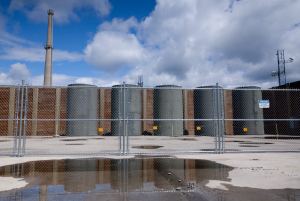
VERNON—Vermont Yankee, spreading across a half-mile bend in the Connecticut River, has been here for decades, and things have grown in around it. Corn and hayfields stand at its edges, and Vernon Elementary School is a long stone’s throw from its gates.
The plant has grown in around the region, too — entwined with the economy, with families, politics.
Even those with opposing views on the plant generally assume this premise: VY is large, important, and appears on the verge of great change, likely to start in 18 months, when its current 40-year operating license expires.
To continue operation, the plant’s management and its corporate parent, Entergy, must overturn a 26-to-4 vote by the Vermont Senate and receive a Certificate of Public Good from a skeptical Public Service Board. The Louisiana company must remain certain it’s all worth it for 20 more years of operating the smallest, second-oldest, and most-scrutinized nuclear plant in its fleet of 10.
Unless the federal Nuclear Regulatory Commission divests Vermont of significant control of the process, shutdown seems inevitable.
If, indeed, that is the case, removing the plant’s influence on the region’s economy, along with its half-mile of concrete and steel, will require great effort, care, and capital.
What then?

Nuclear alphabet soup
When a nuclear plant ceases operation, there are only three ways to deal with it. Each has its own emphatic code word in Nuclear Regulatory Commission jargon.
DECON is when the entire plant is decontaminated, dismantled, and removed, the radioactive fuel put in storage, and the land usually returned to a field. DECON was done at the Yankee Rowe and Maine Yankee plants. It usually takes under 10 years to finish.
ENTOMB is as it sounds: entomb everything in concrete until deemed safe. It’s not common practice.
SAFSTOR is a way to hold a plant until you’re ready for DECON. Almost half of the 23 plants currently in some phase of decommissioning in the United States are in SAFSTOR status.
With SAFSTOR, the fuel is removed from the reactor and stored on site, and all systems are disconnected and drained. The plant is then locked up, and monitored, in a condition that allows the radioactivity to decay. A plant can stay in SAFSTOR for 60 years before full decommissioning.
Entergy, state regulators, and participating groups agree that if the plant is not relicensed in 2012, Vermont Yankee will be put into SAFSTOR. Sometime between 2032 and 2072 the plant would start the DECON process.
The exact date is a matter of money.
DECON costs
The plant is required to keep a fund to pay for decommissioning. Vermont Yankee’s fund contains about $400 million. Estimated costs for DECON are between $600 million and $900 million.
For SAFSTOR, the cost is just over $200 million, spread over five years, from 2012 to 2017. After 2017, the plant will cost about $6 million each year to maintain.
The estimated cost to move from SAFSTOR to DECON is over $385 million. At the current rates of economic growth, the decommissioning fund could be adequate to pay for all this in 30 to 50 years.
SAFSTOR involves a few key steps, according to Uldis Vanags, the state Department of Public Service’s nuclear engineer.
“They would obviously shut down the reactor, stop producing power, and then take measures to offload the core into the spent fuel pool,” Vanags said.
“After you offload the core, you start de-energizing systems — essentially draining all the liquids out of the systems, and removing electrical contacts,” he continued.
Then, “they would spend about 2½ years de-energizing systems, and putting the plant into this phase, where it can sit safely for 30 years, however long, without anyone doing anything major to it.”
The plant is powered with uranium rods, roughly 6 inches square and 12 feet long. A bundle of approximately 90 rods is called a fuel assembly. Every 18 months used, or spent, fuel assemblies (SFAs) are replaced with new ones.
When first removed from the reactor, SFAs are loaded into a huge stainless-steel-and-concrete water pool. Once cooled, they can be stored there for years, until the pool fills up. If shut down in 2012, Vermont Yankee will have to store about 3,500 SFAs.
To maintain spent fuel in the pool under SAFSTOR, the plant would have to separate the pool from the rest of the plant, Vanags said.
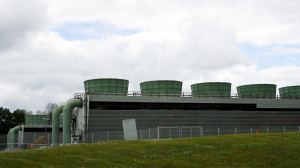
“They would essentially re-route the controls for it, reconfigure it so it stands alone, and build another control room for it, because the spent-fuel system may stay active for some time, until they’re ready to have another spent fuel storage facility built — the dry casks.”
Dry casks, the generally preferred method of storage for spent fuel, are massive concrete and steel cylinders built on concrete pads.
Once set up, they require few inputs and no power to run, though they’re not cheap to build — about $1 million each.
Vermont Yankee has built five casks, and would need about 60 to store all their SFAs in 2012.
Unlike immediate DECON, which requires great labor for about eight years, SAFSTOR will take three to five years of concerted effort. After that, the plant would require a consistent, small number of people to maintain it.
“When you close a nuclear power plant, generally, within three months your workforce is down to about half of what it was,” Vanags said. “In this case SAFSTOR should be completed in about 2½ years, and then the workforce would be greatly reduced, to maybe 25 people.”
In the company’s decommissioning budget, Entergy accounted for about 30 employees each year under SAFSTOR.
Enough money for DECON?
Tom Buchanan, chair of the energy committee for the Windham Regional Commission, has been involved in Vermont Yankee’s relicensing process before the Public Service Board for almost a year; the regional commission itself, since 2007.
Now officially a party in the Vermont Yankee hearings, the commission aims to represent the interests of the 27 towns in the Windham region.
Working as a photojournalist in 1979, Buchanan was sent to Pennsylvania to cover the Three Mile Island disaster.
“I came out of that accident not for or against, but with a real sense of the dangers here, and the importance of managing it well,” Buchanan says.
He’s speaking as an individual, he said, “not as the chair of the energy committee, not as a member of the regional commission. Only the executive director or the staff can speak on the account of the commission.”
As an individual, Buchanan has the manner of someone who’s fully immersed in the present and future of Vermont Yankee — a world of dockets, counter-briefs, and the opaque language of the courtroom.
The likely prospect of the SAFSTOR process being run by a subsidiary of Entergy is troublesome, Buchanan says.
“It’s in the region’s best interest for this plant to be decommissioned quickly, and not to roll into SAFSTOR,” he said. “We have to remember that every nickel drawn out of that fund is a nickel that’s not earning interest, making it harder to reach eventual decommissioning,” he adds.
But it’s also “in Entergy’s best interest for the plant to stay in SAFSTOR as long as possible, because as long as it’s in SAFSTOR, TLG Services is there, making money from the decommissioning fund.”
TLG Services is a subsidiary of Entergy Nuclear that manages decommissioning projects. TLG Services will be used to first to put the plant in SAFSTOR and then, eventually, DECON. TLG managed the eight-year decommissioning of Maine Yankee, completed in 2005 and considered a successful, even exemplary, project.
Entergy, he says, must complete the process in 60 years — “but the Nuclear Regulatory Commission allows them to extend that.”
“What if the fund is not sufficient to complete the process? We’re talking about something 50 years in the future — will Entergy even exist at that point, what authority will the NRC have, and what if there’s not enough money in Entergy’s fund?”

If the company is around in 50 years and the fund is sufficient, Entergy’s budget for decommissioning remains questionable, he said.
“When Entergy bought the plant, they signed a memorandum of understanding where they agreed to remove all structures,” Buchanan says.
Now, he says, the company proposes to remove “only contaminated structures, and remove the rest only to 3 feet deep. That would leave huge tunnels, manholes, concrete conduits, foundations and basements and who knows what else behind.”
Entergy had always planned on building dry-cask storage, but recently, he said, “Entergy has raised the possibility of leaving the fuel in the spent-fuel pool, densely packed in there.”
“Then while talking through it, they raised the idea of using the spent fuel pool indefinitely,” Buchanan adds. “That was new, and it just slipped in, in answer to a question. When we raised that in the technical hearings, most of the other parties were in shock.”
It is possible to store fuel in the pool for 50 years or more. The method has some advantages — because if the fuel is under water and not encased in concrete, it’s easier to inspect, easier to take out, and to move.
Yet fuel pools can spring radioactive leaks. In the past 10 years, such leaks have occurred at the Indian Point, Connecticut Yankee and Salem nuclear plants.
Storing spent fuel in the pool also costs more in the long run, because the pool must be maintained, operated and powered, whereas dry casks simply sit there.
Entergy also has another incentive to using the pool for storage: If Vermont Yankee builds dry-cask storage before shutdown, it would be an operating expense. But once the plant shuts down, the company can tap the decommissioning fund to foot the bill.
Uncertain future
Mike Olson, who got off the night shift at Vermont Yankee at six this morning, sits on his deck, overlooking the small alpaca farm he and his wife keep in North Brattleboro. He talks quickly, rubbing his palms together periodically as though getting down to work.
Olson, in Brattleboro for 40 years and at Vermont Yankee for 12, currently works as an instrument control technician. A certified electrician and millwright, he serves as vice-chair of the IBEW (International Brotherhood of Electrical Workers) at the plant.
“It just so happens we’re 21 days from our contract running out. So we’re trying to get a three-year agreement, representing approximately 160 people,” he says.
“Here you got a plant that’s only got a license for 20 more months, their fuel is only good for about 14 months,” Olson continues. “So are they going to keep going? After 14 months? Only to 20 months?”

Olson describes the current uncertainty as “an emotional and financial situation that’s hard for the company, and even harder for the union.”
Vermont Yankee has two unions on site and employs more than 600 people full-time, others part-time, and contracts labor frequently. Olson says compared to other industries he’s experienced, nuclear is a different world.
“Things are clean, things are neat, and there’s a lot of documentation. Where in the real world of industry they just run it, run it, run it — it’s just about production,” he says. “Not that nuclear power isn’t about production — we’re making energy, but it’s just a different environment.”
“There are a lot of very professional people,” he continues. “My choice to go into nuclear wasn’t only the money, it was the fact that I could work right next to people from GE, Westinghouse, who’ve been all over the world at bigger, better power plants. I could work side by side, pick their brain, and get another perspective on what I might be doing.”
Vermont Yankee’s employees are well-paid — the best in the county. Of course, the possibility of shut-down has employees rethinking their plans, Olson says.
“If you close the power plant, now what do I do? I’m forced to travel out of state, either stay here and commute, or move,” he said.
“There’s a lot of people right now thinking about that. People are looking at other jobs, there’s no doubt about it,” Olson says. “Whether to stay here or to leave, whether their real estate will be worth anything, and to sell now or hang onto it.”
And, he says, “I think this market’s got something like an eight month supply of homes that aren’t selling.”
The impact of closure
The various economic impact studies about the shutdown of Vermont Yankee all have their own set of assumptions, but they agree more or less that if all other things stay the same, during SAFSTOR from 2012 to 2032, the county and the state in turn will lose more than 1,000 jobs.
The studies also forecast a population loss of perhaps 500 people, a total wage decrease of more than $1 billion dollars, and a cumulative loss to the overall economy that could top out at $5 billion.
One study on the public record, compiled by Jacob M. Thomas on behalf on the Vermont Department of Public Service, states that if Vermont Yankee employees move away when the plant closes, “the local real estate market would likely see a depression in home values with a relatively high number of homes entering the market in a short period of time.”
The study says that surge in inventory “might be enough to suppress new-home construction for some time, having adverse impacts on the construction sector as well.”
Once the plant shuts down, an immediate dip in jobs is expected, mitigated by the effort to put the plant in SAFSTOR. But once in SAFSTOR, a sharp decline is expected, bottoming out a decade or so later.
[Readers are invited to peruse the various reports on commonsnews.org.]
It’s impossible to say for certain what will happen economically — there could be replacement businesses, even other energy companies, by 2012.
But Olson isn’t optimistic. “It’s not gonna be good,” he says.
“There’s a lot of businesses leaving Vermont right now,” he points out. Olson describes Vermont as “a harsh environment to do business.”
“Even with my alpacas, you’ve always got something to fill out, to pay,”’ he says. “The farm is nice and beautiful, but you wouldn’t want to pay my property taxes.”
The municipal view
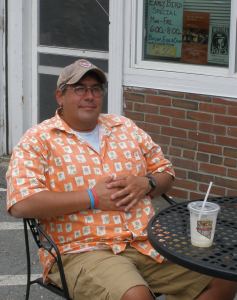
Michael Courtemanche, who chairs the Selectboard in Vernon, and works in IT for the Windham Southeast Supervisory Union, sits in the sun outside the R&B Deli in Brattleboro, sipping an iced coffee.
Vernon, which has hosted the plant since it came online in 1972, maintains a vital relationship with Vermont Yankee, he said. “It’s no lie that they do pay a huge portion of the town’s taxes, probably 50 percent of property taxes, so its closure would be pretty detrimental to the town.”
Vermont Yankee pays more than $1 million in property taxes to Vernon each year.
In its latest decommissioning budget, Entergy allotted nothing — $0 — for property taxes. Vermont Yankee is also taxed by the state according to the amount of energy the plant produces — a tax per kilowatt, amounting to about $3 million a year.
“The minute they stop operating, and producing energy, the value of the plant goes down,” Courtemanche said. “The talk has been on the table of putting the plant into SAFSTOR, so a lot of it would still be there, but it’s not operating, so it’s not worth as much.”
In the absence of property taxes, there’s been talk about trying to tax the spent fuel.
“That stuff is valuable,” Courtemanche said. “In France, they reuse the waste, many times over. And that could certainly be something to look at in the future — if any new plants are built in the U.S. that could utilize that waste.”
Plants in the United States cannot reuse spent nuclear fuel, a process that greatly reduces waste, but also makes the remaining material increasingly viable for use in nuclear weapons.
In 1977, President Jimmy Carter halted reuse programs for fears about the enriched material falling into the wrong hands, and the policy has remained.
It’s common practice to reuse fuel in Europe. President Barack Obama recently commissioned a blue-ribbon panel to look at U.S. nuclear policies and make suggestions, with an eye to the possibility of adopting reuse of fuel. Action on those suggestions is expected to take 10 years or more.
President Obama has also cut funding for the Yucca Mountain storage site, where the federal government planned to store all the spent fuel it has promised to remove from plants across the country. The project had been more than a decade behind schedule.
Vernon will find it difficult to lose Vermont Yankee for other reasons, too, Courtemanche says. “It’s not just about the money, it’s about the people.”
“I truly believe everyone in town either has a relative or a friend that works at VY,” he says. “Their spouses work in our schools — if they had to go find jobs elsewhere, we’d lose teachers, and how many of our schoolchildren are in families that work at VY that would need to relocate?”
Vernon’s volunteer fire department has “a bunch of VY people, our first responders and our EMS people,” Courtemanche adds. “There’s that loss that people don’t even talk about.”
The view from Old Ferry Road
About 10 miles north of the plant, Vermont Yankee’s Brattleboro offices are tucked away in an unremarkable building down Old Ferry Road, not far from a lumber mill and a landfill.
Inside, Larry Smith sits in his second-floor office fielding a call about tritium levels in the river. “Those are normal levels….,” he says. He suggests that the caller contact the state.
Smith is director of communications for Vermont Yankee — he’s been there 13 years. Before that, he worked as news director for WTSA radio.
Smith has a square jaw and a certain ferocity, though he looks weary. His cell phone keeps dinging with text messages every few minutes.
Things are uncertain with the plant, he said.
“Our plans are to get a federal license, and to be successful with the Vermont Legislature. We are getting close, and employees are getting concerned,” he says.

“I hear it every day, ‘Larry, are we gonna run? Are the feds gonna shut us down? Is the state gonna shut us down? Should we look for a job, should we stay?’” Smith says. “It’s a distraction. I worry about it.”
“If this plant were to prematurely shut down, let’s say in 2012, there would not be sufficient money in the decontamination fund, which is now somewhere around $400 million,” he continues. “We would need about $800 million.”
There are two companies in charge of Vermont Yankee, both owned, in turn, by Entergy Corporation.
Entergy Nuclear Vermont Yankee, or ENVY, owns the plant and the decommissioning fund. Entergy Nuclear Operations, or ENO, runs the plant’s operations and power generation.
When the license expires, ENO will have nothing to do in Vermont. ENVY then must apply to the Nuclear Regulatory Commission to access and spend the plant’s decommissioning fund.
Most of the money paid out will go to TLG Services, the Entergy subsidiary, or to another contractor, Smith says.
“Another myth is these jobs aren’t going to go away, these people will all have jobs taking the plant apart — that’s not what will happen,” Smith says. “That’s not what happened at Maine Yankee, at Yankee Rowe.”
According to Smith, “There won’t be any operations people, or maintenance people. A decommissioning company is hired — a construction company — to come in and deal with decommissioning or SAFSTOR.”
Nonprofits brace for a hit
In addition to the loss in jobs and revenue, Smith, who oversees Vermont Yankee’s charitable giving as chair of a donations committee, gives some compelling numbers that reach toward the intangible.
“In 2009, we donated to roughly 100 nonprofit organizations in the tri-state area,” Smith says. “We donated $398,000, and that comes from the Entergy Corporation with no strings.”
“We’ll get a total of 400 applications for funding, and on average we fund about 100 nonprofit organizations,” he adds. “But we never go to them, they come to us.”
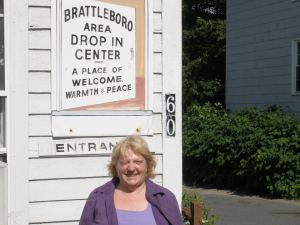
Smith serves as board president of the Brattleboro Area Drop-In Center, a day-shelter, food shelf, and service hub for people and families in need.
The center is relatively quiet this afternoon. A few people linger in the hall and, as usual, Melinda Bussino is in the small back office, overflowing with ledgers, books, and board games. The clock on the wall has stopped.
Bussino, who runs the center with four full-time staff members, says they’ve been seeing about 100 households a day at its food shelf, which last year received visits from 9,400 different people who came to the food shelf at least once.
The food shelf is run by one full-time employee, and the roughly $30,000 per year for the position is funded by Entergy.
“We get funding both from Entergy Foundation, and from their local donor fund here in Brattleboro,” Bussino says. “For the last 10 or 11 years, they have funded us every single year, and increased their funding most years.”
The loss of the yearly donation would hurt, she said.
“We try very hard not to have any one funding source be so big that if it went away suddenly we’d have to close our doors, but it would make a huge difference, particularly with the food shelf,” Bussino says. “We would have to figure out a way to fund a full-time staff position, in addition to some other things.”
Bussino says the need for food in the community is up 31 percent this year, and all the local food shelves combined are providing more than 12,000 area residents with emergency and supplemental food.
“If any food shelf had to cut back their services, cut back their hours, or shut down, in this economy, it would really make a huge impact in terms of hunger,” she says.
“And hunger isn’t just folks that go to bed without dinner,” Bussino points out. “It’s kids who go to school hungry and can’t learn, it’s people who go to work hungry and can’t work, and it’s people with other kinds of health problems from poor nutrition. It really does have a ripple effect.”
Bussino knows firsthand about the less tangible benefits of Vermont Yankee. It’s not just the money, she says.
“It’s the number of volunteers that they provide every year, whether it’s a group of ladies that go shopping for toys to donate at Christmas, or the group that came in with all their different skills as plumbers and builders, and built and outfitted our garage to be an addition to the food shelf, to folks that go on a shopping trip during Project Feed The Thousands and bring us back a huge truckload of food,” she adds.
“The loss of any big corporation that has that kind of charity base in the community would be huge,” Bussino says.
Across town, Jerry Goldberg sits in his office at the Brattleboro Area Chamber of Commerce, getting ready for a day of meetings.
Goldberg, the organization’s executive director, worked in marketing and communications at CBS before he came to Brattleboro, and the walls of his office are adorned with old network posters. He’s spearheading the One and Only Brattleboro campaign right now, and he’s excited about it.
Still, he says, the closing of Vermont Yankee is a big question for the business community.
“It’s sort of like we’re going in for a test and we haven’t studied,” he says.
“The reality is that we’re faced now with a very devastating prospect if they leave this community,” Goldberg says. “Economically, it’s going to have a great impact. Because of the size of their workforce they are an intrinsic part of the health of this community. A lot of people live here, they own homes, they spend money, they raise their children. They do all the things that stimulate our local economy.”
Almost 20 percent of the businesses represented by the chamber are nonprofits.
This percentage of charities is unusual, Goldberg says, but appropriate in an area with so much need. Nonprofits serve a lot of that need, and most of them have been funded at some time by Vermont Yankee, he says.
“It would be a devastating blow to a lot of them to not have that source of revenue,” Goldberg predicts.
Other effects of VY decommissioning will come to light in time.
For instance, for the 4th of July celebration, Goldberg says, “Entergy gives us our fireworks show, every year, and everybody loves the fireworks. Just a simple thing like that — nobody knows they do that.”
As the reality of the plant’s closing confronts the community, he says, “We have to accept responsibility for allowing ourselves to be in this situation.”
“We’ve been putting off thinking about it, and now it’s the piper that has to be paid,” Goldberg says.
A ‘stunning’ brief
All these considerations are compounded by the fact that the ongoing litigation before the Public Service Board concerning Vermont Yankee’s relicensing recently took a strange turn, Buchanan says.
“About two months ago Vermont Yankee filed something I can only describe as a stunning brief, claiming preemption in all matters,” he adds.
“Their position is the Public Service Board has no authority whatsoever,” Buchanan says. “That it’s all controlled by the Nuclear Regulatory Commission, and once the plant is approved for construction, the state has no further authority through the entire period of NRC licensing.”
“It’s a very provocative claim that challenges the Public Service Board to shut them down,” he continues. “When they made that claim it seemed like drawing a line in the sand here in Vermont. Not because they want to save Vermont Yankee, but because they want to save this claim of preemption, and broaden it nationally. It really sounded like they were throwing Vermont Yankee under the bus. They’re arguing the case now to win benefit for the rest of the industry.”
Indeed, the chief executive of Entergy, Wayne Leonard, told the Rutland Herald that it might help Entergy’s bottom line if Vermont Yankee were shut down, claiming the plant was “simply not covering its cost of capital.”
The relicensing process has thus led to the bizarre situation of a company forcefully arguing to keep a plant it doesn’t mind losing, and a region that relies on the plant’s operation planning to shut it down, only to host its valueless structures and radioactive fuel for decades to come.
“The state’s failed, Entergy has failed, everybody has failed,” Buchanan says. “The antinuclear folks will probably win, the plant will shut down, and then they’ll have to deal with what they wanted — a rotting carcass of a plant that just sits there, indefinitely.”
This bleak view will not necessarily come to pass.
While the economic and social impacts of the plant’s closing are indisputable, the state has a chance in the next legislative session to establish regulatory authority and have a real say in what happens to the plant, and the fuel, after shutdown.
A hub for this authority could be the Vermont State Nuclear Advisory Panel, Buchanan says. The panel is required to advise the government on nuclear power in general, and Vermont Yankee in particular.
It’s made up of five appointees of the governor, and one member each from the House and Senate. They’ve recently been reconstituted and are scheduled to meet three times this year, Buchanan notes.
“If they can pull that together, and really represent the interests of the state and the public, then there’s a possibility this whole thing works,” he says.
