

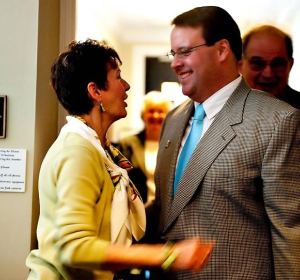
Editor’s note: This story is by Kirk Kardashian, a freelance writer who lives in the Upper Valley.
Subtlety isn’t Steve Howard’s strong suit. The second sentence on his campaign website declares that “he worked waiting tables while attending school.”
For most people, that sort of credential would be stuffed at the end of a resume, if it made the document at all. But for Howard, a 38-year old Democrat from Rutland, those seven words mean a lot.
“I want Vermonters to know that I understand middle-class values,” he explains, “that I know what it is to struggle and not have enough money to do all the things you need to do for your family.”
That struggle didn’t embitter Howard; on the contrary, it has informed his career as a state legislator and grassroots community organizer. Now he wants to take his experience a step further, to the lieutenant governor’s office.
Howard is the son of an insurance agent (father) and an administrative assistant (mother). His parents were also part owners of the now-defunct Mill Village Country Store in Rutland. Growing up, Howard worked at the store after school, and the experience he says taught him the importance of community — the lifeblood of a country store — and “how hard small business people work and how hard, sometimes, it is to make a living.”
Politics played a role in Howard’s life from an early age. His father was a staunch Reagan Republican, which meant that, for a while, Howard was, too. But that changed in 1984, when a teacher encouraged him to go see Madeleine Kunin deliver a stump speech during her gubernatorial campaign.
“I just thought she was the best thing since sliced bread,” he recalls, and he resolved to do what he could to help her win. His father wasn’t thrilled at the idea of his son campaigning for a Democrat. “As long as you live under this roof,” he told his son, “no way.”
Howard got around the prohibition by colluding with his grandmother; she gathered the Kunin campaign pamphlets at her house, and it was from there that he’d go door to door, asking for voter signatures. More than any political issue or personal quality of Kunin’s, he thought it would be good for Vermont to be led by a woman, someone whom he felt was both strong and compassionate. “I found it very intriguing and exciting,” he says.
Bitten by the bug of retail politics, Howard volunteered for other campaigns while attending Mount Saint Joseph Academy in Rutland, and then at Boston College, where he worked to raise money for women seeking various political offices. As his senior internship project in college, he came up with a unique idea: an attempt at the state legislative seat for his district.
Though Rutland is known as a more conservative district, and Howard was running as a progressive Democrat, the Republican incumbent wasn’t seeking re-election. Howard canvassed the district, knocking on doors and talking to voters, and won in the fall of 1992. When he started the 1993 session, it was the spring of his senior year.
On the first day of his legislative career, feeling like an unknown freshman at a big high school, Howard sat down for lunch in the capitol by himself. Before he could take a bite of his food, Ralph Wright, the speaker of the house, called him over to his table. “He took a liking to me right away,” Howard says, “and was shocked that I won in Rutland Town. From that point on, he was a very influential person who taught me a lot about the political process.”
Howard’s first stint in the statehouse lasted six years. During that time, he served on the House Ways & Means Committee and the Commerce & Institutions Committee. The most significant issue in those years was the Vermont Supreme Court’s decision in Brigham v. State of Vermont and the resulting passage of Act 60, the Equal Educational Opportunity Act.
Howard grappled with the proper legislative response to Brigham while he was on the Ways and Means Committee. Reflecting on the outcome today, Howard says he wishes the bill the House sent to the Senate had become the law — it calculated the property tax based on the property owner’s income, not the value of the real estate. Rutland was long overdue for a reappraisal, and Howard was worried that his constituents would see drastic increases in their tax bills after the impending reassessment. Act 60 was a compromise, and he supported it because it benefitted two-thirds of the people in his district.

While he was learning the ropes as a lawmaker, Howard was picking up gigs on the organizing side of politics. In 1995, he became the chairman of the Vermont Democratic Party. Later, Ralph Wright asked him to recruit for the House. He put those skills to work after the 1999 session, when he left the statehouse to run his own business as a grassroots organizer and political consultant. In Vermont, He was hired by NARAL Pro Choice, to campaign in support of women’s rights, and Housing Vermont, to protect tenants’ rights in a housing development in Brattleboro.
Nationally, Howard worked for the Coalition Against Bigger Trucks, at a time when rising shipping costs caused WalMart and other major businesses to seek permission to drive triple-trailer trucks over the roads. On that campaign, he lobbied lawmakers and canvassed first responders and local community leaders to influence the pending federal highway bill. “It was old-fashioned, grassroots shoe-leather campaigns,” he says. It also fit with his passion for rail, since the triple-trailer plan would have undercut demand for freight lines. Against the odds, the campaign worked, and the super-long trailers never made it on the highways.
Howard returned to the Legislature in 2004, this time as the representative for the Rutland City district. He’s also still running his political consulting business, assisting clients in Vermont and Massachusetts. That means, when the Legislature is in session, he’ll break from a House Transportation or Ways and Means Committee meeting and phone a client running for the Massachusetts statehouse, or instruct grassroots organizers in that state on how to execute an effective door-to-door campaign for Deval Patrick. This led Richard Westman, the former Republican chair of the transportation committee, to describe Howard as “very political.”
Howard doesn’t deny that. In fact, he thinks that the lieutenant governor’s office could use a good shot of politics. “I want to transform it from this sort of sleepy, ceremonial office into a sector of grassroots organizing and action,” he says. “I want to be a leader who spells out a vision for the state and goes about building the movement that we need to make that vision happen.” That’s quite an addition to the constitutional duties of the office, which are limited to a total of two jobs: to be the president of the Senate, and serve as the acting governor when the governor is unavailable. The annual statutory salary is $63, 701.
A grassroots organizer needs something to organize around, and Howard isn’t lacking for projects. He’s picked issues, he says, that have some of the most entrenched special interests.
Howard’s first priority is to implement a Medicare-for-all self insurance program. “We’re going to have to build a movement of middle class Vermonters in small businesses who want this change,” he says. Another priority is clean, safe energy. “I want to take on Entergy Louisiana and end our dependence on nuclear energy and fossil fuels, and dramatically increase our support of energy conservation and renewable energy produced here in Vermont,” he says. He rounds out the top three with the seemingly intractable poverty gap in education.
What those issues have in common, Howard asserts, is that tackling them will not only improve the health of Vermonters, the environment and childhood development, but will also help accomplish the overall mission of improving the state’s economy. Eliminate the health care burden from employers, and they will hire more employees. Support energy efficiency and renewables, and green jobs will spring forth. Give all kids an equal, effective education, and you not only set the stage for a good workforce, but you also avoid some of the expenses of corrections and social welfare programs down the line. “To make these reforms,” he asserts, “we’re going to have to take on some very powerful interests, and it means we need somebody with organizing experience to make things happen.”
What might these campaigns from the Howard’s office look like? He says Sen. Bernie Sanders’ communication strategy is one model. He intends to have one town meeting in every county every year, and he plans to go door to door in towns around the state to engage people and get his message out.
Since the lieutenant governor is politically independent from the governor, Howard will have the discretion to support issues that might run counter to the administration’s policies. He says he’s open to working with the governor, but that he has a few beliefs he won’t compromise on if Brian Dubie wins the election. “I am 100-percent pro-choice,” he says. “I will never be not pro-choice. I trust women and am not going to change my position on that.” Another no-go: any reversal of civil rights for gays and lesbians.
Howard seems to be well-liked in the statehouse, even by some political opponents. Westman, the Republican from Cambridge who’s now running for Lamoille County’s Senate seat, served with Howard on the Transportation Committee. “I personally like Steve,” he says. “I think he’s a good legislator. He’s a lot more liberal than I am, but I think we worked OK together.” The most salient disagreement they had was in the annual transfer of money from the Transportation Fund, which is used for infrastructure projects, to the General Fund, which tends to focus on human services spending. Westman fought to reduce that transfer, while he says Howard was more willing to let it go.
In the term that just ended, Howard sat on the Ways and Means Committee with Janet Ancel, a Democrat from Calais. She’s endorsing him for lieutenant governor, and she’s impressed by his ability “to always bring us back to talking about working people, about lower and middle class Vermonters,” she says. Alison Clarkson, a Democrat from Woodstock, echoes that sentiment. “He always asks the questions I wished I had asked,” she says. By that she means he often inquires about how a piece of legislation will impact a particular population, such as the elderly or single parents. Michael Obuchowski, a Democrat from Bellows Falls, speaks highly of Howard’s ability to decode statements from other politicians, to understand the background and motivation behind political speech. “He just has this intimate knowledge of what’s going on,” he says, “which will make him effective in the lieutenant governor job.”
Talking to Howard about politics, one gets the sense he considers it a sport with serious consequences. He trains for it everyday, and one of his favorite pastimes is to walk through neighborhoods and meet people, to get a feel for the community. “I find that kind of fun,” he says. Time will tell if he can turn that hobby into a full-time job.
Editor’s note: Kirk Kardashian is a freelance journalist based in Woodstock, Vt. Photographer Karen Pike generously gave vtdigger.org permission to use images. Her website is: http://kpikephoto.com/
