


The week-old dairy calf, gangly and still, lay on a barn floor in the mid-summer heat, her long-lashed eyes rolled back exposing the blue-white rims. The next day, when I went to help a neighbor with the newborns at his several-hundred head dairy farm, the calf was dead.
U.S. Department of Agriculture regulations defining organic standards mandate that if this calf had gotten one dose of antibiotics, even to save her life, she could never give organic milk—even after the two years it takes for her to become a milker, and even though neither she nor her milk retained any trace of antibiotics.
Farmers are not generally callous or cruel, but neither are they sentimental. Organic standards mandate that they take all measures to save the life of an animal, but treatment strategies can be subjective, and loss of organic status factors into a farmer’s decision. After all, antibiotics don’t always work, and sometimes animals recover without them. So decent farmers may wait while an animal suffers and crosses that line past which no intervention can reverse the slide to death.
“Yes, I have seen examples of when producers had a little too much optimism,” says Brian Baker, director of the Institute for Sustainability at Alfred State College, which is part of the State University of New York.
Baker, like many farmers and organic proponents, now recognize the USDA’s 100 percent ban on antibiotics needs to be re-examined, especially in light of a growing concerns about animal welfare.
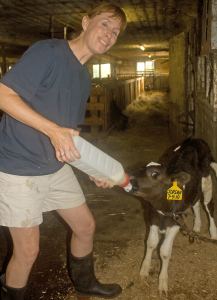
A few weeks later, another calf started to fail. Too weak to suck, the calf named Jordan let milk from the bottle leak into my hand as I cupped her head. The farmer weighed his options, and muttering in frustration and anger, reached for the antibiotics and the phone. He injected the calf, and called the Northeast Organic Farming Association, Vermont’s organic standards monitor, to report that the animal was no longer organic. The next morning the calf was on its feet, but ruined as an organic milker. With that one shot, an ethical farmer lost an investment in quality organic stock.
On industrial farms and feedlots, especially in meat and egg production, daily low-dose antibiotics make animals grow larger, quicker, and they hold off disease and infection so livestock can survive crowded, sometimes filthy conditions at industrial farms and feedlots. As the 15 million to 17 million pounds of sub-therapeutic antibiotics that America’s livestock consume annually increasingly breed resistance in many virulent pathogens, more and more of the antibiotics humans rely on are failing. The U.S. government estimates the annual health care costs of antibiotic resistance at $50 billion: 1.7 million hospital infections cause more than 90,000 patient deaths each year, up from 13,300 in 1992.
In the 1990s, an embattled organics movement defeated the attempt of agribusiness to allow all drugs, and even toxic pesticides and genetic engineering, to fall under the proposed USDA organic label. Some people involved in that regulatory process speculate that when agribusiness saw that its strategy to undermine standards would fail, it began advocating such strict regulations that few farmers would adopt them and those that did would become uncompetitive.
While some European and Canadian organic regulations are tighter, farmers there can administer therapeutic antibiotics as long as the animal is treated rarely, and is withdrawn from meat or milk production for twice the time the drug remains in its system.
In the United States, many organic farmers are beginning to question the 100 percent ban on antibiotic use for livestock; others remain pure. Allowing one-time therapeutic antibiotics is “a slippery slope,” says Ronnie Cummins, national director of the Organic Consumers Association, and would “undermine consumer confidence in organics. It’s the same position [I have] as on human vaccines. They are dangerous, and that’s why I didn’t vaccinate my kids.”
But when I took an unscientific survey at the Montpelier Vermont farmers market, every consumer I asked assumed that organic livestock are, and should be, getting antibiotics for life threatening diseases, and that a “no-antibiotics” label meant no sub-therapeutic use. Organic farmers I talked to want the regulation changed, and several local producers said they would not go organic, precisely because they wanted the option of treating a sick animal without risking financial hardship or animal suffering.
It’s time for U.S conventional/industrial agriculture, like its European counterparts, to outlaw the sub-therapeutic dosing that contributes to antibiotic resistance and facilitates livestock mistreatment.
But it’s also high time for the organic movement to incorporate science and compassion into organic standards and allow the rare, regulated use of life-saving antibiotics.
This column is a slightly longer version of Terry Allen’s monthly column in the September 2010 issue of “In These Times.” Contact: tallen@igc.org / www.terryjallen.com
