


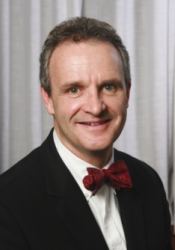
Crisply pressed and dapper in the wilting July heat, Chris Bray is gearing up for his television debut. He seems ready with his camera-friendly blue shirt and his position papers tucked neatly into a folder for easy access. Still, television is a new experience for him. “I’ve got this radio thing down,” he mutters mostly to himself. “But television… I don’t know about television.”
As the cameras at CCTV, Burlington’s public-access station, prepare to roll, Steve Howard, Bray’s opponent in the Democratic primary for lieutenant governor, blows into the studio with barely a minute to spare. Howard, a six-term state representative from Rutland, grabs the attention of the audience with forceful gestures and well-honed populist sound bites about “fighting for the middle class” as Vermont’s “wealthy get wealthier.”
In terms of style, if not policy, Bray and Howard are night and day.
A two-term state representative from the New Haven-Bridport-Weybridge district, Bray is soft-spoken and thoughtful. He uses the vocabulary of a consensus builder, not a warrior. His strength, he says, is in bringing people together, not pitting them against each other.
None of this appears to have dampened Bray’s enthusiasm. “Between now and August 24th, I’m going to show up at every place that will let me in,” says Bray who appears undaunted by the obstacles he faces over the next month.
An eclectic career
If you can think of a job, Chris Bray has probably done it at one time or another. Born in New Britain, Conn., in 1955, he credits his doctor-father with his ethic of public service, but it has been a long, circuitous route to get there. He came to Vermont in 1973 to attend UVM, graduating with a degree in zoology in 1977, back when he was still thinking of become a doctor himself.
To pay the bills after UVM, he “logged, sugared and did some carpentry.” In 1985, he took a grown-up job with National Life. Having gotten his feet wet in technical writing, he went on to become a product development specialist at Intel, IBM and Apple. What he soon learned was that “if the best software can’t be communicated, it’s useless to the user.”
In 1991, he got his master’s degree from UVM and went on to teach in the English department there for four years. (He now serves on the institution’s board of trustees.) After a summer at Middlebury’s Bread Loaf Writers’ program, Bray started Common Ground Communications, which provides writing, editing, design and production services to a variety of clients and publishing houses. In 2006, he graduated from the Snelling Center for Government’s Vermont Leadership Institute.
He and his partner, Kate Selby, live on a horse farm, The Equestry, in New Haven with one of their four children, the rest of whom are grown.
A determination to win job No. 2
With less than a month to go until the August 24th primary, Bray is facing a long, uphill slog. Under the best of circumstances, primaries rarely attract large numbers of voters, although the hotly contested gubernatorial primary may change that this summer. Add to it the fact that most voters consider the lite gov to be a throwaway job and that Bray has little name recognition outside of Addison County and the slog becomes a mountain climb.
Money, of course, is one of them. Predictably, Howard has raised more money than Bray – $50,000 to Bray’s $27,000 (including $10,000 of his own money), according to the July filing, with Bray claiming another $15,000 in non-money donations. At the same time, Bray insists that he wants the campaign to be about “ideas, not bank accounts.”
Bray’s big idea – the one that informs all the others – is that lieutenant governor is a real job and that the person who holds it can have an impact on the lives of Vermonters. First of all, he notes, the lieutenant governor presides over the Vermont Senate, which can mean breaking a tie in close votes, and sits on the committee on committees. Despite its numbingly bureaucratic name, that committee is responsible for making committee assignments, arguably an important function. “If we create good, balanced committees,” says Bray, “that can definitely affect the outcome of a piece of legislation.”
Investments in Vermont agriculture and economy
More importantly, though, is what Bray plans to do with the time that isn’t set aside for specific duties. While Brian Dubie, the current lieutenant governor, has treated the job as a less-than-full-time gig, Bray vows that he will consider it a 40-hour-a-week undertaking, allowing him to focus on specific programs that might otherwise slip through the cracks, programs such as local economic development that would not just rearrange the deck chairs on the Titanic but in fact keep the Titanic afloat.
As he sees it, the Titanic is the agricultural economy, which is in serious danger of sinking unless new thinking is brought to bear. Some of his new thinking involves old thinking, which is to say using agriculture to provide food. At present, Vermont imports 97 percent of its food, which leaves only three percent homegrown. What would happen, Bray wonders, if that figure were bumped from three to thirteen percent? Then he answers his own question: “If we could produce 10 percent more food in the state, it would mean 2,500 new jobs and another $500 million in income.”
Thus far, his proudest legislative accomplishment is the Farm-to-Plate Investment Program, which was created by the Legislature in 2009. The initiative, put forward by a group of sustainable agriculture projects, begins with strategic planning for the ag economy over the next decade. In Bray’s view, strategic planning is a commodity in woefully short supply in Montpelier.
“We want to do a detailed survey of supply and demand,” says Bray, “asking farmers not only what they’re producing be also what they like to eat.” With that information at hand, he would consider what useful role the state might play to support that effort, be it a mobile slaughterhouse or infrastructure repair.
The less conventional piece of his plan calls for growing crops that can be used as fuel sources, particularly crops that can be turned into biodiesel fuel. That, too, he sees as a job-creation strategy, far more so that, for instance, relicensing the nuclear plant in Vernon whether or not it is owned by Entergy. “If we put the energy that went into building Vermont Yankee into renewables, we could get it done,” he declares.
He also has thrown his support behind the idea of a Freedom and Unity bond that would allow Vermonters to invest in each other, using the money to make microloans to small entrepreneurs with big ideas. “If we don’t help ourselves,” he wonders, “who else is going to do it?”
And if his ideas don’t necessarily make for good sound bites, they have won him endorsements from such diverse public figures as environmentalist Bill McKibben and former Gov. Philip Hoff, who told the crowd at a Brandon house party that Bray’s “essential decency comes through. He’s running as an idea man, not a popularity contest. I think if we can get him through this primary, he could win, but to do that, we all have to step up.”
CORRECTION: The Farm-to-Plate Investment Program began in 2009 and Bray says it may generate as much as $500 million in the Vermont economy.
