

In 2002, a poll conducted on the eve of the gubernatorial election in Vermont showed that Doug Racine, a Democrat, held a 10-point lead over Jim Douglas, the Republican candidate running for Gov. Howard Dean’s open seat.
In the end, Douglas won the election by 3 percentage points against Racine and beat Independent candidate Con Hogan handily.
David Coriell, a spokesman for the governor, is still piqued by the memory of that Mason-Dixon Polling and Research, Inc., poll, which was commissioned by The Burlington Free Press that year and released just two days before Election Day. The D.C.-based firm missed the call by 13 points.
“We’ve always looked at those polls a little askew,” Coriell said. “Not that they were necessarily wrong, but they may have undershot the governor’s popularity, especially coming down to the wire in an election. … Doug Racine was up by 10 points, and the governor was pretty sure that wasn’t the case, and he worked hard to the end and pulled it out that year.”
Now, eight years later, in another election season with no incumbent running for the governor’s office, there may be more reason than ever to look askance at polling firms that conduct surveys in Vermont.
So far, only two firms have conducted polls in Vermont this year – Research 2000 and Rasmussen Reports–but already there are questions being raised about the accuracy and methodologies of both polling firms.
WCAX, the Burlington-based TV station, hired Research 2000 to poll Vermonters in February. That survey pitted Republican candidate Brian Dubie against each of the five Democratic candidates for governor. (In each case, Dubie won; Deb Markowitz, secretary of state, was the closest Democratic finisher.) Rasmussen has conducted two polls that show similar results.
Meanwhile, Mike Townsend, executive editor of The Burlington Free Press, said the newspaper hasn’t decided whether it will hire Mason-Dixon this year or choose another firm for election polling.
Rasmussen and R2K have been drawing national and local fire for the quality of their polling. Rasmussen has been openly and frequently criticized by Democrats for polling with a Republican slant. Garrison Nelson, a University of Vermont political science professor, points as evidence to the fact that well-respected data aggregator pollingreport.com doesn’t carry Rasmussen’s polls. (The Web site doesn’t carry Mason-Dixon, either.)
Also, none of the three pollsters used in Vermont are members of the National Council on Public Polls, a 40-year-old association that sets standards for pollsters. NCPP has been pushing firms to make their methodologies transparent (out of 58 pollsters listed on fivethirtyeight.com, a site that analyzes polls, only 18 belong to NCPP).
The association renewed that call last week after a dustup involving polling analyst Nate Silver, founder of fivethirtyeight.com; Research 2000 (R2K) based in Maryland; and Daily Kos, a liberal political blog that had relied heavily on polling by Research 2000 (R2K). Silver called into question some of the data generated by R2K for Daily Kos; the blog, in turn, asked a group of independent analysts to review the pollster’s findings. The analysts determined that the results contained “extreme anomalies.” In the aftermath of this revelation, Kos dropped its contract with R2K, and both sides have now lawyered up. One of the R2K attorneys sent a cease-and-desist order to Silver, demanding that he stop publishing comments about the polling firm. For the latest on the dispute, check out “Kos legal filing …” and “First look at Daily Kos’ lawsuit.”
Anson Tebbetts, news director for WCAX, said last week he wasn’t sure whether Channel 3 and its two other polling sponsors – Radio Vermont and Vermont Business Magazine — will hire R2K again, though he expects the news organizations will discuss next steps very soon. WCAX has used the Maryland-based pollster for many years.
“We’ve had good results, and … we haven’t had any issues with them,” Tebbetts said in an interview.
Was the station worried about the February poll? “No candidates called me to complain,” he said. “And I didn’t hear anything at the time that people were concerned about it. Most people we talked to said that seems about right. There was nothing really shocking.”
Nelson, a veteran observer of Vermont politics, had one word of advice for WCAX: “Run,” followed by, “run as fast as you can.”
“I think they (R2K) were cooking data,” Nelson said.
The firm repeatedly showed margin-of-error rates of around 3 percent for its polls on President Barack Obama’s approval rating in 2009, according to the Daily Kos report. A standard error rate would be around 6 percent, given the polling sample size, Nelson said.
The analysts wrote on Daily Kos: “We do not know exactly how the weekly R2K results were created, but we are confident they could not accurately describe random polls.”
Is there any indication that their polling in Vermont has been erroneous? “It wouldn’t surprise me,” Nelson said. “The basic problem is that anybody can play. Anybody with a telephone and computer thinks he can be a pollster … there are 70 different polling operations out there.”
While the R2K polls favored left-leaning proclivities, Rasmussen is criticized for a right-of-center slant.
The Rasmussen difference
Scott Rasmussen, who started his career in broadcasting (ESPN), and started his polling company 10 years ago with no formal training in statistical analysis, according to FrumForum, staunchly defended his enterprise as nonpartisan in an interview with Vtdigger.org. Being accused of bias is “part of the territory,” he said.
“In 2006, Republicans complained about our polling and said because we showed two good results for the Democrats,” Rasmussen said. “There’s a couple of things: No. 1, we poll more frequently than everybody else, so when there is a trend emerging, we pick it up sooner than anybody else. If you poll once a month on a race, you’re going to see a trend more quickly than if you poll once every four months. And in a year that’s trending against the Democrats, we do put out more polls that aggregate more people who don’t like these polls. It’s part of the nature of the beast.”
The pollster argues that his enterprise, which is dependent on advertising, became successful by “providing quality and reliable information on a timely basis.”
“If you don’t do that, if you aren’t showing a good picture of what the reality is, you’re not going to have that audience,” Rasmussen said.
Both Nelson, and Eric Davis, professor emeritus of political science at Middlebury College, are adamant that Rasmussen’s polls are biased toward Republicans. Davis points to the pollster’s book, “In Search of Self-Governance,” and his appearances on news and talk show programs (he is a frequent guest on Fox News, a conservative TV program) as proof that the pollster is a conservative.
Nelson said Rasmussen’s bias carries over in his polls.
“The problem with Rasmussen is … they always show Republican candidates doing better than other polls do,” Nelson said. “That’s why when Dubie beats all the Democrats, it’s no surprise. That’s why I wouldn’t rely on that. So I think Deb (Markowitz) relying on that poll showing that she’s more electable than anybody else is … (let me) put it this way … I wouldn’t go too far on that dock because she might fall in.”
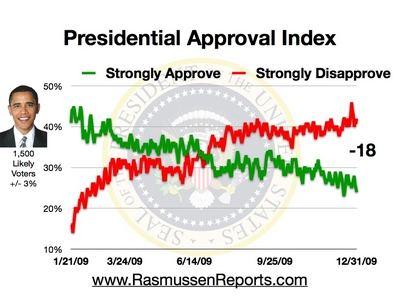
The approval ratings for Obama are a case in point, Nelson said. Instead of using a range of favorability and unfavorability responses like other pollsters do, Rasmussen takes the strongly disapprove ratings and subtracts them from the strongly approve ratings for his “daily tracking index.” This technique artificially lowers Obama’s approval ratings, Nelson said. In August last year, for example, when Obama was at the height of his popularity, Rasmussen cited a 47 percent approval rating, whereas Gallup pegged the president’s favorability level at 53 percent.
In a story posted on Politico.com in January, one academic called Rasmussen’s polls a “lightning rod.” Another expert said Rasmussen “underpolled” Obama throughout 2009. That anomalous consistency, Eric Boehlert, a senior fellow with Media Matters, told Politico.com, makes the data look as though it comes out of the “Republican National Committee.”
Rasmussen counters that his more frequent, automated polls more accurately track voting trends. He cites the example of Martha Coakley’s upset loss in the Massachusetts Senate race last January. Rasmussen was the first to show a poll with Brown in the lead, and “we got all kinds of grief over it.”
“We showed Scott Brown in the 40s, whereas other people were showing him much lower,” Rasmussen said. “The … poll picked up the trend a little bit sooner … I don’t know why it happened, I just know it did.”
Rasmussen said all major national TV news broadcasts carry his polls – with the exception of the more liberal MSNBC.com. Last year, 538.com rated him the third most accurate pollster; he now ranks 15th according to the site.
Unlike most pollsters, who employ operators to conduct surveys, Rasmussen uses automated polling — a computer-generated voice conducts the survey, and respondents can only reply to automated prompts using a touch tone phone. According to the Rasmussen Report Web site, this polling technique ensures that “the automated technology insures that every respondent hears exactly the same question, from the exact same voice, asked with the exact same inflection every single time.”
Davis, the professor emeritus from Middlebury, said automated polling “is not as effective as live operators in coming up with a sample that includes likely voters.” For example, he wrote recently in a vtdigger.org comment, “How effective is an automated response system in screening out those under 18 who pick up the phone?”
Rasmussen argues his automated response system provides a consistency in polling not possible with human beings who get tired at the end of a telephone polling shift. There is a notable difference between unfavorability ratings found in operator-assisted and automated polling: The digital system tends to free respondents to become more negative in their assessments of candidates, he said. “The operator and automated polls get the same results for the favorable side, but the unfavorable numbers will be higher with an automated poll,” the pollster said. “I don’t know why, but I would guess some people feel a little bit uncomfortable saying something negative about a person. We were all taught by Mom if you don’t have something nice to say, don’t say anything at all. Now, that might not be the reason, but there’s a difference.”
Automated polling has several other distinct advantages: It’s inexpensive and fast, which means polls can be conducted with much more frequency.
Rasmussen said his firm polls more often than any other company, and it does so with staggering breadth. In addition to gubernatorial campaigns around the country, Rasmussen Reports covers every congressional race. It will poll each race at least 2-3 times before the general election, he said, and the firm may poll in hotly contested races once a week in the fall lead up to Election Day.
In Vermont, Rasmussen plans to conduct another gubernatorial campaign poll before the primary and at least two polls in the General Election.
