

Editor’s note: This story is the third in a series of profiles of the six major party, gubernatorial candidates.
In Profile: Matt Dunne, a precocious candidate with no shortage of confidence
In Profile: Shumlin, a gubernatorial candidate marked by determination and smarts
In Profile: Bartlett, the underdog once again — this time in the race for governor
By Dirk van Susteren
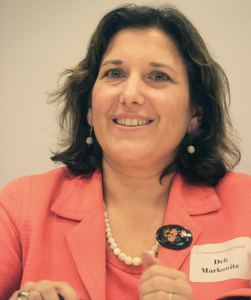
Deb Markowitz, candidate for the Democratic nomination for governor, likes to tell about an experience she had with Madeleine Kunin that helped propel her into politics.
Nearly three decades ago, Markowitz, then a student at the University of Vermont and a woman’s-rights activist, had just returned from spring break and was about to call a cab from the Burlington airport when she bumped into the woman who was one of her inspirations.
Kunin, the former lieutenant governor who had just lost a race for governor, recognized Markowitz as the waitress who had served her several times at Pauline’s Café in Burlington. The two chatted briefly, and then Kunin asked: “’Can I give you a ride? Where do you live?’” Markowitz’s apartment was on the way.
The UVM student from Westchester County, N.Y., excitedly climbed into Kunin’s car, and at some point, as they headed through traffic, she mentioned how she viewed Kunin as a role model. “I told her how great it was that she had run for governor” even though she had lost. (Kunin eventually would win the governorship, holding it for three terms).
As Markowitz recalls, Kunin, behind the wheel, replied that women have always been doing the work behind the scenes. “Only after we’re brave enough to risk defeat will we ever sit at the head of the table!’”
Markowitz says Kunin asked that she promise if she were ever to run for office she wouldn’t “chicken out.”
As it turns out, Markowitz is now at the table, reaching for the head.
After her studies in philosophy and political science at UVM, Markowitz moved to Washington for law school at Georgetown. She returned to Vermont to work for one of Vermont’s better-known law firms: Langrock, Sperry and Wool. A few years later, interested in civic affairs, she took a job with the Vermont League of Cities and Towns, establishing its Municipal Law Center, which helps local officials with state and federal laws.

Twelve years ago, sensing political weakness in the secretary of state’s office, Markowitz took her first election plunge. She ran for secretary of state, beating the incumbent Republican, Jim Milne, in a squeaker. She has easily held onto that office in five subsequent elections, one year with the nominations of both Democrats and Republicans.
In her spare time several years ago, she helped found the Women’s Leadership Initiative, a statewide group that encourages women of various political stripes, to become leaders in their fields. Among those involved have been Denise Johnson, the first woman to serve on the Vermont Supreme Court, and Martha Rainville, who became Vermont’s first female adjutant general.
Markowitz may be at the table, but the table has settings for four other Democratic hopefuls, hoping to run in the November election against Republican Lt. Gov. Brian Dubie, who does not face a primary. The Dems include: Susan Bartlett, chairwoman of the Senate Appropriations Committee; Matt Dunne, a former state representative, who is head of community affairs for Google; Peter Shumlin, the Democratic leader of the state Senate, and Doug Racine, a state senator and former lieutenant governor.
All candidates are respected in party circles, though insiders say Bartlett may want for name recognition.
Kunin has offered Markowitz more than inspiration. Last December at Union Station in Burlington, she endorsed Markowitz, saying she would consider Vermont’s challenges “with a fresh set of eyes” and declaring that as secretary of state Markowitz has developed “the executive experience to make tough decisions.”
That same day Markowitz announced that EMILY’s List, the Washington, D.C., political action committee, had endorsed her. EMILY’s List (acronym: Early Money Is Like Yeast) rounds up financial support for female candidates across the country who are “pro-choice” and champion other causes it deems progressive.
Markowitz, it seems, would welcome Vermont’s “women’s vote” – to the extent there is such a voting bloc in 2010. The “vote” may not be quite as obvious or getable as it was, say, 30 years ago. Headway has been made on gender equality over the past three decades, and this year there are other pressing issues facing Vermont – the economy, energy and health care – which Markowitz and the other candidates have been addressing.
Yet, at forums and political events across the state Markowitz has been making a subtle pitch that might at least catch the attention of some women. She often mentions that she has been a “working mom” with three kids (now teenagers, one in college) and that she knows how to balance a busy career with family responsibilities and household chores.
“I’m a mom, and I know how to get things done,” she says.
“I know what it’s like to leave work and head to Shaw’s to buy the food for school lunches,” she said in a recent interview.
There’s more to Markowitz’s pitch, of course, than her populist attempts to identify with Every Mom. She tells voters that as secretary of state she has executive experience in government that none of the other candidates shares. She has run an office with dozens of employees and a budget of millions, while the others have served in the Legislature. She says she expects support from hundreds of municipal officials from across the state – from town clerks to cemetery commissioners – with whom she has worked with over the years.
Strategy: Do the math
Markowitz, the first to declare for governor, began assembling an organization last fall. In October, through EMILY’s List, she found her campaign manager, Paul Tencher, 29, a Rhode Island native. Her team includes seven other full-time staff and a dozen interns, mostly high school and college kids.
Tencher, after graduating from Seton Hall University, worked in restaurants and as a newspaper reporter in his home state before becoming the campaign manager for Elizabeth Roberts, who became Rhode Island’s first female lieutenant governor. He subsequently worked for women candidates in Ohio, New Jersey and Missouri, earning a spot as one of EMILY’s List’s recommended operatives.
Over coffee at La Brioche in Montpelier, and while occasionally checking his Blackberry, Tencher predicted a big turnout in the Aug. 24 primary but nothing like the 80,000 figure some have suggested. The primary was moved up from September this year, and late-summer voting, with some people on vacation and parents getting kids ready for school always presents a question mark. Tencher assumes the vote will be closer to 50,000, and he says the winning candidate may need 15,000 or more votes to win.
With their arithmetical estimates, Markowitz and the other candidates are trying to identify supporters and nail down commitments. Early voting absentee voting begins on July 9, and Markowitz will urge her backers to vote early.
“Yes, absolutely, there’s a women’s vote out there,” says Tencher, stressing his candidate wants it. He reports that past elections suggest that 58 percent of the voters will be women. But he emphasizes the truism that “women don’t vote as a monolith.”
About 30 percent of the vote, he says, will come from Chittenden County, which helps account for why the campaign’s headquarters is in Burlington, at Union Station, where Kunin had her office. Markowitz’s strength seemingly will be in Washington County, especially in Montpelier, where she and her family live. Her husband, Paul, has connections in the environmental community, having been the director of the state recycling program. He now consults on energy and global-warming issues.
Tencher says the campaign will open a second office, possibly in Brattleboro. He says the campaign’s goal, with an eye on the general election, is to have a Markowitz “captain” in each of the state’s towns.

Money does seem to be a problem, but it’s not clear how much the campaign has raised. Tencher declined to disclose the amount, and financial documents don’t have to be filed publicly until July 15. He said that as of mid-June the campaign had 2,000 donors and 90 percent are Vermonters. The campaign has received funding through connections with Emily’s List and from two other women’s political organizations, the Women’s Campaign Forum and the Barbara Lee Foundation of Boston.
Tencher mentioned that the campaign also is looking for support from Jewish communities in Burlington, Manchester and Norwich.
“We know that Deb is pulling away from the pack,” said Tencher. There have been no published independent polls to back that assertion, but a poll commissioned by WCAX and WDEV, released in February, did show Markowitz topping Dubie, the only Democrat to do so. That early poll showed Markowitz ahead of Dubie, 42-41, with 16 percent of the respondents undecided.
A subsequent poll (Rasmussen), released in late March, showed Dubie leading Markowitz, 46-39, but again Markowitz led the Democratic pack.
Markowitz has used these two polls to argue she is the Democrat who has the best chance of beating Dubie in November.
Markowitz focuses on Dubie
Markowitz is a morning person, and over breakfast at the Capitol Plaza, briefly interrupted by a visit with Rainville, who happened by her table, took some jabs at Dubie, which she has done throughout the campaign. She and her opponents in the primary have found it safer, and easier, to focus criticism on him rather than each other.
Markowitz called Dubie — a pilot for American Airlines — the “co-pilot” in the administration of Republican Gov. Jim Douglas. She says the two have done little to foster job growth in the state.
Several weeks ago Markowitz made headlines by criticizing Dubie for running an ad on the New York Times Web site (seen only by Vermonters) that said Vermont “ranks 47th best state for business” and suggesting the could do much better.
“My approach to governing is that you leverage your assets; you don’t just become mired in your negatives,” said Markowitz. She said if the state suffers from a bad-for-business reputation, Gov. Douglas and Dubie, both of whom have served four terms in office, must take the blame. “Let’s focus on things that will draw business here,” she said, mentioning the state’s quality-of-life attributes.
She also whacked Dubie for a fund-raiser he held earlier this month in Virginia featuring that state’s governor, Bob McDonnell, an abortion foe who once argued, in a graduate school thesis that working, women were undercutting family values. McDonnell has opposed housing regulations to protect gay tenants and he took flack earlier this year by proclaiming “Confederate History Month” without mentioning pains of slavery.
Is it fair to smear Dubie for a fund-raiser with McDonnell?
“McDonnell is an extreme social conservative. We can be judged by the company that we keep,” Markowitz said. She described Dubie as a “good family guy,” whom “I like,” but she labeled him, too, as “socially, very conservative.”

Markowitz agrees that she and her Democratic opponents agree on issues, with only a few nuanced differences. All support good schools, a quality environment, better health care, thriving farms, a growing economy (Markowitz released her economic plan this week; see Deb Markowitz JumpStartVT), more public transportation and an energy policy featuring renewable energy, using wind, solar and biomass in various forms. No one likes Vermont Yankee, and everyone seems happy with gay marriage.
There’s hasn’t been much from her campaign or the others about tax burdens or how the state can afford new initiatives. “Times are tough; I’m sure we can live within our means,” Markowitz said, when asked taxes and the state budget. “We are not talking about new money, rather we are talking about refocusing existing programs,” she said.
Markowitz said, however, she favors reducing the number of school supervisory unions in the state to cut costs, while also promoting ways for schools to make joint- purchases. She said she supports a single-payer health-care system, believing the state could work for a waiver from the federal government so Vermont could go that route. She believes the state’s top environmental issue is energy — “because of global warming” – with Lake Champlain cleanup coming in a close second.
She complains that the Douglas administration is too ideological and that it has applied political litmus tests before making major appointments. “I am disturbed by the partisanship,” she said.“ I have never asked a person’s party affiliation before making a hire,” she said.
If elected, she said, she would look for the best people to serve regardless of party affiliation.
She also said she is unfazed by the union support that one of her opponents, Racine, has been picking up. Racine has been endorsed by the Vermont NEA, the state’s teachers’ union; the state AFL-CIO, and the Vermont State Employees Association. Markowitz said she expects rank and file support from the members of all three unions.
Markowitz can be engaging during interviews and at social gatherings – maybe a little more so than at candidates’ forums. She admits it can be difficult saying “in just 60 seconds how I might solve the state’s fiscal problems.” After more than 30 forums, she says she’s still trying to hone her message.
Her public speaking style prompted one keen observer of Vermont politics, who won’t be voting in the Democratic primary, to say: “I don’t get the sense that her argument is as sharp as that of some of the others, who have been more actively engaged in public policy in the Legislature.” He added: “There’s sort of a ‘neutralness’ there, which may come from her being secretary of state, where that approach is required.”
She can get laughs, though, from a crowd. She showed a self-deprecating sense of humor at Middlesex ribbon cutting recently, joking about her height – 5-feet, if that – which sometimes requires that she stand on a platform at a podium to be seen.
Will the women’s vote matter?
What do others think about a “women’s vote” and will her relations with local officials be of benefit?
“I do think some of her most enthusiastic supporters are women,” said Kunin, who then went on to express uncertainty about the role of gender in the race.
The former governor said a female candidate in 2010 might still be perceived as better than men on some of the “softer issues,” like education and the environment.
In this crowded primary, Kunin said, the winner is likely to be the one who has worked the hardest. “The candidate best organized will win, and (Markowitz) is well organized.”

Steve Kimbell, the recently retired Montpelier lobbyist, who managed Kunin’s first statewide campaign for lieutenant governor, reported that “almost all of the heavy lifting was done that year (1978) by women.” Gender was a bigger consideration then, and male candidates had to be careful about what they said and how they acted.
Kimbell laughed, recalling how Kunin’s opponent in ’78, Peter Smith, off-guard, babbled to a female reporter that he expected “all the broads to vote for Madeleine.” Many women apparently did, and Smith lost.
“But I’m not sure that the women’s vote is all that identifiable now,” said Kimbell.
As secretary of state Markowitz runs an office with 68 employees in four offices with a budget of $8.1 million, overseeing professional licensing, state elections and the state’s records. Her office works closely with local officials on elections and countless other matters
A Republican town clerk, who asked that she not be identified, said she has heard few if any complaints about Markowitz’s tenure.
Carolyn Wells, the retired town clerk of Worcester, said she has always found Markowitz to be accessible and responsive. “I could pop her an email, and it would be answered,” said Wells, a Democrat.
“She has been around the state; she has name recognition,” said Wells.
But I’m not sure who I’m going to vote for this year; all the candidates are excellent. … I probably won’t know until I enter the booth.”
Dirk Van Susteren is a Calais, Vt., freelance writer and editor.
