


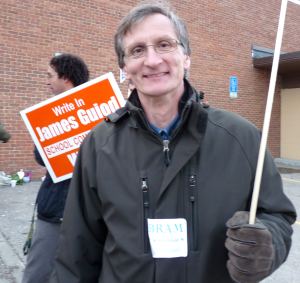
Editor’s note: This story is part of a collaborative Town Meeting Day project with Kevin Kelley’s journalism class at St. Michael’s College. Bethany and Deanna, who both contributed to this report, are students in the class.
The Progressive Party candidates – Max Tracy and Jonathon Leavitt – lost their bids to represent Ward 2 on the Burlington City Council on Tuesday by the slimmest of margins to their two Democratic opponents.
Tracy lost by 13 votes; Leavitt lost by 10. As of Wednesday, it wasn’t clear whether either candidate would call for a recount. Out of a total of 4,923 eligible voters in Ward 2, only 630, or 13 percent, turned out to cast ballots. The ward has a traditionally low voter turnout because it’s dominated by students from the University of Vermont.
The defeats mark the first time in more than 20 years that the Progressives haven’t held a seat in Ward 2, according to several political observers. The party lost one of the seats two years ago to David Berezniak, a Democrat; the other was held by Progressive City Councilor Emma Mulvaney-Stanak, who moved to Ward 3 recently and ran in the election Tuesday unopposed.
Tracy and Democrat Bram Kranichfeld were vying for Mulvaney-Stanak’s vacancy. Leavitt challenged the incumbent Berezniak, who has lived in the ward since the early 1980s.
Thirty-year-old Kranichfeld, a criminal prosecutor and Burlington Electric Department commissioner, won with 307 votes; Berezniak carried Ward 2 with 302 ballots.
“It’s great to have won — it was a hard fought race,” Kranichfeld said.
The fact that Leavitt, 31, and Tracy, 23, who campaigned as a team, came up short wasn’t for lack of trying. Together, they had knocked on 2,700 doors in the Ward over the course of seven weeks. (On Election Day, Leavitt showed off the wear and tear on his boots.) They spoke to constituents about core Progressive issues — affordable housing, livable-wage jobs and health care – and gave measured answers to questions about Burlington Telecom’s financial problems and the Kiss administration’s alleged mishandling of city money.
In the end, though, voters for the first time in memory sided with the Democrats. Kranichfeld’s winning campaign was built around public safety issues – curbing noise, vandalism and drug dealing in the ward – and in several interviews Berezniak said his primary interest was solving the city’s financial problems— financing the public telecommunications utility and funding for the city’s pension system.
“We were confident going into the polls in the end,” Tracy said in an interview on Wednesday. “But it didn’t come our way.”
Tracy hasn’t decided yet whether he’ll contest the outcome of the election. He said it may be worth asking for a recount given how close it was and that “there were a number of spoiled ballots.” But in any case, Tracy says he’ll be back in the next election cycle.

Leavitt vs. Berezniak
Leavitt, in his losing cause, defended Kiss and the Progressive legacy in the city, giving the party credit for Church Street, the Intervale, City Market – and the city’s AAA credit rating. He suggested this track record and the party’s work on behalf of working-class people in the city is undervalued.
Leavitt insists Mayor Bob Kiss hasn’t done anything illegal involving Burlington Telecom. He asserted that the utility’s financing problem “is with disclosure and how information has been offered from the administration.” Political opponents of the administration, he said, are using the problems at city hall for “partisan political ends.”
Leavitt added: “One of the things that I really value from really good city councilors are constituent services … and I think in the really partisan political climate in Burlington right now, that’s something that’s really been lost.”
He said some Burlington leaders were more interested in using hot-button issues to grab headlines than they were in helping residents.
“The political elite forget about meeting people’s basic needs,” Leavitt said. “There are a lot of people in Burlington who have been left behind.”
For his part, Berezniak, 48, who owns a picture frame shop in Ward 2 and has served one term (on) the City Council, is concerned most about the city’s financial challenges. He said the city’s pension system has the potential to have a big impact on property taxes in the city because regulators require 80 percent funding for the retirement funds. If they dipped below that level, taxpayers would pick up the tab.
Even though Burlington Telecom is in a “tough bind” right now financially, Berezniak says the City Council would like to keep the utility open.
“Nobody wants to close Burlington Telecom down; there’s nobody on the council that wants that to happen,” Berezniak said. “In order to keep it as an asset for the city and keep it moving forward, we’ve got to be really flexible about the options we’re willing to consider to have that happen.”
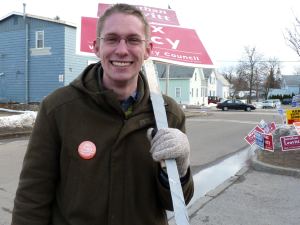
Tracy vs. Kranichfeld
Tracy graduated from the University of Vermont last year with a degree in anthropology and history – and was a prominent labor activist on campus (he led protests at UVM to pressure the administration to raise wages for staff and even went on a five-day hunger strike). He says he got into the race because he is concerned about “working people’s issues” – wages and affordable housing.
“We are socio-economically one of the hardest hit wards by the economic recession,” Tracy said.
He said losing the election was a blessing in disguise because he doubts that the issues he cares most about – affordable housing and economic development–will make it to the table in the next two years because of the city’s financial woes. “Bram’s going to have his hands full with Burlington Telecom,” he remarked.
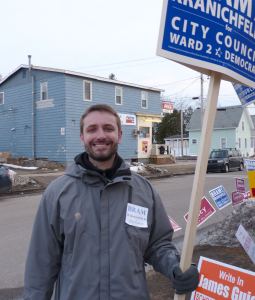
He believes the utility should partner with a private entity to finance the outstanding debt of $50 million, with a provision for allowing the city to maintain an ownership stake in the nonprofit.
His other big issue is public safety – a perennial issue in Ward 2 because of its proximity to UVM. He wants to pursue different options, such as getting more support from the Burlington Police Department or starting neighborhood watches in the area to keep problems with vandalism, noise and drug-dealing at bay. Most of these problems are associated, he said, with the large proportion of college students who live in Ward 2.
