

Editor’s note: Steve Cormier, an intern at Lyndon State College, contributed to this report.
There is a group of Vermonters who want to leave the country, and given that the border is just up the road, exit strategies don’t seem all that difficult to achieve.
But these Green Mountain boys don’t want to go anywhere, actually. They want to stay right here in Vermont.
The members of the Second Vermont Republic want to persuade the state’s powers that be to secede from the Union just like the Confederacy did in 1861 – minus the bloodshed.
The connection to the South, and its history of racism, may be more than superficial, however. And almost as incendiary.
The main problem the Second Vermont Republic faces, according to Thomas Naylor, the founder of the secessionist movement, is the Constitution’s failure to address secession. In his opinion, this flaw – manifest in the federal government’s refusal to allow the South to secede in 1861 – is part of Lincoln’s legacy. President Lincoln, Naylor said recently, “did a real number on us.”
Three years ago, this kind of anti-Lincoln rhetoric caught the attention of John Odum, the founder of Green Mountain Daily, a blog that promotes Democratic candidates and the party’s platform. Odum pointed out an alleged connection between the Second Vermont Republic and neo-Confederate ideology. In 2007, the Republic Web site was linked to the League of the South, which espouses racist views, according to the Southern Poverty Law Foundation, a nonprofit civil rights organization.
In the post, Odum links to an exposé on the Southern Poverty Law Foundation’s Web site that accuses Naylor, a former Duke University economics professor, of holding revisionist beliefs about Lincoln and the Civil War in his speeches, articles and books.
Odum also listed off several board members who have promulgated revisionist histories of the Civil War: Donald Livingston, a professor at Emory University who espouses vehement anti-Lincoln views and Thomas DiLorenzo, a professor of economics at Loyola College in Maryland, who is the author of “The Real Lincoln: A new look at Abraham Lincoln, his agenda and an unnecessary war.” Both men remain on the advisory board for the Republic, Naylor said in an interview today.
Naylor says the Republic linked to the League of the South Web site because the group favored bringing down the “empire”—a goal the Vermont group advocates through secession. They took down the link two years ago because of public reaction, he said.
“We don’t have a litmus test of finding people who support secession in the United States,” Naylor said.
He said the group has “utter contempt” for racism. “The hypocrisy of this is, we are trying to bring down the empire that’s built on backs of black slaves and land of Native Americans,” Naylor said.
Naylor says the Green Mountain Daily’s is an “unconditional apologist for the racist empire,” and he accuses the blog of tarnishing the Second Vermont Republic’s reputation through “guilt by association.”
“Green Mountain Daily is 100 percent committed to preserving empire,” Naylor said. “The pot can’t call the kettle black.”
Radical, conventional, absurd and Vermonty?
The secession idea has its own roots in Vermont, however, that are tied to the state’s reputation for cantankerousness. University of Vermont professor Frank Bryan has explored the idea extensively in books and articles, and most humorously in the book he penned with Bill Mares, “Out! The Vermont Secession Book,” which is a half-serious send up of Vermonters’ overweening belief in rugged independence. The book is an intellectual exercise that takes the state’s outlier status to its logical extreme.
In 2007 Bryan told the Associated Press that “the cachet of secession would make the new republic a magnet” and “People would obviously relish coming to the Republic of Vermont, the Switzerland of North America.”
“What could be more absurd,” asks Naylor, “than little Vermont standing up to the big empire?”
A loose-knit group of rabblerousers – entrepreneurs, academics and other dreamers — are literally running with Bryan’s ideas; they held a rally for the new Vermont political movement last November at the Vermont Independence Convention, and in January, they fielded a slate of 10 candidates for statewide office. The group, which early on dubbed itself the Second Vermont Republic, was founded by Naylor in 2003 and has held “conventions” since 2005. (Bryan is a member of the Republic’s advisory board.)
The name, Second Vermont Republic, is a throwback to a brief period when Vermont existed as a disputed territory and the newly formed colonial government in the aftermath of the Revolutionary War decided to leave the pioneers in the Green Mountains to their own devices for a few years. (Vermont, as it turns out, is one of four states that previously existed as a sovereign government. It was the first state to be recognized outside the original 13 colonies.)
As a political force (they haven’t formed a party yet), Second Vermont Republic members are seeking state recognition at the same time they’re pursuing a divorce from the federal government. But then, irony is apparently one of the movement’s main tools. Think Billionaires for Bush, Vermont style: ponytails and flannel supplant crew cuts and suits.
How do you popularize the revolutionary idea of severing Vermont’s ties with the nation? Apparently through conventional means.
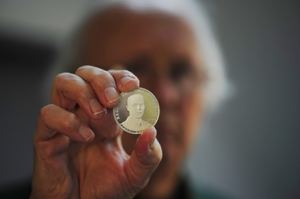
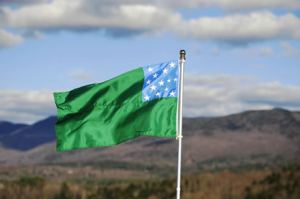
The Second Vermont Republic is running a slate of candidates for statewide races, and they are calling for the state to hold a constitutional convention to consider articles of secession. The secessionists have a Web site, their very own flag, a national anthem and even silver coinage. In addition, the Republic publishes a bi-monthly newspaper, Vermont Commons, which promotes the group’s ideas.
Recently, the secessionists have embarked on a marketing campaign that has garnered coverage in Time magazine, and the Associated Press.
Naylor, 73, said in an interview last week that one of the reasons the Second Vermont Republic has garnered so much attention outside the state’s borders is due in no small part to some perceived impossibility.
“What could be more absurd,” asks Naylor, “than little Vermont standing up to the big empire?”
So why go to all this trouble for a project most people find not only absurd, but perhaps even laughable?
Secessionists take on globalization one local seat at a time
Members of the Second Vermont Republic may court absurdity, but they are dead serious about secession, and they claim that 13 percent of Vermonters support the idea of cutting ties with the United States.
They believe the federal government has become corrupted by corporations seeking to turn a profit at the expense of people and resources worldwide. The Republic opposes globalization and the consolidation of power in Washington, in what Naylor says is one of the largest federal bureaucracies.
Naylor described the Second Vermont Republic’s platform to Time as “left-libertarian, anti-big government, anti-empire, anti-war, with small is beautiful as our guiding philosophy.”
The idea of secession may be radical, but the political platform for the Second Vermont Republic actually echoes the rhetoric of other political parties, namely the Progressive Party and even the Democratic Party to a certain extent. The Republic supports a European-style health care system; the localvore movement; a state bank; an end to Vermont’s participation in the conflicts in Iran and Afghanistan; local control of public schools; energy independence; and effective climate change policies.
Instead of state agencies, the new republic would have ministries, and would seek “local economic solidarity” with nearby states and Canadian provinces. “Secession is not,” as Naylor puts it, “a synonym for economic isolation.” It is, apparently, an antonym for centralized government. The Republic wants political power to rest with local communities.
Members of the Republic believe the only way to accomplish these goals is by seceding from the United States. Political independence is the organization’s primary objective.
But first things first. All this isn’t possible without a benign Republic takeover. In order to make secession happen, Naylor says, “We would need a two-thirds majority (in the General Assembly) because the name of the game is true acceptance.”
The startup Republic is running 10 candidates in state races this election cycle, including gubernatorial candidate Dennis Steele, a fifth-generation Vermonter and founder of Radio Free Vermont. Steele, 42, served in the U.S. Army for three years and worked as a sales executive in California and Hawaii before he moved back to Kirby with his family in 2006, according to the Republic’s Web site.
The Republic is running under the “Vermont Independence Day Party” ticket, which features Peter Garritano, an auto salesman from Shelburne, who is running for lieutenant governor; Dennis Morrisseau, a longtime activist and the founder of Leunig’s restaurant in Burlington, is running for the Rutland County state Senate seat; Robert Wagner, an economist and consultant for Oracle, Inc., is running for a state Senate seat in Addison County.
Candidates are getting the word out through Vermont Commons, the newspaper and Web site, which Rob Williams, the editor, describes Vermont Commons as a “sister” project of the organization and “statewide multi-media coffeehouse,” which brings like-minded, pro-independence bloggers and thinkers together.
“We are giving the candidates a platform to talk about issues,” Williams says. Their overall message, he says, is that nothing changes if Vermont remains connected to “the empire,” that is, the United States.
Full disclosure: A story previously published on Vtdigger.org regarding the state of Vermont’s contract with Correct Care Solutions, a prison health provider, was purchased for reprint in the current issue of Vermont Commons. In exchange, Vtdigger.org received an advertisement in Vermont Commons and a small cash donation for the right to reprint the article. Part of Vtdigger.org’s mission is to provide copy for media outlets. Our stories have appeared in Seven Days, the Stowe Reporter and the Northfield News.
Dennis Morrisseau sings the Second Vermont Republic anthem.
The rationale for secession.
