

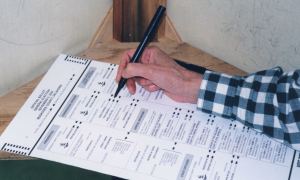
The Vermont House voted Wednesday to move the primary election date up by three weeks – from Sept. 14 to Aug. 24 – after several hours of posturing and debate.
An amendment proposed by Rep. Tom Koch, R-Barre City, which would have kept the Sept. 14 date intact and required the Secretary of State’s office to adopt a new e-mail voting system for overseas absentee voters, failed 50 to 95, along Republican and Democratic lines. Lawmakers then advanced S.117, calling for the earlier primary. Only six out of 145 representatives present voted against it.
If the bill wins final House passage today, it must return to the Senate to reconcile differences between the two chambers.
Democrats supported the bill as proposed by the Government Operations Committee; Republicans by and large backed Koch’s amendment.
The debate centered on General Election absentee ballots for the more than 1,500 Vermont National Guard members to be deployed in Iraq and Afghanistan.
At issue is the federal government’s requirement of a 45-day window between the certification of the state party primaries and the general election.
Kathy DeWolfe, Vermont’s election director, testified earlier this month that if the primary were held on Sept. 14, the vote could not be certified until Sept. 21 at the earliest. She said that getting the general election ballots printed, sent overseas and returned for counting by Election Day would be impossible. DeWolfe also told the committee that electronic voting could not be adopted quickly enough before the primary, because of logistical problems at local town clerks offices and necessary federal approvals.
Republicans argued that pursuing a waiver from the Department of Justice or setting up an electronic voting system for Guard members ought to solve the problem.
There are 10,000 eligible absentee voters in the primary, and typically 5,000 take advantage of the ballots, according to Rep. Linda Martin, D-Wolcott, who explained S.117 to the House members. In the last primary, about 3,200 voters cast overseas absentee primary ballots, she said.
DeWolfe told the committee earlier this month that federal election officials are reluctant to grant states waivers unless they can show genuine hardship. A late primary, she said, is not considered grounds for a waiver. New Hampshire, which is one of 10 states including Vermont that has a late primary, will be sending write-in absentee ballots to voters overseas.
Koch said he thought it was unwise to change the primary date because a summertime election could potentially limit the number of home voters who participate because Vermonters are on vacation or preparing children for school in late August. Koch argued that Vermont could obtain a waiver for the 45-day rule or adopt Web-based voting.
“It’s not necessary for us to inconvenience a lot of people by moving the date three weeks into August when we can do a better job for our troops by using the technology available to us,” Koch said.
Five members recounted their own experiences with absentee balloting or that of family members who were stationed overseas. Rep. Larry Townsend, who joined the service in 1968, said he supported S. 117. “We need to ensure that people over there have the right to vote.”
Rep. Patty O’Donnell, R-Vernon, whose son has served four tours of duty in Iraq, said all of their correspondence is by e-mail, in part because it’s very difficult to get mail in a war zone.
“I can go online and pull up an e-mail, and I know, in that instant, that he’s safe,” O’Donnell said. “We really should be talking about electronic voting.”
However, Martin told members that her committee, Government Operations, said the Department of Justice discouraged states from rushing into electronic absentee balloting for overseas voters because of potential security problems. The committee and the Secretary of State’s office also said there were significant logistical issues, particularly given the short time frame before the primary.
“We surveyed all the town clerks to find out what they thought about the bill; we had to mail the survey to 23 because those clerks didn’t have e-mail,” Martin said.
Martin said a blank ballot is available electronically, in which voters can write in all the candidates, but she said this ballot was created for emergency services only.
Rep. Dave Potter, D-North Clarendon, argued that if the lawmakers adopted Koch’s amendment, the system would be expensive, vulnerable to potential fraud and potentially discriminatory. “Not everyone is computer literate,” Potter said.
Vermonters already use online banking, make purchases on the Web and are comfortable with the level of security available for their money, Koch said, so why couldn’t Vermonters vote online?
“The technology allows for secure balloting – that is not a real issue,” Koch said, suggesting political will was the main obstacle. He argued that the state of Arizona and the democratic primary in Michigan both use online voting as an option for absentee voters.
Other Republican members noted that the Deputy Adjutant General of the Vermont National Guard had testified to lawmakers that an Internet solution to absentee voting made the most sense.
Martin noted, however, that the cost of implementing a new electronic balloting system would be as much as $500,000 – a prohibitive sum in her view, given the state’s current budget gap of $151 million. Koch said such a system would cost $9,500, to which, Martin replied, “you get what you pay for.”
“I’m not sure how secure that system would be,” Martin remarked.
Even if the ballots could be sent via e-mail, according Rep. Donna Sweaney, D-Windsor, it wouldn’t solve the problem.
“The federal law says ballots must be disseminated 45 days before the Nov. 2 election,” Sweaney said. “The primary is Sept. 14. It’ll take to the 21st to get the vote certified. … Even if we send the ballots electronically, it doesn’t matter — we’re still in violation of what the law says.”
