


Nation’s largest dairy coop floats supply management plan
Vermont coops weigh programs to rein in milk supply
Raw milk is a highly perishable product. Once it leaves the cow’s udder, it has to be processed into bottled milk, cheese, butter or yogurt within a few days.
That fact makes dairy farmers more vulnerable to the vagaries of the market than other food producers. Dairymen (and women) can’t wait for a better price. Unlike the farmer who raises soybeans or carrots, a dairy producer’s raw milk has to be processed almost as soon as it’s been vacuum pumped from the Holstein and piped into the steel bulk tank.
On the farm, cows have to be milked no matter what, and day to day that imperative trumps everything else – even the glut of dairy products on the global market.
And when the milk supply outstrips demand, as it does in predictable, 36 month cycles, according to a Cornell University study, milk prices plummet as they did in 2006 and at the beginning of this year.
The current downturn is the worst in living memory. Milk checks are half what they were in 2008 and, in effect, because of the high cost of production, farmers are paying dairy processors to take their milk. (The cost of production is $16-$18 per hundredweight, or 11.6 gallons of milk; farmers receive about $11 per hundredweight.)
Farmers won’t see break-even prices for raw milk until July 2010, according to USDA projections, and economists are already predicting the next downturn — in 2012.
It’s counterintuitive, but some farmers are already bulking up on heifers (teenage cows) in order to profit from a potential price uptick next year, and it’s that surplus of heifers that will likely set off the next dairy market crash, according to Dr. Mark Stephenson, an extension economist with Cornell University.
Currently, there are two short-term fixes for the oversupply problem: killing thousands of cows and/or letting hundreds of farm businesses fail nationwide.
Since last winter, the dairy industry group Cooperatives Working Together has taken more than 225,000 cows out of production in the United States to counter a 2.6 percent, or 5 billion pound annual milk surplus, according Jim Tillison, chief operating officer for CWT.
In Vermont, 26 farms have taken the herd buyout since December of last year, and the process of natural selection has begun. In all 32 have gone under, and UVM Extension agricultural economist Bob Parsons predicts 150 Vermont dairy farms will sell out by next summer. There are 1,046 farms left in the state currently.
Beyond survival of the fittest?
Several dairy groups have proposed a less painful, more long-term solution to the problem: growth management. Proponents believe that if farmers limit the amount of milk they produce, they can control the supply, lessen the volatility of the milk market and ultimately get a better price for their product.
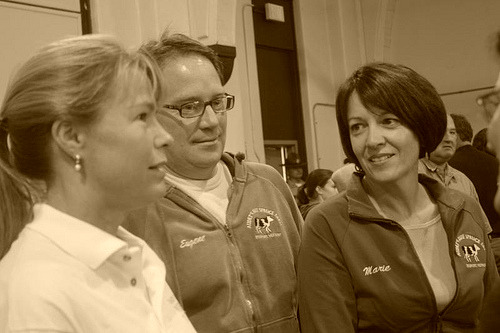
“The quickest way ever for us to make more money, to bring in more revenue is to increase production, whether prices are high or low,” says Marie Audet, a Bridport farmer and member of Dairy Farmers Working Together, the grassroots group that began looking at growth management options in 2006. “So we’re creating our own surpluses. Basically, the only tool we have is what we sell. We’re trying to fix that.”
A coalition of three organizations — DFWT, Holstein Association USA and the California Milk Producers Council – is proposing that Congress adopt a new, “budget-neutral” program that would incentivize farmers to limit increases to their milk supply.
Under the plan, production levels for each farm would be averaged over a three-year period. These averages would be used to calculate a base annual production level for each farm that includes a small percentage increase. Farmers who go beyond the preset level in a given year would be required to pay a market access fee. Everyone else would receive a share of the pooled fees.
Unlike CWT’s herd buyout program, participation would be mandatory. An advisory board and the USDA would administer the program, according to the Holstein Association.
“Supply management is kind of going to cut out some of the opportunity for speculation in the middle,” says Lucas Sjostrom, of the Holstein Association. “Right now we have swings between $10 hundredweight and $20 hundredweight which really equates up a $1.50 swing in the grocery store, however even though our prices have dropped, the prices in the store have not. So if we could manage supply with the perishable product, which in 7 days needs to be either turning into cheese or be in fluid milk in the store, we can give farmers an opportunity to make a profit instead of getting rid of one-third of the dairy farmers every three years.”
Dr. Mark Stephenson, an economist with Cornell University’s extension service, says the 36-month milk cow breeding cycle has the biggest impact on market volatility. Stephenson’s research shows that a growth management program that limited the number of cows in production would stabilize the milk supply — and prices.
Implementing such a program, however, would require an act of Congress. Sen. Bernie Sanders, D-Vt., and Rep. Peter Welch, D-Vt., have voiced support for a growth management plan. Proponents say a draft bill is under congressional review.
Last week Sen. Patrick Leahy, D-Vt., provided a meeting room for a Senate and House staff briefing on the coalition proposal. More than 30 staffers attended. A similar briefing will be scheduled in the House in the next few weeks, according to Amanda St. Pierre, of DFWT.

At the recent Senate Judiciary Committee Hearing in St. Albans, where Leahy recorded testimony about the dairy crisis, Sanders took a straw poll of support for a supply management system. Twenty or so farmers in the audience raised their hands.
The dairy cooperatives that handle raw milk in Vermont have been less enthusiastic. But all three are considering some kind of growth management option, and the issue is starting to gain traction.
Coops weigh in
The biggest news? Dairy Farmers of America, a national cooperative with 18,000 member farmers in 48 states, including Vermont, adopted its own growth management initiative last week.
DFA, which markets 35 percent of U.S. milk, is proposing that this initiative replace the national herd buyout program, according to Ralph McNall, chairman of St. Albans Cooperative Creamery, which works in tandem with DFA. Farmers would pay 25 cents per hundredweight under the proposed growth management initiative, and participation would be mandatory, he says.
The DFA initiative includes elements of the Dairy Farmers Working Together, Holstein and Milk Producers Council proposals, though there would be no market access fee, McNall says.
On a scale of 1 to 10, the decision by DFA to support growth management is a 10 for McNall. “It’s a big, big deal,” he says. “It’s the biggest deal I’ve been involved with in terms of the dairy business.”
Amanda St. Pierre of Dairy Farmers Working Together says she’s hoping DFA will be willing to talk with the coalition soon. “We’re willing to work through whatever issues need to be worked out for the good of the dairy farmers,” she says.
The directors of St. Albans also recently passed a resolution that “supports the concept of a CWT or growth management program.”
Massachusetts-based Agri-Mark, Inc., which serves 1,300 members in New York and New England, including 400 from Vermont, will consider growth management proposals among other options at its next meeting in mid-October.
Neal Rea, the chairman of Agri-Mark’s board of directors, says the cooperative is “in favor of looking at options and ideas to reduce national milk supply.” Rea says Agri-Mark was one of the first coops to support supply management in the United States through the CWT herd buyout program.
Though Agri-Mark has continued to support the Milk Income Loss Contract (a federal subsidy system) Rea says cooperative directors “have some concerns over programs that are run and controlled by the federal government.”
“If we had to make that (a DFA-style growth management initiative) a mandated program the government would probably have to be involved,” Rea says. “They’d collect the money and it would have to go through USDA and the concern is that USDA would probably have to run the program. They’d request dairy farmer input, but it very well could be a government run program determining how we spend our money.”
The National Milk Producers Federation, which represents coops and runs the CWT herd buyout program, came out with its own set of recommendations last week, none of which, with the exception of a requirement for full participation in CWT (currently 67 percent of farmers pay in 10 cents per hundredweight), appear to address the long-term effects of oversupply. An attempt to reach Jerry Kozac, CEO of National Milk, yesterday was unsuccessful.
A few weeks ago, Christopher Galen, spokesman for the trade group, said, “We at National Milk have not taken a position yet on the so-called price stabilization plan, which as you know is being promoted by the Holstein Association, by Dairy Farmers Working Together and there’s also a group in California called the Milk Producers Council and they’ve become the three musketeers, if you will, having formed a coalition to support in concept this growth management plan.”
St. Pierre says that if the industry doesn’t work with farmers to create a system that provides long-term stability consumers will suffer.
“Ultimately, who’s going to be hurt is the American consumer,” she says. “When we’re seeing consolidation of the farming industry we’re down to 55,000 dairy farmers. Couple more of these cycles and we’ll be down to 15,000 to 20,000 in the whole country.”
She is particularly disturbed by the pain her neighbors are enduring. “An eerie silence has fallen on the Vermont dairy industry,” St. Pierre says. “It’s almost grieving to be honest with you.”
McNall says if prices don’t go up soon and the long-term volatility problems aren’t resolved, the state could lose its dairy industry.
“We’re at a crossroads like I’ve never seen before,” McNall says. “It’s extremely serious. Here in the Northeast, Vermont especially, it’s on the verge of perhaps losing our dairy industry. And I’m not sure a lot of people understand that. It’s that serious. Our infrastructure is in trouble. It isn’t just us. Our bankers, our suppliers, they’re in trouble. And people can’t afford to exist like this. I don’t mean to sound that negative, but in reality dairying could change fast here in the state of Vermont. There’s no other state that depends so much on dairying as Vermont does. On a per capita basis, well, you and I have more at stake than anyone else in the country.”
Bob Wellington, an economist for Agri-Mark, Inc., the dairy processor that manufactures Cabot Cheese summed up the situation this way: “This is not a case of having no supply control. We have supply control right now and it’s harsh and it’s cruel and it’s low milk prices. We have to ask: Which system do you prefer?”
