

More than $49M directed to defense companies
and the Vermont National Guard in two-year period
Please note: This is the first in a series of stories about federal budget earmarks (also known as appropriations requests) made by Vermont’s congressional delegation.

Like his compatriots in Congress, Rep. Peter Welch, Vermont’s second-term Democratic congressman, brings home the bacon, i.e. cold, hard cash from Washington.
Since he took office in 2007, Vermont’s lone U.S. House representative has requested $98.5 million in federal budget earmarks for Vermont, according to information from Welch’s web site and Taxpayers for Common Sense, a nonprofit, nonpartisan budget watchdog group based in Washington, D.C. (Earmarks are allocations of revenue directed to a specific project or recipient, according to FackcheckED.org, without adherence to the “competitive allocation,” a.k.a. bidding, process, as the Office of Management and Budget puts it.)
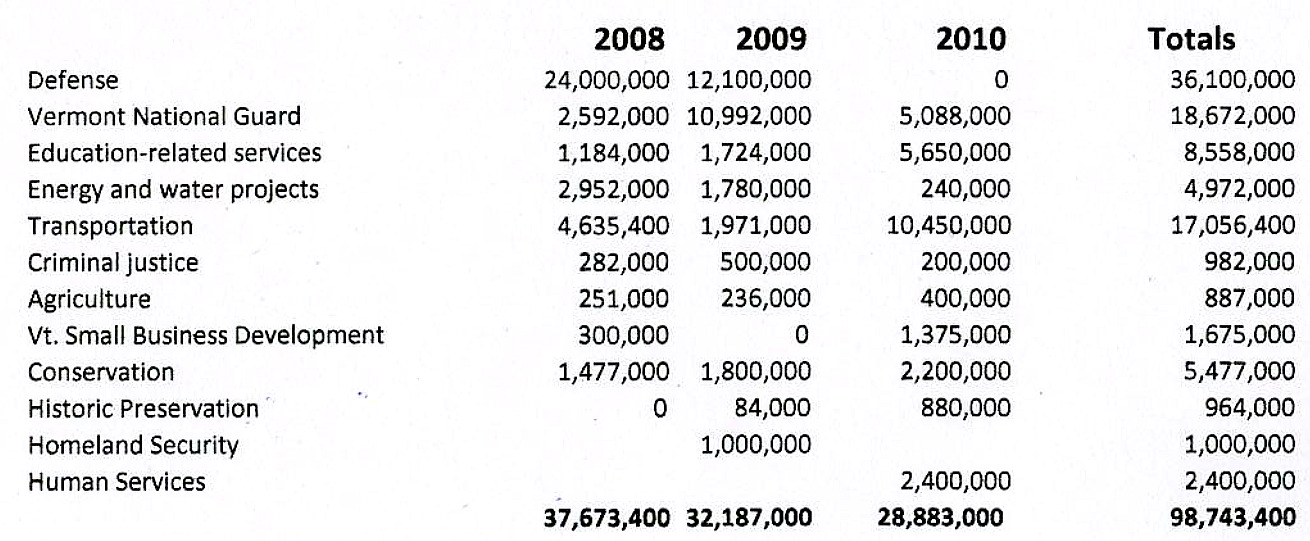
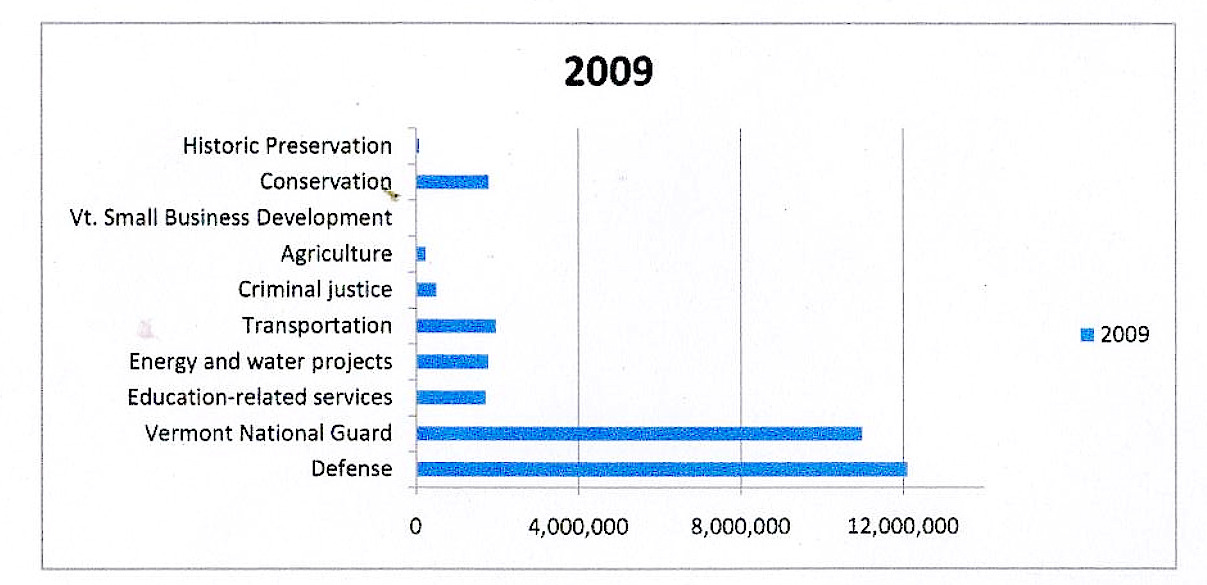
Welch directed $49 million out of $69.8 million, or 70 percent of his total earmarks, toward defense-related spending in 2008 and 2009, according to public information gathered by TCS.
Of that, $13.5 million was earmarked for the Vermont National Guard. The rest of the money was given to defense contractors in Vermont, including $10 million to General Dynamics in Burlington for the manufacture of XM312 machine guns.
Though Welch says “his highest priority is to help Vermont’s community-supported organizations succeed,” his single largest earmark category is defense contracts with private companies.
In several e-mails, Paul Heintz, communications director for Welch, writes that the congressman “particularly focuses on projects that will bring jobs to Vermont” and “supports the Vermont National Guard. The congressman’s defense appropriations do just that – bring jobs to Vermont – and those jobs are tremendously important to communities all over Vermont, including Waterbury, Northfield, St. Albans and St. Johnsbury.”
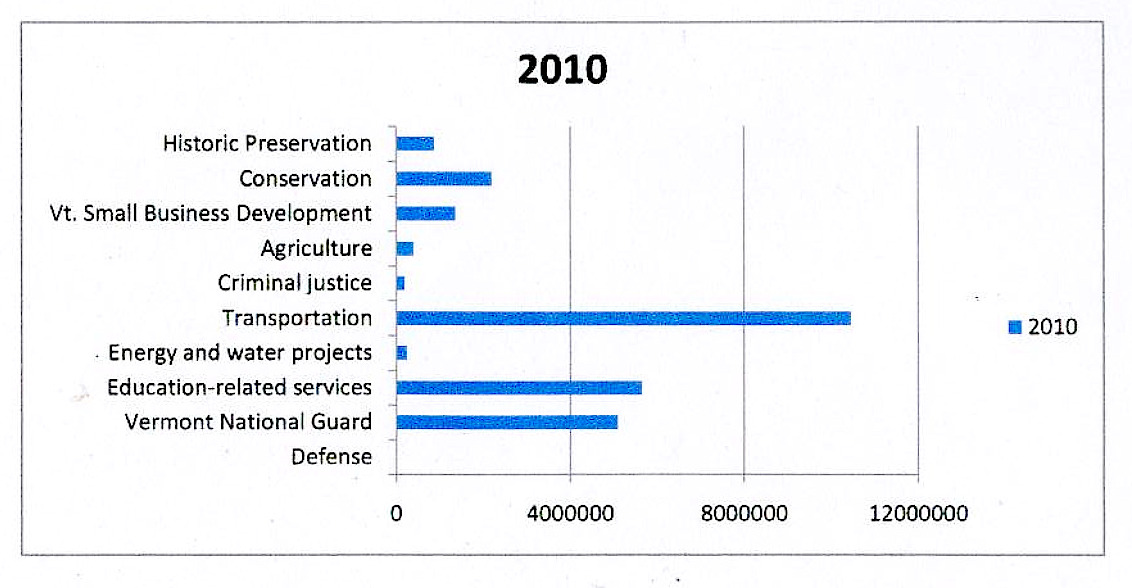
In 2008 and 2009, Welch earmarked $36.1 million for private military contracts. That figure represents more than 50 percent of his $69.8 million in total requests. For FY2010, he will not have any defense appropriations requests, according to Heintz.
“After he was appointed in January to the Committee on Standards of Official Conduct, Congressman Welch decided out of an abundance of caution to not seek defense appropriations for businesses in 2010 because of the possibility the committee might investigate the defense appropriations process,” Heintz wrote in an e-mail.
The following earmarks were sponsored by Welch in 2008 and 2009:
$10 million, XM312 machine guns, General Dynamics, Burlington
$2.5 and $2.4 million, lithium and zinc batteries, Energizer Battery Company, St. Albans/Bennington
$2 million and $2.4 million, medical shelter systems, Mobile Medical International Corporation, St. Johnsbury
$2.4 million and $1.6 million, Kiowa helicopter “warrior health system,” Goodrich Corporation, Vergennes
$2.4 million, wireless sensors for Navy aircraft, Microstrain, Williston
$2.4 million, boat trap system for port security, Moscow Mills Manufacturing Services, Waterbury
$2.4 million, water purification system, Seldon Laboratories, Windsor
$2.4 million, field deployable fleet hydrogen fueling, Northern Power Systems, Barre
$1.6 million, merino wool socks for the Marines, Darn Tough Socks, Northfield
$1.6 million, New England manufacturing supply chain initiative, Vermont Manufacturing Extension Center, Randolph Center

The Vermont National Guard is the next biggest earmark winner. In the last three years, Welch has helped to make $18.6 million (including $5 million in FY2010) available to the Guard for 17 military tractors, a security system for the Ethan Allen Range, renovation of a 1928 farmhouse for residential housing, a training center and a Readiness Center.
Transportation comes in third place at $17 million. Welch has approved spending for Burlington ($3.375 million) and Rutland ($3.323 million) airports and nearly $6 million on buses and equipment for the Chittenden County Transportation Authority, in addition to streetscape projects in St. Albans and Springfield.
Altogether, appropriations requests for everything else — police departments, conservation efforts, historic preservation projects, homeland security, human services, energy, agriculture, small business development, and educational and cultural programs – get the smallest wedge of the pie. In 2008 and 2009, these funding categories represented just 19 percent of Welch’s total requests. This year, they’ll be closer to 53 percent of the total.
Where does Welch fall in Vermont’s three-man congressional lineup? Dead last. In 2009, Sen. Patrick Leahy obtained 113 earmarks worth $248.5 million; Sen. Bernie Sanders secured 39 requests worth $106.8 million; and Welch sponsored 29 totaling $32 million, according to the Center for Responsive Politics (opensecrets.org). Many of the defense requests Welch signed onto are co-sponsored by Leahy and other members of Congress.
Among his peers in the House, he ranks 156th for the total amount of money he has requested as a co-sponsor and 291st out of 435 representatives as a solo sponsor, according to Steve Ellis, vice president of programs for TCS.
Despite its small population, Vermont does well for itself in the national standings. It ranked 7th for earmarks per capita, $131.94 for each resident in 2009, according to TCS. Alaska, which holds the No. 1 position, delivered $331.94 per person last year; the national average was $41.06.
TCS reports that nine of the top 10 states on the list each have a member on the Senate Appropriations Committee (in our case it’s Leahy).
Within the context of the earmark system, however, Welch’s appropriations requests are a drop in the national discretionary spending bucket. In 2009 alone, the committee approved 11,286 earmarks totaling $19.9 billion in funding requests tacked onto the budget bill.
Of the $3 trillion FY 2008 budget, $2 trillion was committed for programs like Social Security and Medicare, Ellis says. Discretionary spending accounted for $1 trillion, and that figure included $550 billion for the Department of Defense. The $18 billion in congressional budget earmarks came out of the remaining $450 billion.
“That’s more money than the entire Department of the Interior and the Department of Commerce combined received in funding in 2008,” Ellis says. “Somebody here (in Washington) can argue it’s not a lot of money, but to any regular person, $18 billion is a hell of a lot of money.”
