

Grain is largest expense
The recession has forced most of us to do some serious belt tightening. Buying frivolous stuff and eating out are somewhere on the top of the list of guilty pleasures these days. Many Vermonters face more serious sacrifices, such as putting off repairs to vehicles or giving up health insurance.
But what if you had hundreds of big hungry mouths to feed, in this economy? The kind that bellow and moo?
There’s no question that dairy farmers are in a bigger pinch than most of us because of record low milk prices, but there’s another factor to consider, too — the escalating costs of production.
Cows eat a lot. High producing milkers eat a lot more. And grain is a dairy farmer’s biggest expense.
Each day, a cow consumes 110-120 pounds of wet feed (silage) or 55-60 pounds of dry matter (hay and grain). More if she’s producing milk, according to the UMass Extension service.
In slightly warmer climes, such Pennsylvania, farmers can grow enough corn, soybeans and hay to feed livestock through the winter. Vermont’s climate constrains the nutritional value of grain crops, and so though dairymen (and women) here do grow corn – largely for silage – they have to buy supplemental corn and soybeans to feed their cows.
This means the “input” costs, or the expenses farmers incur for day-to-day operations, are higher here than they are in other dairy states like Florida or Ohio.
Grain expenses add significantly to the cost of milk production in Vermont and that makes it harder for dairy farmers to ride out the current milk price crash and compete with farmers in other states on the open market, according to Bob Parsons, an agricultural economist with UVM Extension.
Right now, farmers are losing $100 per cow per month, and many have eaten into their equity to survive. (See related story.) As they gear up for winter, one of the biggest challenges they face is significantly lowering the cost of producing milk.
The biggest ticket item on a farmer’s balance sheet is grain, according to data from the 2008 Yankee Farm Credit Northeast Dairy Summary, an analysis of the financial health of 500 New England farms.

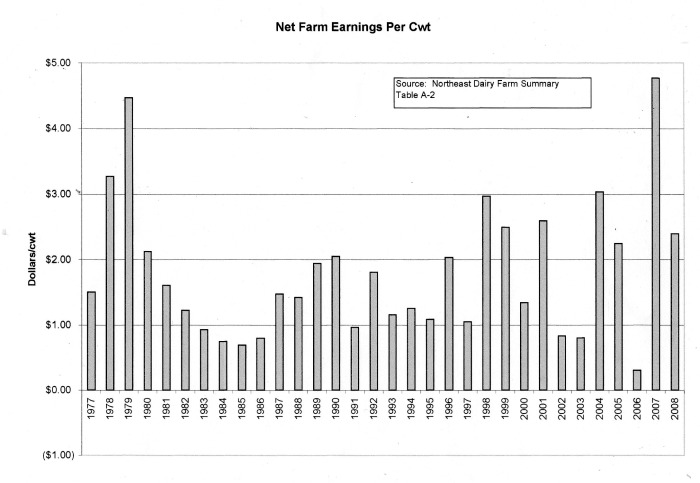
Last year, feed accounted for $6.19 of the cost of production per hundredweight (a unit of measure that translates to 11.6 gallons of milk), double the amount farmers paid out for hired help, and nearly a third of the total cost of production, $18.19 per hundredweight, on the farms included in the analysis. In 2008, the farmers brought in $19.59 per hundredweight.
This year, the average cost of production for farmers statewide is $17-$18 per hundredweight, and the milk price has hovered in the $11-$12 per hundredweight range since February.
Even when milk prices hit new heights in 2007 and 2008 (after a record slump in 2006), farmers saw short-lived profits because of the inflated cost of corn and soybeans.
Demand for ethanol drove up the wholesale price for corn, according to Don Blayney, an agricultural economist at USDA Economic Research Service.
“Feed inputs have gone up for dairy farmers over the last two or three years,” Blayney says, “mainly because of all the ethanol regulations and outside effects of ethanol on corn and soybeans. All that added demand, taking corn away from feed production immediately shot up feed input prices for all farmers. For quite a while, corn was so very, very cheap that people got used to it.”
Blayney says corn prices are expected to moderate slightly and that will blunt the cost of production losses farmers are enduring. It won’t be enough, however, to pull farmers out of the red ink this winter and next spring. Particularly since many farmers, especially those in Addison County will likely have poor yields for silage and hay this year because of the wet summer growing conditions.
Economist Bob Parsons says some farmers are looking at 30 to 40 percent crop yields in certain fields. Many, he says, will be forced to buy more grain than they normally would.
“You’d have to kind of wake up and think that the planets and stars are all lined up against you,” Parsons says. “A poor harvest at the same time you have low milk prices and high feed prices – that combination is like three hits in the gut in a row.”
It’s not just grain that’s gone up. Farmers are also being squeezed by higher prices for fertilizer, dairy supplies and fuel, according to Tom Gates, cooperative relations manager for St. Albans Cooperative Creamery, Inc. All of these expenses are cutting into their profit margins, Gates says.
“If they can’t find a way to reduce their cost of production significantly, that will be a big challenge for dairy farmers,” according to George Putnam, CEO of Yankee Farm Credit, a government-sponsored enterprise that provides loans to farm businesses in New England. “The situation is dire. In 2006, we thought that that was the worst it had ever been in the memory of anybody working. But this is considerably worse than 2006.”
