

Milk market crash, rise in costs a double whammy
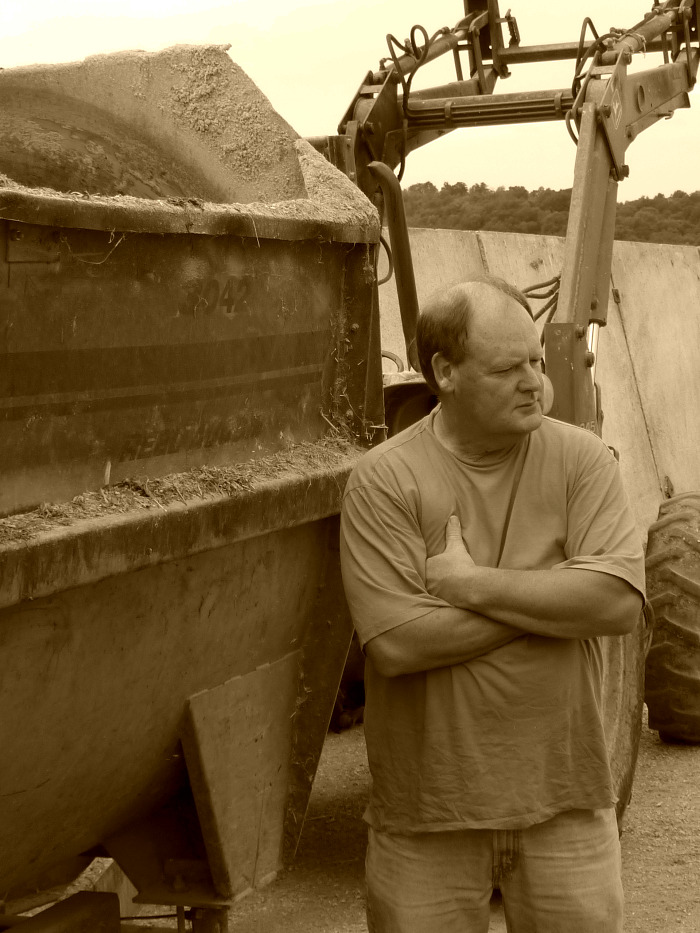
The Clifford Farm in Starksboro
In spite of what some in the industry are calling the worst ever returns on dairying, Eric Clifford is carrying on the family tradition come hell or high water. He’s determined to keep the land his forebears cultivated – all seven generations of them – in farming.
It hasn’t been easy. Since dairy prices plummeted to $11-$12 hundredweight (the equivalent of 11.6 gallons of milk) last February, Clifford estimates he’s lost approximately $250,000 on his 215-cow dairy farm in Starksboro. He and his wife, Jane, are looking into refinancing their 498-acre property.
“We have made the choice to stay in business,” Jane Clifford says. “The dairy farm has been in operation since the late 1790s, and we’ve chosen to say, OK, we’re going to use some of the equity we’ve built up. Our strategy has always been when times are good you pay down debt, you work within your means, you try to be as efficient as you possibly can and you work really hard.”
This fiscal conservatism has enabled the Cliffords to ride out previous milk market crashes. They don’t buy new “toys,” i.e. tractors and equipment, or borrow money for big expansions. Frugality is a way of life for them.
The Clifford’s place, located on Route 116, is a modest working farm in a valley lined with fields along the banks of Lewis Creek. The clapboard house and low-slung barns sit near the road. Wooded hillsides in the near distance bound the flat tracts of farmland.
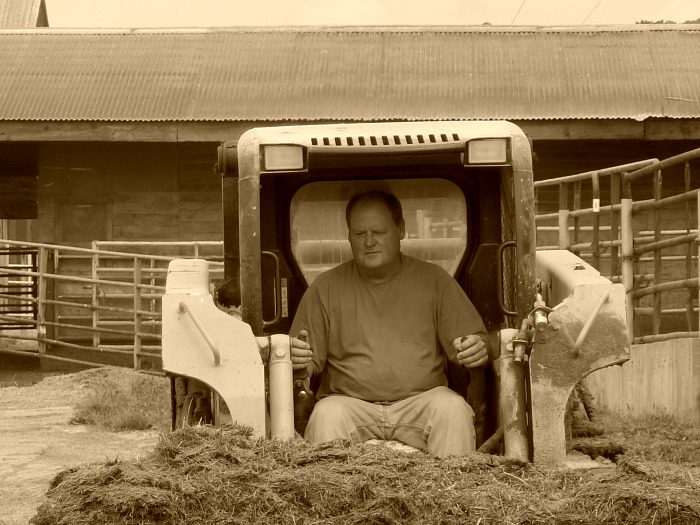
Eric Clifford was on a skidsteer, moving silage from a concrete bunker to a steel dumpster when I stopped by recently. He took a good half-hour out of his day to talk about how the farm is faring.
Though the workload never bothers him, he says the constant worry about finances is getting to him. Normally, he says he usually has no difficulty working out solutions to the day-to-day issues that come up on the farm, but lately he finds himself aimlessly standing in the farmyard contemplating his finances for minutes at a time. The facile answers typically at hand aren’t coming to him. The only thing he’s counting on right now is doing everything he can to tough out the slump.
“When consumption in the United States is down for dairy products and the export market is just a fraction of what it used to be and production is up, it’s not a very rosy picture out there,” Eric Clifford says. “Believe me, I’d love to be telling you that by Christmas we’d be getting cost of production and things would be booming. But there’s farms out there that don’t have any more borrowing power and the financial institutions just aren’t going to be willing to lend them any more money.”
The Cliffords, who belong to Dairy Farmers of America, an 18,000-member national dairy cooperative, received $10.50 cwt, or per hundredweight, last month for their raw milk.
Like most farms in Vermont, the cost of production at the Clifford’s – the expenses the business incurs for labor, grain and equipment – is in the $17-$18 cwt range.
Because the milk price is far below the cost of production, losses are mounting for farmers every day. According to Vermont Agency of Agriculture estimates, the state’s dairy farmers are spending roughly $100 per cow per month to stay in operation.
The Cliffords have lost more than $26,000 a month on average since the beginning of the year.
“We’re looking at what the Farm Services Agenc y (USDA) has to offer,” Jane Clifford says. “We are in a position where we have built up equity over the years. We will be using that to get through this next downturn.”
The Cliffords don’t anticipate a turnaround in dairy prices anytime soon. It could be next summer before their milk check gets close to the cost of production. USDA predicts the average market price will be $14.65-$15.65 per hundredweight in 2010.
“Hopefully, the industry will make some choices that we don’t get hit this hard again,” Jane Clifford says. “It’s always going to be cyclical. Milk is a very perishable product, but it seems that the cycles are longer and lower than any of us can remember so we need to do something about that.”
Blue Spruce Farm in Bridport
Marie Audet, who helps to run Blue Spruce Farm in Bridport, is working to change the cyclical nature of the milk market. She believes farmers must find a way to control the supply of milk in order to stabilize prices over the long term. Audet is one of the organizers of Dairy Farmers Working Together, a nonprofit group with national reach that is lobbying Congress to pass the Dairy Price Stabilization Act, which is designed to give farmers an opportunity to manage the milk supply more efficiently.
Blue Spruce Farm is one of the state’s few large farms. The three Audet brothers – Earnest, Earl and Eugene – milk 1,200 cows. They have 25 full-time employees, half of which are family members.
“There used to be a misconception,” Marie Audet says. “People thought if you had a bigger barn that you were a business, but it’s still all farm families, it’s just some families have grown bigger than others.”
Audet declined to say how much money the farm has lost since the beginning of the year, but if you do the math — 1,200 cows at an average cost of $100 per cow per month, based on Agency of Agriculture figures – you get the idea.
Audet summed up the situation this way: “We’re losing money everywhere.
“We’re making the same amount of money we were 40 years ago per hundredweight,” Audet says. “Ask yourself how you could survive if you were making the same money you did 40 years ago for a whole year. You would have to borrow money off your equity as well to pay your bills and feed your family. “
Grain, fertilizer, seed, insurance and equipment are not selling at 1970s prices. In fact, what the dairy industry calls “input” costs have escalated over the last five years.
The combination of higher expenses and record low milk prices puts farmers in an untenable position.
“We can’t really fix things as they need to be fixed,” Marie Audet says. “Our employees can’t get raises, we can’t make improvements that we had planned on making for our housing for animals. Everything’s been put on hold and then you’re borrowing money just to pay the bills.”
Ryan Brothers Farm in Craftsbury
Willie Ryan of Ryan Brothers Farm in Craftsbury decided he couldn’t stomach borrowing money to keep his dairy operation going. He and his brother, Marvin, sold their milkers under the Cooperatives Working Together herd buyout program in June. Up to that point, Ryan says they were losing $10,000 a month on their 197-cow operation.
“The way it looked, I was going to have to start borrowing money by September to keep the cows going,” Ryan says. “I’m 60 and my brother’s 63 and we decided we were too damn old to borrow money. Back when we were 35 we would’ve just slugged it out.”
Ironically, selling the herd turned out to be the best way for the Ryan farm to stay in business. The brothers planted crops last spring and kept 160 heifers. They plan to start milking again next spring, about the time the market begins to pick up.
“Instead of losing $100,000,” Ryan says. “I’m probably going to bank $100,000 out of the deal.”
Ryan, who is president of the Orleans County chapter of the Vermont Farm Bureau, is worried, though, about his fellow farmers.
“It’s gone beyond depressing,” Ryan says. “Farmers are actually scared. They owe more than their equity. I don’t know if you could sell a farm at the moment. A lot of people who’ve been conservative, all of a sudden, they couldn’t have an auction tomorrow and clear up their debts.”
