

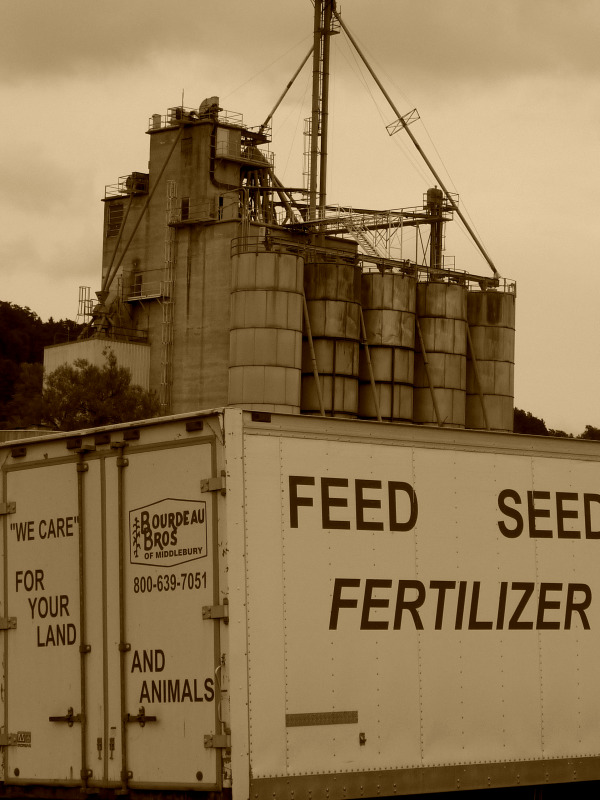
Unpaid bills pile up at local graineries, equipment dealers see business slow
Vermont farmers are sustaining unprecedented financial losses this year, and many are juggling bills in order to survive the severest downturn in memory.
As Diane Bothfeld, dairy policy analyst at the state Agency of Agriculture put it, “They’re shuffling who gets paid every month.”
That means agricultural vendors tied to the fortunes, or this case the misfortunes of the dairy industry, are bleeding red ink, too.
Agricultural suppliers around the state say they don’t know how long they can hold out.
Farmers are putting off purchases of tractors and dairy equipment, and dealers in Williamstown and South Royalton are seeing significant declines in sales and service calls.
Commodity businesses that supply grain, fertilizers, seed and chemicals to farmers, are in an even tougher situation because their products are essential for day-to-day dairy operations. Last spring and through the summer, several grain dealers in southern Vermont allowed farmers to rack up hundreds of thousands of dollars in unpaid bills, many of which are more than 60 and, in some cases 90 days, past due.
Unpaid grain bills pile up
The owners of Whitman’s Feed Store in North Bennington and Bourdeaus’ and Bushey Inc. in Middlebury say they’ve borrowed millions of dollars to cover their losses and because their delinquent account receivables have grown significantly, banks aren’t willing to lend them more money. Officials at Poulin Grain and Blue Seal Feeds did not return repeated calls.
Art Whitman, owner of Whitman’s, says he has extended $3 million in credit to farmers this year – three times more than he normally would. The regional grain company, which was founded by Art’s father in 1945 and employs 37 workers and has gross receipts of $24 million, serves 175 dairy farms in the Bennington area and Washington and Rensselaer counties in New York State.
“In the past with low milk prices, most farmers have relied on their suppliers to get them through,” Whitman says.
This time, though, the dairy downturn has been deeper and lasted longer than usual and farm debts have piled up more quickly. In addition, the tight credit market has made it difficult for businesses to borrow money for operating expenses.
“Our accounts receivable fluctuate dramatically and most banks don’t understand that,” Whitman says. “Banks will have a tendency to look at my accounts receivable and discount them a lot, just saying if anything is over 90 days we don’t consider it an asset at all, which isn’t true, usually very rarely does a farmer file bankruptcy.”
Jim Bushey, one of three owners of the agricultural supplier, Bourdeaus’ and Bushey, says his business is also suffering. The company, which operates three different legal entities, employs more than 150 workers and sells fertilizer, chemicals and grain directly to farms from 10 locations in New England, including a facility in Middlebury.
Bushey says, “Volume is down in both dollars and in physical tons,” and the company has borrowed “millions.”
Thirty to 35 percent of farm accounts are 60 days past due, he says.
“These numbers are such, it’s scary,” Bushey says. “When people are trying to juggle their money to pay for the electric light bill, to buy food for the family, get the kids ready for school, and then normally the schedule would be pay the smaller bills and try to cover as many of the people as possible.”
The biggest bill, the one farmers are most likely to put off, is the feed bill, Bushey says. It typically represents 20 to 25 percent of a farmers’ income, he says.
“That’s the bill that gets left because it is the largest and most difficult to pay,” Bushey says. “It’s the first one that doesn’t get paid and it doesn’t take long before it becomes an extremely sizable account.
Bushey says a single cow eats roughly 3 tons of purchased feed at an average cost of $750 per year. A farm with 1,000 cows can quickly rack up hundreds of thousands of dollars in bills.
“You’re talking a lot of money,” Bushey says. “We’ve got dairies that are spending over $100,000 a month in feed.”
In the spring, when farmers buy grain and hire Bourdeaus’ and Bushey to plant crops, they can run up accounts of $300,000 in 30 days, and $500,000 in a 60-day period, he says.
“People say, how can you allow an account to become $500,000?” Bushey says. “Well, that’s just normal and customary. That’s the kind of debt and the kind of business these farm businesses generate.”
Grain companies left holding the bag?
Bushey calls outstanding bills of 90 days or more “dead money” because banks won’t allow the company to borrow money against it.
“When you get to that point then I have troubles,” Bushey says. “I can’t use that money, and that creates an issue. I can’t extend money, that’s what it comes to. And at some point in time, we’re not there currently, we’re going to have to start limiting, if this crisis continues, we’re not going to have a choice. There comes a point in time when you physically can’t borrow any more money.”
Cutting farmers off, however, is a double-edged sword, as Art Whitman is quick to point out.
“If I don’t sell them grain they’ll go someplace else and I’ll never get the money because they’ll end up having to pay another grain supplier or they go out of business, Whitman says.
What happens when a farm goes out of business?
Jim Bushey says, “I’m going to be right behind them. How else does that work? There’s only so many failures that any entity can survive, and if some of these entities, these farms fail, and there’s gonna be some failures, it’s an opportunity for those failures to be switched into other ag businesses.”
In the event of a bankruptcy, unpaid bills for commodities are considered unsecured debt.
“The banker has the real estate,” Bushey explains. “He has the cows. If the farm equipment dealer sells him equipment he has a lien on the farm equipment. If a car dealer sells him a car or a truck, he has the car or truck as security. If the cattle dealer sells him a cow, he has the cow.
“When it gets down to people like ourselves, there’s nothing left,” Bushey says. “Everybody’s in front of you.”
Business slows for other agricultural companies
Other agricultural vendors are also facing red ink.
Jenny Cummings and her husband, Robert, the owners of New England Farm Systems in Williamstown, sell BouMatic milking systems, pipelines, parlors, gutter cleaners and vacuum pumps to 100 customers in Vermont. They typically gross $300,000 to $400,000 a year.
These days their customers aren’t scheduling regular equipment maintenance. Most of the Cummings’ business lately has been providing service for emergency breakdowns.
Because some customers have owed New England Farm Systems for more than a year, the couple has had to borrow against equity in their house to keep the business afloat, Jenny Cummings says. They’re carrying $45,000 in accounts receivable right now.
“Anytime it affects the farmers, it affects us,” she says. “The customers who pay very well are paying a little slower, and the ones that pay slow are paying very slow, and we’ve always had a hard time with the ones that just aren’t paying at all.”
Lawrence Trottier says his company, LF Trottier & Sons, which sells John Deere tractors in South Royalton and White River Junction, has seen tractor and equipment sales slow to a trickle this year. Farmers don’t even have the money to maintain their equipment, he says.
“We’ve seen a definite change this year in the amount of repairs for farmers,” Trottier says. “You usually find a farmer who even though he doesn’t think he can afford it breaks down a piece of equipment and in an emergency will purchase that. That’s been almost a non-happening. There have been very few purchases.”
Farmers were Trottier’s main customers when he started selling tractors 37 years ago, now he sells more lawnmowers and tractors to “weekend farmers.”
“We don’t get farm customers coming in,” Trottier says. “They buy a little oil and this or that, but you don’t see them coming in buying more than they absolutely have to. But you can’t blame them.
Trottier anticipates diversifying his business even more in the near future, and he isn’t alone. Art Whitman says as the dairy industry hits the skids, more agricultural vendors will have to shift their businesses toward consumer products.
“What’s going to happen is that as the number of farmers are either put under more stress or put out of business, people like us are going to find other ways to make a living and our main focus is not going to be agriculture,” Whitman says.
Copyright, Vtdigger.org
