

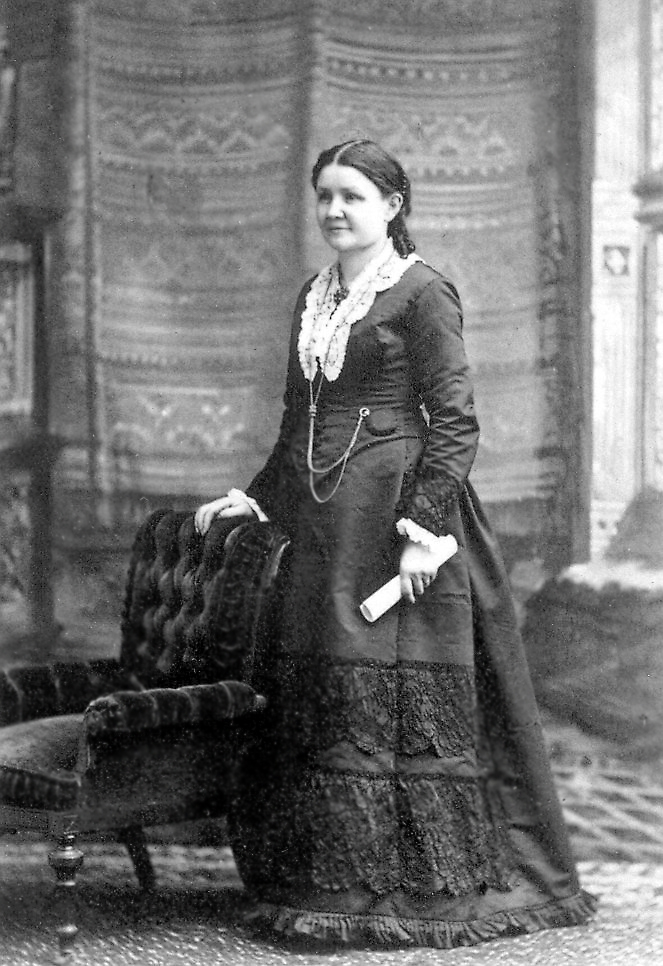

In 1870, Carrie Kilgore took a revolutionary action: She tried to vote.
Fifty years before women won the right in America, Kilgore presented her ballot to election officials, who promptly rejected it. She sued, representing herself in court “under my constitutional right to speak in my own case.” When the lower court refused her claim, she appealed to the state supreme court. Years later, she regretted not appealing to the U.S. Supreme Court.
In a life full of battles, this may have been one of her few regrets. Kilgore rarely shied away from a fight, even if it meant battling for years. Extraordinarily, at a time when few women worked outside the home, she managed to become not only a medical doctor, but, after an extended legal battle, also a lawyer, making her an early and dynamic leader in the struggle for women’s rights in America.
Kilgore was born Carrie Sylvester Burnham in 1838 in Craftsbury, the child of James Elisha Burnham, a wealthy businessman. Carrie was only 3 years old when her mother, Eliza Annis Arnold Burnham, died from complications in childbirth.
James Burnham remarried within a year of Eliza’s death. His new wife, Philena Sophia Sprague, taught the girls household skills, such as cooking, sewing, gardening and how to drive the family cows to and from pasture. Most importantly, the girls learned to work hard and use their time wisely.
Her father valued schooling. “(W)hen he died,” Carrie later wrote, “he intended to leave his daughters with a good education, an extraordinary thought for a man in those times.”
But James died when Carrie was only 12, and she was forced to suspend her studies. Her stepmother, Philena, needed her help in the family-owned woolen mill and in caring for an extended household of 18 people.
By the age of 15, however, Carrie was able to begin her own career, teaching at schools in Craftsbury, Greensboro, Danville and Newbury, which helped fund her continued studies at Craftsbury Academy and Newbury Seminary.
Carrie felt she needed to get the most out of each day. She would stay up late at night studying, and when she went to bed she would tie her arm to the bedpost. It was a trick to make sure she wouldn’t get too comfortable and oversleep. She wanted to rise early to study more. Kilgore and her roommates — one of her sisters and a mutual friend — made their own clothes late at night.
She noted that the young men who boarded at the same house could serve as ministers on Sundays to earn enough to pay their board, an option unavailable to the young women.
Carrie moved to Wisconsin to teach for a number of years before settling in New York City, where she enrolled for classes at Bellevue Hospital. Having studied and taught physiology, she wrote, “I wanted to know the human system as I could a plant or flower in my botanical work.”
She was one of only 30 women in a class of more than 500. The women faced harassment from the men, including at least one professor who “repeatedly exposed” patients, both male and female, in front of the women, in hopes of shocking them into quitting the program. After these classes, the male students would line the hallways, forcing the women to walk an intimidating gauntlet to leave the building. But, she wrote, “(w)e continued our studies without noticing apparently any of the insults heaped upon us.”
In 1865, at the age of 27, she received her degree of Doctor of Medicine and worked as an assistant physician at a medical institute in Boston. There she helped a male doctor prepare a book on physiology, but received no credit when it was published.
Perhaps because of this affront, she moved to Philadelphia and started running a “French School for Young Ladies,” essentially a finishing school for daughters of fashionable families. Not surprisingly, the school “did not satisfy my highest idea of an education for girls,” she wrote.
She eventually closed the school and began studying law with Damon Kilgore, a lawyer she had met in Wisconsin who had since moved to Philadelphia. He, too, was far ahead of his time. Together they waged war against the second-class status of women. When they married years later, in 1876, they signed a then-radical prenuptial agreement stating that she would retain her right to own property, which by law women surrendered when they married.
Carrie Kilgore recalled that after she argued for her right to vote before the Pennsylvania Supreme Court, one of the justices “congratulated me upon my effort, and asked for a copy of the argument.” When her argument was published, a U.S. senator from Massachusetts sent a copy to Harvard’s library.
Despite the compliments, the court ruled against her. She had argued that the Pennsylvania Constitution granted the vote to all “freemen,” which she said was a generic reference to all citizens. The power of her argument apparently alarmed some men, because the next year, a state convention amended Pennsylvania’s constitution to say that “every white male citizen” could vote.
In 1871, Carrie Kilgore applied to study law at the University of Pennsylvania. The dean of the school, however, said neither women nor African-Americans belonged at the school. “(I)f they admit a woman I will resign,” he wrote, “as I will neither lecture to (blacks) nor women.”
Kilgore didn’t quit, and after a decade-long struggle, she was allowed to study law at Penn. Two years later, at the age of 45, she became the school’s first female law graduate.
She won immediate admission to the Orphan’s Court of Philadelphia, since judges believed the care of children fell within a woman’s domain. But judges barred her from other state courts. For several years, she fought to practice before the state’s Common Pleas Courts.
“It was tedious to recite the various steps which the lady took to secure her footing in court,” wrote The New York Times, which like other U.S. newspapers, and several European ones, reported on her efforts. “(T)o detail the many rebuffs which she encountered would arouse the indignation of the impartial observer.”
In 1884, Kilgore finally won admission to the state’s Common Pleas Courts. Then in 1885, she persuaded the Pennsylvania Legislature to allow women’s admission to the bar. The following year, she won admittance to practice before the Pennsylvania Supreme Court and became the first woman to serve as an officer in a state judiciary. In 1890, she became the fourth woman ever allowed to practice before the U.S. Supreme Court.
When her husband died in 1888, she was left with two young daughters to raise. Some suggested she place her children in a home while she took over her husband’s law practice. “Yes, they shall be put in a home, and I shall continue my profession,” she responded, “but it shall be a home of my making. They have lost their father; they shall not lose their mother while I live.”
She continued to practice in Philadelphia for the next 21 years.
In 1908, she was one of five passengers on a hot-air balloon flight, when the balloon ruptured and plummeted 3,000 feet into the Schuylkill. Miraculously, all five survived the harsh landing in the river. Asked by a reporter whether the incident had scared her off future balloon rides, she replied: “No, I am not afraid to go again.” Her only regret, she said, was that she would have hoped for a smoother ascent. She no doubt would have said the same thing about her life.

