

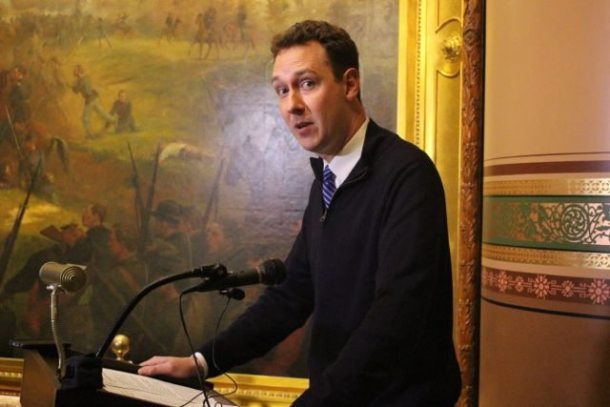
Conor Casey, the executive director of the Democratic Party, said he was “happy to hear” that Scott will address the issue in a press conference on Saturday, but he was skeptical that the Republican candidate will adequately allay fears that he would personally benefit from government contracts should he become governor.
Scott is co-owner Dubois Construction, an excavation company based in Middlesex. The Agency of Transportation and municipalities have held contracts with Dubois. Since 2001, the company has received $3.8 million in state contracts. Scott’s share of the company is valued at $2.5 million; he made $46,000 in profits last year.
As governor, he would oversee agencies that approve bids for construction work.
Scott has said he would put the company in a blind trust so that he would have no knowledge of where revenues for Dubois come from.
He plans to make an announcement Saturday about his plans for “full separation” from Dubois. On Friday, Scott would not disclose what he would be discussing at his press conference. The lieutenant governor would not confirm or deny if he was selling a share of the business.
Casey says a blind trust “doesn’t pass the straight face test.” It would be impossible, he says, for Scott to create a firewall. The Dubois name would be “instantly recognizable” to officials in state government who decide what firms win contracts and the knowledge that requests for proposals had been submitted by their boss’ company could give Dubois an edge in the bidding process.
“How will the blind trust prevent his company from getting preferential treatment during the procurement process?” Casey asked. “How will Phil Scott’s blind trust prevent his company from benefitting from insider information?”
While blind trusts are sometimes used at the federal level, Casey cited federal statutes that say these kinds of arrangements don’t go far enough to protect the public interest.
“Conflicted assets transferred to blind trusts do not lose their taint and are subject to restrictions until they are sold,” he said.
In order to avoid a conflict of interest, Casey said Scott must completely separate his financial interests from DuBois Construction or pledge not to receive state contracts while he is in office.
“Scott left voters in the dark during the primary and as early voting is starting he has still failed to answer the question,” Casey said.
State employees are prohibited from having any financial interest in business transactions in “their area of influence in state government,” according to personnel policies promulgated by the Department of Human Resources. An executive order also bans gubernatorial appointees from owning or having a direct or indirect financial interest in an entity that does business with the state.
If Scott was elected and continued to receive state contracts as a co-owner of Dubois, Casey said he would be obliged to rescind the state’s personnel policy and the executive order regarding appointee conflicts.
