


[B]URLINGTON — A major selling point for the $220 million Burlington Town Center mixed-use redevelopment is that the proposal for as many as 274 condos and apartments includes a percentage that will be affordable housing.
But critics of the project say a previous downtown development that also promised affordable housing — but didn’t build it — should serve as a cautionary tale for those hoping the Town Center project will bring more reasonably priced housing downtown.
City officials and Town Center developer Don Sinex say a preliminary development agreement, approved by the City Council on a 10-1 vote in May, guarantees that at least 20 percent of the housing units in the Town Center development will be what’s considered affordable.
However, the idea that Sinex could “simply pay the fee” to avoid building affordable housing has persisted among project opponents online and at public meetings.
That’s partly because, for many, this isn’t their first rodeo. They’ve opposed other developments in the past and have a long memory for episodes where the public interest appeared to fall prey to developers’ economic interests.
In 2003, the development company Retrovest signed a deal with Burlington to redevelop the last city-owned urban renewal parcel at the corner of Battery and Cherry streets, a project that came to be known as the Westlake development.
The project included the Westlake Condominiums, the Courtyard Marriott Hotel and the expansion of the Lakeview parking garage. The developers were supposed to put a mixed-use commercial and residential building known as the Westlake Lofts on the land where Hotel Vermont is now, city records show.
The city’s inclusionary zoning ordinance requires that a certain percentage of housing developments be affordable. And the Westlake Lofts project was to include additional affordable housing so the developer could earn height bonuses for the hotel and condos.

All four components of the project, including the lofts, were approved by the Development Review Board as a single package in 2005.
The project was required to provide 12 units of affordable housing, but only seven were to be constructed in the loft building, with the board and the city accepting a $60,000 payment to support the construction of five other affordable units elsewhere — a sum that affordable housing advocates bemoaned at the time as paltry.
Ire over the size of the payment led to a 2006 change in Burlington’s inclusionary zoning rule that set the fee for not building affordable housing at $100,000 per unit with a multiplier of 1.5 times the number of required affordable units.
The Westlake development was grandfathered around that change in a later settlement with the city, because the ordinance was revised after the project received DRB approval.
But once the project got the green light, it became clear the company wouldn’t be building either the lofts or the attendant affordable housing. Department of Planning and Zoning records show that footings from the Lakeview garage foundation extended into the loft site, increasing construction costs beyond what the company could manage — especially as it struggled to fill the 30 luxury condos already built.
Instead, the city reached a settlement with the developers in 2008 that would allow them to pay $371,250 into Burlington’s Housing Trust Fund. The settlement also returned the land where the lofts were supposed to go to the city, paving the way for the arrival of Hotel Vermont through a subsequent deal with different developers.
The DRB reluctantly approved the payment, registering its concern that the developers “appear to have reaped a benefit from the profitable components of the project without having to fulfill their commitment to complete the least profitable component, giving the appearance that they have ignored the explicit conditions of the board’s approval of the project,” city records show.
That money ultimately supported the construction of affordable housing at the Thayer Commons and Wharf Lane apartments, but the $371,250 wasn’t fully paid until 2011. The city retained leverage during that period by withholding a final certificate of occupancy, though the developers were given a temporary certificate while completing the payment, records show.
Michael Long, who served on the DRB at the time, said he recalls feeling a total lack of control over the outcome. Long is now a member of the Coalition for a Livable City, a group that opposes a zoning change and the current design for the Town Center redevelopment.
“If you read the (inclusionary zoning) ordinance it seems like they covered their bases, but if you look at the Westlake development, they built the project with bonuses, and then they came back and said, ‘Oh, jeez, guys. Sorry, we can’t do this,’ and the city didn’t have any real way to hold them to the agreement,” said Long, a retired English teacher.
Attorneys for the Westlake developer argued, and the city and DRB ultimately concurred, that the issues with the garage footings constituted an “unforeseen change in circumstances” that prevented Retrovest from building the lofts.
Preventing another Westlake
Long and other project opponents have questioned whether the unforeseen could scuttle the affordable housing promised at Burlington Town Center.
Sinex points to his agreement with the city to include affordable housing on the site. Affordable housing is also required for the expedited Act 250 review his project will seek.
“I have stated many times that, if the project is allowed to proceed as contemplated in the predevelopment agreement, we will build the inclusionary residential housing,” Sinex said in a statement. “I’ve agreed to that and will do it. The city has been very clear that it wants the inclusionary housing units built as a part of the project, and I agree.”

Mayor Miro Weinberger said he too is confident that, at the very least, Sinex will meet his obligations under the city’s inclusionary housing ordinance.
Weinberger said no developer has sought to make a payment in lieu of affordable housing in the decade since the fee was increased. Further, he said the city will not issue a certificate of occupancy for the Town Center project unless the inclusionary zoning requirement is met — the same detente that eventually led Retrovest to pay what it owed the city.
In addition, a VTDigger review of city records and the agreement with Sinex reveals at least two notable differences between the current deal and the city’s agreement with Retrovest for Westlake.
First, a provision in the Westlake agreement explicitly stated that building affordable housing off site would be acceptable if building it into the project proved too difficult.
In a 2008 letter to the DRB, an attorney for Retrovest pointed out that the Westlake development agreement stated that “in the event the on-site housing is not feasible,” the city agreed to recommend a payment to the Housing Trust Fund to satisfy the inclusionary zoning requirement. No such language exists in the Town Center agreement.
Second, while project opponents point to language in the Town Center agreement that simply states it must comply with the inclusionary zoning ordinance — a provision that opens the door to a payment instead of on-site affordable housing — the agreement also states the project must comply “with the definition of a ‘priority housing project’ under” Vermont’s Act 250.
Qualifying as a priority housing project has the benefit of allowing an expedited Act 250 review, but to meet that designation a project must also meet the state’s definition of “mixed income housing,” which means at least 20 percent affordable units for at least 20 years.
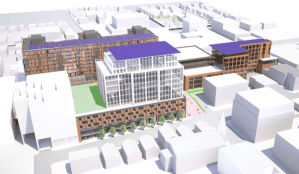
For the Town Center project that would mean roughly 55 affordable units, which is what Weinberger and Sinex have promised publicly on numerous occasions. It’s also what’s reflected in floor-level diagrams of the building design included as an attachment to the city’s agreement.
A priority housing project also must be located entirely in a designated downtown, and the statute does not allow a payment to satisfy the affordable housing requirement.
The Burlington zoning that applies to the project includes more stringent affordability rules than the state’s, including that inclusionary housing remain affordable in perpetuity — not just for 20 years.
Burlington’s standard for inclusionary zoning is rental housing that costs 30 percent of income for a household making 65 percent of the median in the region. That equals roughly $1,000 a month for a one-bedroom apartment on income of just under $40,000 annually.
Affordable housing advocates and some city councilors have questioned whether Burlington’s standard actually offers rents low-income residents can afford, and the city has said it plans to re-examine the standard in the future.
When the City Council approved the agreement with Sinex in May, it debated whether the affordable housing contemplated by the project was sufficient and whether it was being shunted off into its own section on one of the lower floors — a design feature that rankled Progressives on the council as well as project opponents — but there appeared to be consensus that it would be built on the premises.
“I think we’re in a position to ask for more in this agreement when it comes to affordable housing,” said City Councilor Max Tracy, P-Ward 2, at the time. Tracy was the lone no vote, though fellow Progressives registered similar concerns.
While the Town Center agreement allows the city to weigh in on the design and location of the different types of housing, it states that Sinex will have “complete discretion and shall retain final control over such issues.”
