[T]he Vermont Human Rights Commission has found that the state discriminated against a young man with mental health problems.
The 18-year-old man, referred to by the initials C.S., spent a grim two-and-a-half year period in segregation, according to a commission report. C.S. was alone in a single occupancy cell with limited recreation time, restricted access to books or television, and little human interaction.
The five-member commission voted four-to-one to back the findings of an investigator that there are reasonable grounds to believe the Department of Corrections discriminated against C.S. because of his disability and violated Vermont law.
The commission says the department violated a federal mandate that requires people with disabilities to be served in the most integrated setting possible under the Fair Housing and Public Accommodations Act.
Karen Richards, executive director of the Vermont Human Rights Commission, said the report shows that prison segregation of the young man “exacerbated his mental health issues” to a terrible degree.
Two years and four months at Southern State Correctional Facility
When C.S. was 17, he was charged with sexually molesting two younger relatives. In October 2010 when he was incarcerated, he had not been convicted of a crime. He was 18 years old.
C.S. had been in the custody of the Department for Children and Families for about a decade at that point. Because there was no other place for him to live at the time he was charged, and he did not have a legal guardian, he was sent to Northern State Correctional Facility.
After several months, C.S. was transferred to Southern State Correctional Facility in Springfield.
Opened in 2003, the Springfield prison is the state’s newest facility. With 370 beds, it is the second largest in Vermont, with an extensive medical center and two units dedicated to mental health care. It houses many of the inmates with complex medical and psychiatric needs.
C.S. was at Southern State for two years and four months, beginning in April 2011. The Human Rights Commission investigation determined he was held in segregation for that entire period.
The Human Rights Commission investigator writes in the report that they had “no doubt” that C.S. had several psychological disabilities.
From childhood, he was assessed with developmental disabilities, and he was diagnosed with several significant psychiatric conditions, including bipolar disorder and post-traumatic stress disorder. As a young child, he had been neglected, abused and sexually victimized, according to the report.
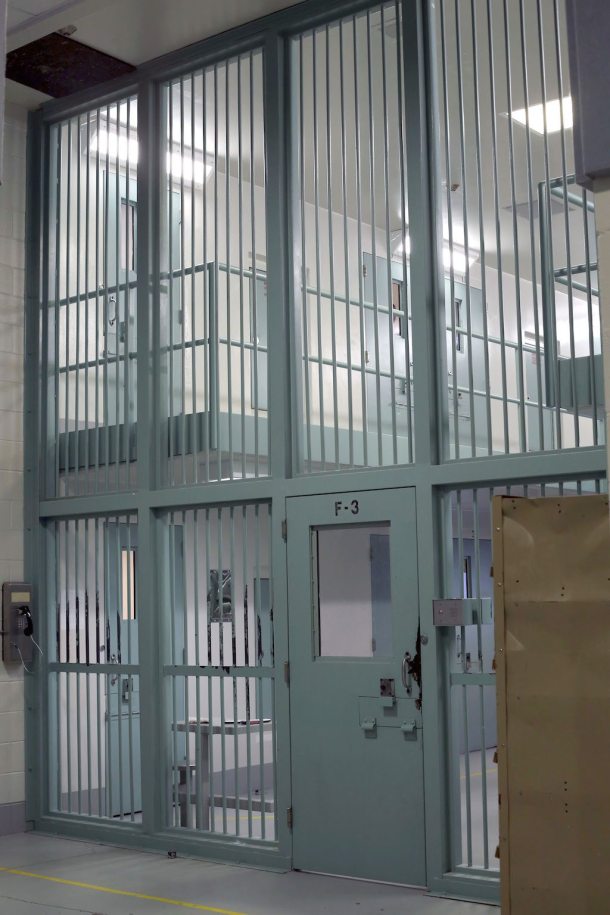
The investigation states that C.S. lacked fundamental social skills, which led him to be the target of extreme violence in prison — including one instance in 2012 when a fellow inmate beat and strangled C.S. When correctional officers found him he was “clinically dead.” The attack occurred in Foxtrot, Southern State’s restrictive housing unit.
The report cites childhood psychiatric and special education evaluations of C.S., and two evaluations completed while he was at Southern State. Yet, the investigation says, there is little evidence that personnel at the prison were aware of his psychological assessments.
“This suggested to this investigation that the significant care providers did not know who he was, or why he was the way he was or care why he was the way he was,” the report states.
Meetings between staff of Correct Care Solutions, the private health care company the DOC contracted with, and C.S. were “quick and dirty” interactions that were “superficial, ineffective,” according to the report. The meetings with the staff were held through a cell door or in a space that wasn’t confidential, and he was “almost always” shackled during those interactions.

C.S. began to self-mutilate his genitals in September 2012. Between then and when he was transferred out of SSCF on Aug. 30, 2013, there were 29 documented instances, according to the investigation.
In one instance, he reportedly tied “15” homemade ropes around his penis, causing it to turn black. He inserted objects into his urethra, including at one point inserting a pen, which led to his hospitalization.
There are also records of other instances of self-harm. C.S. reportedly used chips of his teeth or pieces of linoleum to cut himself. He picked at a vein until blood covered the floor of his cell.
The investigation writes that staff at Southern State “took the position that C.S. did these acts to manipulate staff and ‘the system’ and termed his self-mutilation ‘choice behaviors.’”
In January 2013, shortly after C.S. was hospitalized, Dr. Meredith Larson, the DOC’s chief of mental health developed a plan for his care that involved instructing staff to “ignore” him when he acted out.
She also designated C.S. as seriously functionally impaired, or SFI, a classification used solely in prison to indicate individuals with mental illness or other conditions that may cause them to behave differently than the general population. C.S. later told an investigator that his situation at Southern State did not change after he received the designation.
The investigation concedes that C.S. “could be manipulative and attention-seeking,” alluding to a statement that he made that indicated he was satisfied to have cost the state money for the hospital trip after he inserted the pen into his penis.
The investigator indicates that C.S. was disruptive, and at times “violent and incredibly vulgar.” He racked up 153 disciplinary reports during his time at Southern State.
“But behind this kind of manipulation there seemed to be the deepening madness and despair of a person who was already seriously damaged from childhood,” the investigation states.
After more than two years, Mark Potanas, the Southern State superintendent, requested that C.S. be transferred to another facility. Staff at his facility, he wrote, “appear to be at an impasse” with C.S.
The segregated cell
The investigation found there were “really minimal efforts” at Southern State to treat C.S. and provide him with services to allow him to move safely into a less restrictive environment, Richards, executive director of the commission, said.
Richards said that the commission does not intend to downplay the seriousness of C.S.’s situation and behavior.
At the time that C.S. first went into segregation at Southern State, his criminal charge had not yet played out in the courts. It was not clear whether his case would be adjudicated in adult criminal court or on a juvenile docket, as he was age 17 when the charges were brought.
In fact, C.S. was not convicted until March 2013, when he pleaded guilty to the charges.
Richards noted that C.S. initially went to prison in 2010. “Had he had a guardian he would have been out in the community,” she said.
“The contrast between out in the community and a seg cell is just unbelievably stark,” Richards said. “You almost can’t get any more disparate than that.”

The investigation also details of C.S.’s record after he was moved to Northern State Correctional Facility in September 2013.
Staff there worked with C.S. to set up short-term case plans, establishing rewards for good behavior. In his first few weeks at the facility in Newport, he was rewarded with things like a two-hour period with a newspaper. Eventually, incentives increased to a limited amount of time with a video game, time working out in the gym, getting a job in the prison.
In August 2014, almost one year after moving to Northern State and after extensive work with staff, C.S. entered a general population unit.
Segregation and mental illness
The practice of placing prisoners with mental illness in segregation units has come under scrutiny nationally and in Vermont.
In January, President Barack Obama announced a ban on holding juvenile offenders in solitary confinement in federal prisons — part of a package that also included expanding use of “secure mental health units” for inmates with serious mental illness.
DOC Commissioner Lisa Menard said in an email this week that she cannot comment on the case because it is not resolved. She added, “As with any report, the department considers all information and recommendations provided.”

Menard said that the DOC has processes to review cases when prisoners are put in segregation, which include several tiers of review. If the inmate has mental illness, mental health staff are involved in the review process.
“Ideally, individuals can be placed in general population,” Menard said. “The safety and security of the facility and certainly the safety and security of the individuals are considered when making these decisions.”
“We regularly review utilization of segregation in general and continue to try to implement alternatives such as behavioral plans,” she wrote.
AJ Ruben of Disability Rights Vermont said Tuesday that the use of the Alpha Unit, which he says is primarily a segregation unit, for detainees and prisoners with mental illness is troubling, particularly when contrasted with the services that would be available to those same individuals were they in the community instead.
“The fact that you’re a prisoner doesn’t mean that you should be subjected to torture instead of treatment,” Ruben said.
Richards, the director of the Human Rights Commission, said the correctional system should provide mental health treatment to inmates instead of employing punitive measures like segregation.
“Ultimately folks are released out into the community again when they’ve finished serving their sentence,” Richards said. “The cost of serving them in the community is going to be much higher than it would be if they received adequate mental health treatment in the prison,” she said.