

[B]ernie Sanders’ path to the Democratic presidential nomination has narrowed over the past month, and Tuesday’s tough results make the Vermont senator’s chances almost invisibly slim.
Sanders won Rhode Island, but lost four crucial states to Hillary Clinton, and the losses, on the heels of last week’s New York defeat, make it nearly impossible for him to catch up in the race for nomination delegates.
Clinton won Pennsylvania, the most delegate-rich of the night. She also captured Maryland, Delaware and Connecticut, beating Sanders by double-digit margins in three out of the four victories.
Clinton’s already impressive lead in the number of pledged delegates will grow to more than 300 from Tuesday’s results, a whopping number that requires Sanders to win every remaining state by tremendous margins.
With super delegates added into the equation, Clinton has earned nearly 90 percent of the delegates required to clinch the nomination.
Sanders campaigned earnestly in all five states over the past week, even as polls showed he was in a tough spot.
He held huge rallies in Baltimore, Providence, Philadelphia and New Haven. On Sunday he was endorsed by the United Electrical, Radio and Machine Workers of America, a national union comprised of 35,000 members.
“From coast to coast people are standing up, they are fighting back and they are saying that we need a government that works for all of us, not just wealthy campaign contributors,” Sanders said during a Pittsburgh rally Monday night.
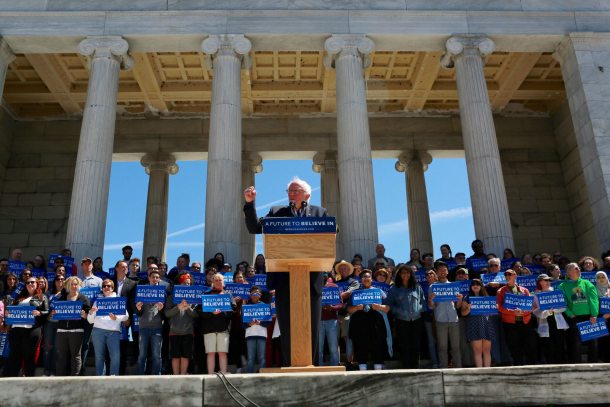
On Tuesday night, Sanders spoke at a rally of more than 6,000 in West Virginia, where voters go to the polls on May 10.
He spoke before the results had been announced, and did not address the day’s voting.
Instead, he tried to put his campaign in perspective. He pointed to national polls that show a rising line of popularity since he first announced his candidacy nearly a year ago on the shores of Lake Champlain.
“We had no name recognition outside Vermont,” Sanders said. “And I want all of you to get up to Vermont and visit our beautiful state.”
Sanders then decried the closed primary voting rules that were imposed in four out of the five states that voted Tuesday — as well as New York, where Sanders lost badly last week. Closed primaries prohibit one of Sanders’ strongest constituencies — independent voters — from casting ballots.
Sanders then went on to say that his campaign was fighting against a political family — the Clintons — that had waged three impressive presidential campaigns.
“The fight that we are waging is not an easy fight,” Sanders said. “But I know you are prepared to wage that fight against the 1 percent, against the billionaire class, against a small number of people with incredible wealth and incredible power who control our economic life, our political life and our media life.”
The Vermont senator has pledged to stay in the race through mid-June, reiterating Tuesday to The New York Times that he wouldn’t bow out “until the last vote is cast.”
In the same article, senior adviser Tad Devine said the campaign would reassess the race Wednesday while making clear that Sanders would not bow out.
“If we are sitting here and there’s no sort of mathematical way to do it, we will be upfront about that,” Devine told the Times. “If we have a really good day, we are going to continue to talk about winning most of the pledged delegates because we will be on a path toward it.”
Following the New York Times story, a number of high-level Sanders aides rejected Devine’s comments, including spokesman Michael Briggs.
“There’s nothing to reassess,” Briggs said in an email. “He’s made it clear that he’s going forward to give voters in California and every other state that still hasn’t voted a voice and a choice in the democratic process.”
The next state on the primary calendar is Indiana, where 92 delegates are in play and voters go to the polls on May 3. A total of 14 voting contests remain, and polls put Clinton ahead in many of the upcoming states.
In his speech Tuesday, Sanders looked back on a surge of wins last month, adding “as of today, we have won 16 primaries and caucuses all over this country, and with your help we’re going to win here in West Virginia.”
Clinton, meanwhile, made her remarks from Pennsylvania, instead projecting to the future.
“With your help, we are going to come back to Philadelphia for the Democratic national convention with the most votes and the most pledged delegates,” Clinton proclaimed to applause.
“And we will unify our party to win this election,” she said.

