

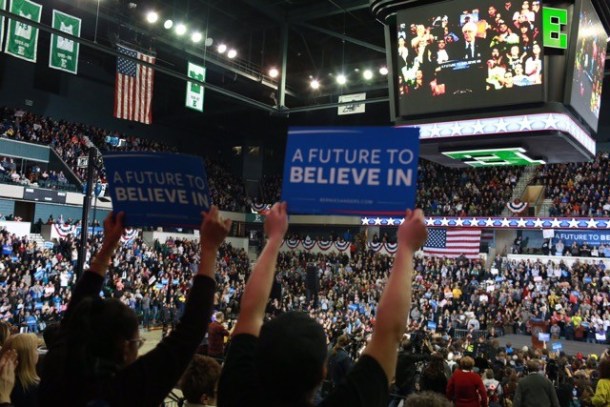
[W]hile the fight for the presidency plays out in public with primaries and caucuses, a different battle is being waged behind the scenes — the effort to win over superdelegates to the national convention, many of whom have already declared the candidate they will back.
In the public fight, Hillary Clinton, the narrow winner in Iowa, and Sen. Bernie Sanders, who finished first in New Hampshire, appear to be neck and neck. But in the backstage battle, the margin is lopsided, raising questions about the process.
The nominating convention isn’t until July, but Sanders allies have amped up criticism on the superdelegate count in the Granite State, where Clinton came out badly bruised, losing the popular vote by more than 20 points. Even so, she managed to secure a few more delegates than Sanders.
That revelation prompted MoveOn.org and the New Hampshire Republican Party, which sees Sanders as a weaker general election candidate, to circulate petitions demanding superdelegates follow the will of voters.
While hundreds of superdelegates have already committed to Clinton — including a number of Vermont political stalwarts many of whom are uncommitted — say it’s too early in the primary process to officially endorse.
Sanders recently met with a number of superdelegates. He said over the weekend on CBS’ “Face the Nation” that he was confident he could eventually garner the support of party leaders across the nation.
“I think if we continue to do well around the country and if superdelegates — whose main interest in life is to make sure that we do not have a Republican in the White House — if they understand that I am the candidate and I believe that I am who is best suited to defeat the Republican nominee, I think they will start coming over to us,” Sanders said.
While Sanders holds a slight edge over Clinton in regular delegates, 36-32, his lead dwindles when superdelegates are taken into account.
Clinton has picked up 87 more superdelegates since New Hampshire, bringing her overall delegate lead to 481 to Sanders’ 55, according to an Associated Press tally released Thursday.
There are 712 superdelegates nationally. Nearly 200 remain uncommitted, according to the Associated Press. The superdelegates represent about 30 percent of the 2,382 delegates needed to claim the Democratic Party nomination.
Delegates are allowed to flip at any time before the summer convention in Philadelphia, where the presidential nominee will be chosen.
Sanders has picked up a handful of superdelegates since New Hampshire. He is banking on a wave of primary wins to promote his electability and pressure Clinton loyalists to flip sides.
Sanders’ quest for Vermont superdelegates
While Sanders is projected to capture a decisive win in Vermont – and net most of the 16 delegates — Clinton could easily capture a majority of the state’s 10 superdelegates.
In an interview with VTDigger on Thursday, one of those super delegates — Rep. Peter Welch, D-Vt. — wouldn’t say who he would endorse for the presidential race.
“It is ideal for the party when there’s an alignment between what the overall popular vote is and the so-called ‘superdelegates,’” Welch said Thursday. “If there’s a big divide at the convention, that’s really bad for the party.”
(However, on Friday, less than 24 hours later, Welch apparently dropped that view and declared his support for Sanders on Vermont Public Radio. His chief of staff said he made the decision Friday morning.)
Clinton has already secured four other Vermont superdelegates: U.S. Sen. Patrick Leahy, Gov. Peter Shumlin, Former Gov. Howard Dean and Billi Gosh. Other superdelegates include Richard Cassidy, a lawyer who served in the Dean administration, and Sanders himself, who as a member of the state’s Congressional delegation is granted a vote.
The uncommitted superdelegates include Rep. Timothy Jerman, D-Jericho, Dottie Deans, chair of the Vermont Democratic Party and Jim Condos, the Vermont Secretary of State.
“I go back and forth on my decision all the time,” Deans said. “I’m really trying to listen to not only Vermonters, but also the nation.”
Jerman said he wants to take into account Sanders’ “native son state” status, but he did not fault the Vermont delegates who have backed Clinton.
“A lot of the people from our state who have made a decision have very personal contacts with both of the candidates,” Jerman said. “They’ve known them for years.”
Nationally, Sanders’ superdelegates include U.S. Reps. Keith Ellison and Raul Grijalva, who often stump on the trail for Sanders.
Former Sen. Paul Kirk of Massachusetts, a longtime confidant of Ted Kennedy, has also thrown his support behind Sanders, as well as a few other party leaders nationally.
While the Sanders superdelegates often praise his policies, they also say Sanders has the potential to bring in new voters to the Democratic party – a common reason for a superdelegate endorsement.
For Grijalva, an Arizona progressive, Sanders can better attract Latino voters. Ellison says Sanders’ economic message has powerful potential in African American communities.
“I determined that Senator Sanders offers the greatest opportunity for down ballot victories in 2016,” said Jake Quinn, a North Carolina delegate and activist who is backing Sanders. “If Sanders tops my ticket, he will attract unaffiliated voters and Republican voters.”
Chad Nodland, a North Dakota delegate and lawyer who backed Sanders last summer, said that even if his state swings towards Clinton, he believes that Sanders is the right candidate for his constituents.
“If I had the chance to sit down with each and every one I think I could convince them that Bernie is the right choice,” Nodland said.
While the superdelegate issue has all the signs of a full-blown scandal to Sanderistas, their mistrust of the Democratic National Committee is nothing new.
The Sanders campaign has criticized members of the Democratic National Committee – especially chairwoman Debbie Wasserman Schultz –as establishment party actors working to help Clinton.
They have charged the DNC with organizing a low-visibility debate schedule and unfairly cutting the campaign off from crucial voter data after a breach by a Sanders staffer.
Schultz confronted the dissonance between delegates and voters on CNN last week, saying “Unpledged delegates exist really to make sure that party leaders and elected officials don’t have to be in a position where they are running against grass-roots activists.”

