



Warm weather in December led to below average ticket sales and low turnout during Christmas week at ski areas in Vermont, industry representatives say, but ample time remains to post solid numbers by the end of the season.
Killington resort has seen slower-than-average sales in spite of operating the only lift in the Northeast in the early season, said Michael Joseph, the resort’s communications manager.
Over Thanksgiving weekend the mountain saw about 30 percent of the sales seen last year at the same time, Joseph said.
For part of the 59 days the mountain’s been open this year, it offered only intermediate and expert terrain as a result of poor snowmaking conditions.
“It was definitely a challenging start to the year, and we had to figure it out on the fly,” he said. “But the weather’s definitely turned wintry here. It’s looking like we’re going to get some serious cold.”
The below zero temps that hit after Christmas were good news for the mountain’s snowmaking, Joseph said.
Mad River Glen President Jamey Wimble said his area weathered the warm spell without any terrible consequences.
“For us, we’re predominantly natural snow, so it’s not that abnormal for us to miss Christmas week,” he said. That is the case probably half the time, Wimble said.
The business copes by running the mountain with a lean staff, he said. “We’re not incurring the big expenses other areas are, trying to be open, trying to make snow,” Wimble said.
Unseasonable weather is fairly common in the Northeast, according to David Kaufman, UVM senior lecturer in parks, tourism and recreation.
“The best winter is always a normal winter – it’s cooler when it’s supposed to be cooler, it’s cold when it’s supposed to be cold, it snows when it’s supposed to be snowing, and it’s sunny all summer,” Kaufman said. “Unfortunately, that doesn’t happen that often, and as a result, people in tourist-based industries in Vermont kind of just roll with it and hope for the best.”
When Mad River Glen opened its first chair lift in the 1940s, Kaufman said, there was no snow on opening day, and people couldn’t ski. Unpredictable weather is simply a fact of the industry that resorts must factor into their business models, he said.
“If you start to worry about weather on a daily basis, you’re going to go crazy in this business,” he said.
Resorts typically don’t make a lot of money between opening day and Christmas week, Kaufman said, because most skiers and snowboarders in that period already own season passes.
The outlook for the remainder of the season, although uncertain, looks promising, said Parker Riehle, president of the industry group Ski Vermont.
Just 12 percent of the state’s ski trails were open at the end of December, Riehle said. Snowmaking capacity was at 80 percent, a result of weather patterns “turning on a dime” and producing temperatures suitable for snowmaking, Riehle said.
Riehle said newer snowmaking devices allow resorts to produce artificial snow in temperatures as high as 32 or 33 degrees, although he said as a rule of thumb 28 degrees normally is the upper limit.
On average, the state pulls in about $700 million a year from the ski industry and another $700 million in indirect economic activity, Riehle said. Indications of how the late winter weather has affected the economy won’t be evident until tax receipts are released in February, but Riehle said it’s likely to have had a significant impact.
The biggest effect is on employment. When the weather doesn’t cooperate at the beginning of the season, ski areas tend to delay hiring.
About 12,000 Vermonters are employed in an average winter at the state’s 20 alpine and 30 nordic ski resorts, he said. An additional 22,000 each winter typically work in jobs ancillary to the ski industry, he said. About 70 percent of those workers are seasonal, he said, and many will have to stretch their savings or find other work while resorts get up to speed this year.
The resorts hardest hit were the small ones, many of which couldn’t open in time for Christmas, Riehle said.
All told, the ski industry is about a third of Vermont’s tourist economy, Riehle said, which in turn represents just over a tenth of the state’s economy, when looking at the state’s $29 million GDP.
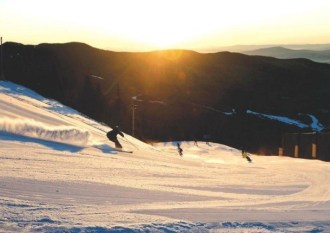
With 4.7 million skier visits last year, Vermont set a record and beat California for the second-highest number of skier visits of any state, he said. Vermont typically is third behind Colorado and California, he said.
Vermont used to have more skier visits than any other state, and by a large margin, Riehle said.
Back when that was true, 30 or 40 years ago, resorts were less pressured to pull in a large percentage of their revenue during a few holiday periods, said Sugarbush co-owner Adam Greshin.
People at that time had much more leeway to take time off during the week to ski and to schedule days off for ski vacations, Greshin said.
And other sports’ growing popularity keeps skiers occupied elsewhere further into the ski season as well, Greshin said.
Now ski areas are pressured to make a large portion of their annual revenue from only about 40 days, which proportionally drives up the uncertainty with which resort managers must cope, Greshin said.
The warm weather this winter certainly will affect the state’s economy, Kaufman said, but Vermont’s ski areas may not be the most important driver.
The snowmobile industry likely will be hit even harder, he said.
When warm weather persists too late into the season, riders decide to wait another year to purchase snowmachines, Kaufman said. Because the machines cost so much, retailers are hurt by sitting on inventory, he said.
The weather could save the state some money, he said – for instance, by lessening the need for plowing and salting roads – but that hurts state employees who don’t earn as much overtime as in more typical years.
Businesses downslope from ski resorts may suffer as well, he said, especially in cases where hotels allow refunds for late cancellations.
But poor weather over the Christmas holiday shouldn’t unduly harm most resorts’ bottom line, Kaufman said. The Christmas season is one of three important holidays in the ski industry, with Martin Luther King Day weekend and Presidents’ Day weekend the two others.
“Usually something goes bad on one of these holiday periods,” he said. It’s not uncommon for resorts to be closed or open with only limited terrain over Christmas week, Kaufman said.
“The best skiing in the state usually comes in February or March,” he said. “Everything else, you say, ‘Great, thank you, Mother Nature, for treating us well this year.’”
Kaufman said February was a slow month last year, with an average temperature of 7 degrees during a period when the normal average is 21 degrees. The cold weather kept skiers and snowboarders indoors, he said. Nevertheless, the season was one of the best in years. This year could be similar in that regard.
“There’s no reason we won’t have a strong year when all is said and done,” he said.
Correction Jan. 13, 2016, 11:40 a.m.: The amount of snowmaking by resorts in the state and the number of ski trails that were open were incorrect in the original version of this story.
Correction Jan. 25, 11:32 a.m.: The percentage of tourism as part of the state’s economy has also been corrected.
