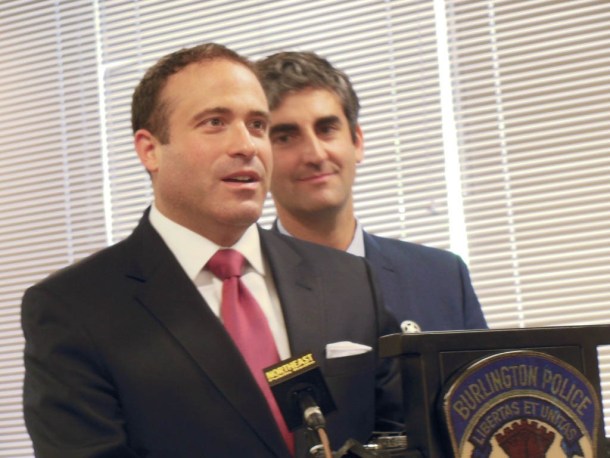
An article on racial profiling written in 2001 by the man appointed to become Burlington’s next police chief has raised red flags for some, but Mayor Miro Weinberger said Wednesday that his pick will be a leader on matters of diversity and equality.
Deputy Inspector Brandon del Pozo of the New York Police Department was appointed Tuesday to replace the retired Michael Schirling at the helm of Burlington’s police force. Del Pozo is due to come before the City Council next week for confirmation.
In a 2001 essay published in an Australian academic journal, QUT Law Review, del Pozo examines the ethics and legality of racial profiling. Del Pozo argued against quick dismissal of racial profiling, writing that in some instances it is a legal, ethical and useful tool for policing.
“While crafting policy that works against harmful and counterproductive generalizations with only marginal benefits,” del Pozo wrote, “police departments and politicians must also recognize that there are ethical applications of racial profiling which, if neglected, would do more than merely encumber police officers: the neglect would wreck unnecessary harm on all sectors of the citizenry.”
Del Pozo wrote the 36-page essay while he was a beat cop in the East Flatbush neighborhood of Brooklyn, as he was studying for a Master’s of Arts in criminal justice at the John Jay College of Criminal Justice in New York City. He submitted it to the journal at the urging of a professor, he said.
In a phone interview Wednesday, del Pozo said that he is against using racial stereotypes as a basis for policing.
“It’s never been ethical and it’s never been legal, and I won’t tolerate a police department that practices it,” said del Pozo, who is of Cuban descent.
Reflecting on the article, which he wrote while in his mid-20s, del Pozo said that race can play a role in identifying suspects.
“Following up on leads and descriptions in order to catch people who committed past crimes is good policing, and skin color is part of a description,” del Pozo said, “but it should never be an excuse to use skin color simply to intrude on innocent people’s lives.”
The appointee said that he did not volunteer the essay in the vetting process before Weinberger chose him to replace Schirling; del Pozo was told that there had been a very thorough background check.
According to Weinberger, del Pozo’s approach to diversity in policing played a large part in his selection to head the police department. Del Pozo’s candor about race impressed a team that advises the administration on matters of inequality and diversity, Weinberger said, as did his strategies to maintain diversity within the ranks of the Burlington police.
Although Weinberger had not read the article in full at the time of the interview, the mayor said that he hadn’t “seen anything yet that shakes my sense that he actually will be a real leader on diversity issues.”
The mayor went on to say that del Pozo’s paper shows the nominee’s long record of thoughtfulness regarding the challenges of policing in America.
“I do see something positive about someone who has been thinking about these issues as long as he has and isn’t afraid to grapple with them and commit things to paper and try to work out these issues,” Weinberger said.

Curtiss Reed, executive director of the Vermont Partnership for Fairness and Diversity, who helped in the search for the next BPD chief, said that del Pozo’s rigorous approach to the 2001 paper is a sign that he will bring “transformative leadership” to Burlington.
“Bringing that kind of critical thinking to the job bodes well for the city,” Reed said.
The relationship between law enforcement and minority communities is different today than it was at the time the article was written, Reed added.
University of Vermont economics professor Stephanie Seguino, who has worked with the Burlington-area police departments on racial profiling, said del Pozo’s article “is certainly cause for concern.”
She said that the article expresses a stance on racial profiling that is at odds with the Burlington and South Burlington police departments, where there has been an effort to clamp down on profiling.
“We are an increasingly diverse community,” Seguino said. “We require leaders in the community who are able to bring us together and overcome some of the racial division.”
Seguino conducted a study on traffic stops in the Burlington metro area in 2009-2010 that found that the number of stops per 1,000 people was 25 percent higher for African Americans than for whites. That study prompted a series of discussions in Chittenden County on diversity and racial equality.
Allen Gilbert, of the Vermont chapter of the American Civil Liberties Union, raised issue with parts of del Pozo’s article that suggest that patterns in data are enough to provide evidence of law-breaking.
“A correlation is not evidence of wrong-doing. It’s profiling,” Gilbert said. “Correlations provide an excuse rather than evidence to target someone as a criminal suspect.”
Statistical generalizations have no place in policing, del Pozo said.
“Every citizen is an individual with a complete set of rights that has nothing to do with larger numbers,” del Pozo said Wednesday.
Del Pozo said that he has never used racial profiling in his own career. His attitudes on policing minority communities have been informed by his experience as an officer in New York, as well as his personal experience.
The article is part of a long path to “come to terms with ethical and moral issues of American policing,” del Pozo said. The Dartmouth alumnus also has a master’s in philosophy and is a philosophy doctoral candidate.
Del Pozo, whose nearly two-decade career in the NYPD has spanned the high crime rates of the 1990s to “stop and frisk” searches to the 2014 death of Eric Garner, said that his perspectives on policing have matured since he wrote the article.
“I wouldn’t need to write this paper today,” del Pozo said. “The police need to be guardians of our most vulnerable communities not burdens.”