

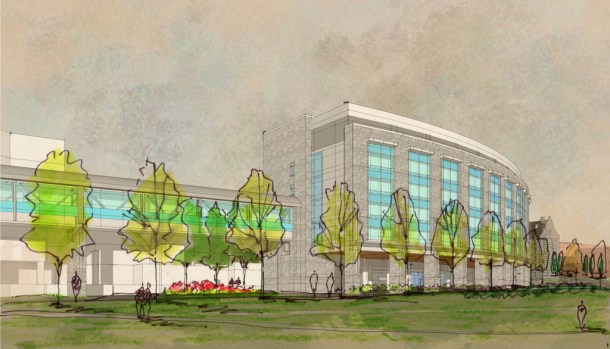
[T]he regulatory Green Mountain Care Board on Wednesday gave the University of Vermont Medical Center the green light to build a $187 million inpatient facility.
The board gave approval over the dissent of one member and concerns raised by Legal Aid that the project could increase the cost of medical treatment at the state’s largest hospital.
In its decision, the board recognized the need for the medical center to update its inpatient facilities, but adds that it is “also cognizant of the inherent risks of a project of this scale and significance.” As a result, the board included a set of conditions designed to mitigate the risks — mostly financial — associated with the project.
The decision concludes a regulatory review that started more than two years ago. There is a 30-day appeal window, but Vermont Legal Aid, which represented consumers in the review, doesn’t plan to appeal the decision, one of its attorneys said Wednesday.
Applying conditions to the project’s approval shows the board is “aware” of its potential to impact health care costs for consumers, and it appears the board will closely monitor any cost overruns, said Legal Aid’s Kaili Kuiper. Hospital officials have said the project won’t increase what people pay for medical care.
The planned 180,000-square-foot building will house 128 single-occupancy patient rooms, and the seven-story structure would be located on the west side of UVM Medical Center’s property in Burlington above the existing emergency department parking lot.
The new facility will replace out-of-date, double-occupancy rooms that hospital officials say make it difficult to prevent infections, offer patients privacy and afford space to accommodate diagnostic equipment, as well as patients’ families and visitors, according to hospital officials. The buildings to be replaced are 25 to 60 years old.
The board’s review process is meant to ensure major projects fit into a thoughtful and efficient buildout of Vermont’s health care infrastructure. By a vote of 4-1, the board agreed the new inpatient facility met that criteria, though one member voting in the affirmative wanted conditions that were not included in the final decision.
The conditions that were included require UVMMC to submit an updated cost estimate based on “construction documents, rather than on schematic designs.” The new estimate can’t exceed the current one by more than 8 percent. It also requires the hospital to demonstrate that it is meeting financial projections in its application. Also, the project must be completed within six years of the board’s decision allowing it to go forward, or approval can be revoked.
If any of the conditions imposed by the board are not met, it reserves the right to issue further orders it deems “necessary or desirable” to keep the project in line with the terms of its approval.
Con Hogan, who cast the lone dissenting vote, said the project is “badly needed,” but even with the conditions imposed by his colleagues, the former Agency of Human Services secretary said he was unconvinced UVMMC can sustain the project’s financial burden.
Hogan wrote in a dissent issued with the ruling that among the assumptions underlying UVMMC’s plan to pay for the new inpatient building is that Medicare and Medicaid payments “will not be less than they are today.” He adds there is “little basis” for that assumption, highlighting the federal government’s intent to overhaul how Medicare pays doctors and hospitals.
Kuiper, the Legal Aid attorney, also said UVMMC’s assumptions about what government health care programs will pay in the future are problematic.
She pointed to a report from Deloitte, a firm hired by the board to review UVMMC’s application, which says the hospital’s financing assumes the same 3 percent rate increase from government programs as it does from private insurers — despite historical increases to Medicare and Medicaid rates that hover between 0 percent and 2 percent.
Hogan also raised the concern that the hospital’s application fails to account for potential decreases to its growth in patient revenue. Patient revenue growth is controlled by the board, and Hogan wrote that it’s possible that regulators will approve smaller increases than UVMMC is anticipating.
According to UVMMC’s own consultant hired for the application process, a 1.5 percent decrease to the assumed revenue growth would leave the hospital searching for $15.8 million. That’s roughly equal to the operating cost of the new facility, which UVMMC has said it will pay for by becoming more efficient.
Kaufman Hall, UVMMC’s consultant, concluded there is “significant risk” that the assumed levels of growth in patient revenue won’t be met.
UVMMC estimates it will take more than 20 years to pay down the interest on borrowing necessary to pay for the project, at which point it will begin paying down the principal. That means revenue and payment rate estimates in its application would need to be borne out over decades.
Hogan also questioned the aggressive fundraising goal of $30 million in donations to support the project. UVMMC told the board it has secured $11 million and said the rest will be raised by 2018.
The decision specifically allows UVMMC to move forward with a $9.7 million land deal to purchase just more than an acre from the University of Vermont, and allows it to commission construction schematics for the project.
Hospital officials are reviewing and analyzing the decision and are in the process of developing a plan to address the conditions set by the board, according to a news release. Once it breaks ground on the new facility, the hospital expects it will take 38 months to complete. Officials anticipate the new facility to open in late 2018.
UVMMC CEO John Brumsted issued the following statement after the decision was released: “I appreciate the board’s thoughtful review and approval of the project. We still have some work to do to meet the board’s conditions, which will lead to providing patients and families in our region with inpatient facilities that match the high quality of health care our doctors, nurses and staff deliver every day.”

