

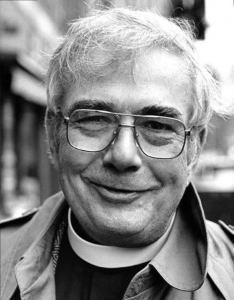
[A]sk Norman Runnion for his life story and he’d point to a newspaper.
Take the old Kansas City Journal-Post, where he played as a child while his father pounded on a manual typewriter.
Or the Evanston (Ill.) Review, where he broke into journalism pasting up the sports page for $5 a week.
Or Vermont’s Brattleboro Reformer and The Herald of Randolph, where he capped a globetrotting career covering the world for wire service desks in New York, London, Paris and Washington, D.C.
“I’m a newspaperman, my father was a newspaperman — I love that word, I grew up on that word. It would never have occurred to me to be anything else.”
“I’m a newspaperman, my father was a newspaperman — I love that word, I grew up on that word,” he said in 1989. “It would never have occurred to me to be anything else.”
Except an Episcopal priest, which he tried for a decade at midlife. But Runnion eventually returned to writing, which he did until shortly before his death Friday at Randolph’s Gifford Medical Center at age 85.
When Newfane mystery novelist Archer Mayor wanted an interesting character name for his 1993 book “The Skeleton’s Knee,” he borrowed Norm Runnion’s. But fiction was no match for the real man’s feats.
The lifelong scribe made his own headlines as recently as two years ago, when he wrote a widely circulated column recalling his work as Washington night news editor for United Press International when President John F. Kennedy was assassinated Nov. 22, 1963.
“For those of us who were around on that searing day in American history, it could have been yesterday, not 50 years ago,” he recalled of an event for which UPI’s coverage won a Pulitzer Prize. “I can hear today the haunting sounds of the muffled drums as they passed below our windows, leading the solemn procession past the thousands of people who jammed the sidewalks to watch and mourn.”
Runnion went on to write the main story about the 888-page Warren Commission report on the shooting.
“The report was embargoed for a later release to give journalists time to absorb the contents instead of rushing out with the first available tidbits,” he wrote. “But the stark principal finding was right there: Oswald, acting alone, had murdered America’s beloved president.”
Ask Runnion what sparked his interest in journalism and he’d rewind back to his birth in Kansas City, Mo., in 1929. His mother was a teacher; his father, like his grandfather, was a newspaperman.
“I grew up in a newsroom — quite literally,” he told this reporter in a 1989 interview.
For Runnion, home was wherever his father worked. At age 12, his family moved to St. Louis and the Star-Times; in 1941, it was Chicago and the Sun.
Life changed in 1945 when Runnion’s father fell underneath a commuter train and was killed. The next day, Runnion, then a high school junior, enrolled in a journalism course. Eventually receiving a degree from Northwestern University’s Medill School of Journalism in 1951, he worked “four god-awful months” at the Chicago City News Bureau, servicing a half-dozen metropolitan papers with crime reports.
“I was covering the night police beat in the south side of Chicago, which had the second highest crime rate in the world outside of Singapore at that time,” he recalled. “Earned 25 bucks a week for approximately an 80-hour week.”
Runnion went on to join United Press International, reporting and editing in New York starting in 1953, in London in 1955 (where he covered Winston Churchill), in Paris in 1957 (where he covered Charles de Gaulle) and in Washington, D.C., in 1960.
“Came in on the tail end of the ’60 elections, spent the next three years covering Kennedy, the civil rights movement, covered Martin Luther King’s march on Washington, got assigned to cover the space program, covered Alan Shepard’s flight, covered John Glenn’s flight,” he recalled.
Runnion was also the lead writer of UPI’s coverage of the Cuban missile crisis.
“I was really incredibly lucky,” he said. “Everywhere I went was one after another of the biggest news stories of the world. Those were the most monumental news stories of my generation. What the hell more do you want?”
In 1966, Runnion decided he needed a break. Moving to Vermont, he joined the Reformer in 1969 and became its managing editor in 1971. Working in Windham County for two decades, he both reported and made state news.
In 1983, for example, Runnion was the only journalist invited to the wedding of then Vermont House Speaker Stephan Morse — a ceremony presided over by then Gov. Richard Snelling — with explicit instructions not to write a word.
If the bride and groom didn’t suspect Runnion had other thoughts when he arrived with a camera, they knew it when they picked up the Reformer the next publication day and saw their nuptials splashed as an exclusive atop the front page.
Runnion, deemed by one competitor “chief curmudgeon of the Vermont press corps,” surprised readers in 1990 by leaving the paper to attend Virginia Theological Seminary, work as a seminarian assistant at the all-black St. Luke’s Episcopal Church in Washington, and serve as rector of St. Martin’s Episcopal Church in Fairlee.
Invited to address several New England press associations, the new priest condemned the media for “growing ineptness” he blamed on a loss of ethics and “corporate obsession with the bottom line.”
“I don’t think the First Amendment is a protective umbrella for the kind of sin journalism we are seeing in our culture today,” he said at one event. “I don’t think picturing violence for the sake of money is what Thomas Jefferson and Alexander Hamilton had in mind. The fact is, the public has a right not to know a lot of the junk that is being tossed their way in the name of the ‘right to know.’”
Runnion would retire from the church in 2001 and return to journalism by writing for the weekly Herald of Randolph, near his Brookfield home. His column on the 50th anniversary of Kennedy’s assassination was reprinted by the statewide news website VTDigger.org, spurring a flurry of public comment.
“Hey, Norm: Oswald did not do it,” one reader posted.
“Good point — I agree,” Runnion replied. “It was ET and the aliens.”
Runnion will be remembered July 8 at a public service in Randolph to be led by Vermont Episcopal Bishop Thomas Ely, with specifics to come from that town’s Day Funeral Home. (“He wrote a partial obituary and said, ‘You can fill in the blanks,’” his wife Linda said Monday.) He’ll also live on through nearly seven decades of his published work.
“I personally witnessed much of this history and believe what I saw over what people who were not there claimed happened 20 or 30 or 50 years later,” he recently posted to Internet readers sharing conspiracy theories. “But hey, it’s differences of opinion that make the world go around. Cheers, Norm.”
Brattleboro-based writer Kevin O’Connor was hired as a high school intern by Norman Runnion in 1978. Email: kevinoconnorvt@gmail.com
