

[S]enators are proposing seven new sections to the economic development bill that they tore apart on the Senate floor this week.
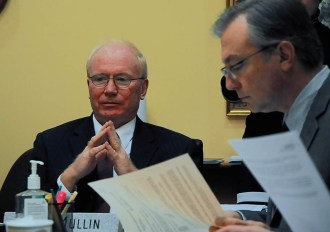
Sen. Kevin Mullin, R-Rutland, chair of the Senate Committee on Economic Development, Housing and General Affairs, requested to postpone a third reading on the economic development bill, S.138, until Friday.
In the meantime, committees are reviewing a flurry of short amendments related to a sales tax holiday, “blockchain” technology, fortified wines, gun silencers, a cloud tax, a research and development tax credit and an affordable housing tax credit.
The Senate Committee on Finance voted down, 5-2, an amendment from freshmen Sens. Brian Collamore, R-Rutland, and Becca Balint, D-Windham, to create a sales tax holiday Aug. 28-29.
Sen. Tim Ashe, D/P-Chittenden, said a sales tax holiday would cost the state $2.5 million in revenue. The full Senate will decide whether to approve the amendments Friday.
Senate Finance also approved an amendment Wednesday to move language that eliminates the cloud tax into S.138. The cloud tax bill, S.97, passed the Senate 26-0 in February and moved over to House Ways and Means. The language would exempt software accessed through an online cloud, but not tangibly purchased, from the state’s sales tax.
 Sen. Joe Benning, R-Caledonia, introduced an amendment that would amend the state’s ban on selling gun silencers to allow persons licensed under a specific federal law to make, sell, export and research gun silencers, among other things.
An amendment from Sens. Peg Flory, R-Rutland, and Dick Mazza, D-Grand Isle, would increase the tax credit for research and development from 27 percent to 30 percent. (In 2014, the Legislature lowered the same tax credit from 30 percent to 27 percent.)
Benning and Sen. Philip Baruth, D-Chittenden, introduced an amended version of the affordable housing credit that was taken out of S.138.
Balint introduced a second amendment that would enable the state to use blockchain technology, an emerging, highly mathematical, tamper-proof technology used for uploading data from different sources. Vermont would be the first state to recognize the technology if the amendment passed, according to Mullin, and that could get the state attention at certain technology conferences.
Each amendment went to a committee of jurisdiction where time allowed, and Senate Finance discussed several of them.
“We’re looking at the affordability of the changes that are being made,” Ashe said Wednesday. “These are the types of changes that usually would take four months for a legislative process to undertake, and we’re doing the best in the time we have.”
The Senate convenes at 11 a.m. on Friday.
Major sections that remain in S.138:
• Changes to the Vermont Strong Scholars and internship initiative.
• Analysis of advanced manufacturing and information technology programs.
• Establishment of a Governor’s Committee on Employment of People with Disabilities.
• Amended language that creates a neighborhood development area.
• Language directing the Agency of Commerce and Community Development to complete a study on peer-to-peer lending programs.
• Language directing the state to create a media production database for filmmakers who want to make movies in Vermont to find production equipment and extras.
• Miscellaneous changes to liquor laws that allow the Department of Liquor Control to issue 200 fortified wine permits across the state with a $100 fee.
• Dozens of empty sections waiting to be merged with H.124, the House’s economic development bill.

