

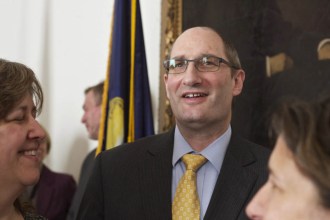
[A]s the Shumlin administration and the Vermont State Employees’ Association debate how the state will manage $10.8 million in personnel and labor cost reductions, the impact of those cuts remains unclear.
Late last month, the House approved a $1.48 billion general fund budget package that includes a $10.8 million reduction in personnel and labor costs originally proposed by Gov. Peter Shumlin.
There are a number of ways that the state could arrive at those savings, but, according to Secretary of Administration Justin Johnson, who is responsible for finding the reductions, the state’s options are limited so long as the VSEA refuses to reopen a contract negotiated in 2013.
Johnson sent out notices to departments and agencies in early March announcing that the state could be looking at as many as 325 reductions in force (RIFs).
If the layoffs go through, he said, there would likely be some impact on the services the state offers.
“It’s not a direct correlation, but it’s certainly something that departments and agencies have to look at and struggle with,” Johnson said.
Ultimately, the positions that are cut will be decided by the agencies and departments themselves, working with his input, Johnson said Wednesday.
The bulk of the reductions would hit the Agency of Human Services, which, according to Johnson’s notification, should brace for a $4.6 million cut. AHS officials did not respond to inquiries as to how they would manage the cut, but Johnson said that positions such as social workers with the Department for Children and Families, which has seen a rise in caseload recently, are not likely to end up on the chopping block.
Johnson said that departments could find labor savings in a number of ways — by keeping vacant positions unfilled, restructuring some programs or reducing positions in programs that are not in high demand.
According to the Joint Fiscal Office, RIFs do not necessarily equal long-term savings for the state. Associate Fiscal Officer Stephanie Barrett told the Senate Finance Committee last month that layoffs tend to be followed by an upward creep in labor costs.
After the last round of RIFs in 2009, when 111 state workers were laid off under Gov. Jim Douglas, the number of employees in the executive branch grew by less than 1 percent through FY 2011 and 2012, according to the Department of Human Resources 2014 annual report. However, hiring picked up again in FY 2013 when the number of employees grew by 3.2 percent.
Johnson said he is looking to departments and agencies to produce “permanent savings,” meaning that management should not expect funding to be restored next year. That means reducing the workload of a department, rather than shifting the same amount of work onto fewer employees, he said.
“We need to clearly say these are the things we’re going to do and these are the things that we’re not going to do,” Johnson said. In some cases, departments can find efficiencies and restructure, he said.
According to Steve Howard, executive director of VSEA, Vermonters can expect to see an impact from job cuts.
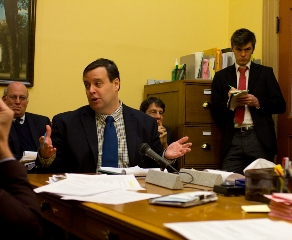
“Whenever there are significant RIFs to a state workforce that still has not really caught up from the last round of RIFs, there is going to be an impact on the services Vermonters receive,” Howard said.
The VSEA has been an outspoken critic of the FY 2016 budget, arguing that the state should be raising more in taxes rather than cutting jobs and services.
“Our position is strong that we’re not reopening the contract,” Howard said. He confirmed that the VSEA has been in discussions with the administration, which he described as “pretty constructive.”
Along with a broad coalition of groups, including the Vermont Workers’ Center and Rising Tide, VSEA plans to hold a demonstration in Montpelier on Saturday over the state’s approach to the budget.
At a news conference Wednesday, Shumlin said it is too early to tell which services would be affected by the $10.8 million reduction in labor costs. He said the current year’s budget challenge requires collaboration, and encouraged cooperation around the labor reductions.
“We shouldn’t be fighting about this,” Shumlin said. “We should be sitting down and figuring it out together.”
Johnson said his department is working with the VSEA to try to find solutions to the $10.8 million question, including possibly offering incentives to employees who are nearing retirement. However, each option takes time to study, he said.
“I don’t want to do something that saves me money somewhere and costs me more money somewhere else,” Johnson said.

