



[A] major economic development bill moving through the Senate received the endorsement of 12 regional development corporations across Vermont.
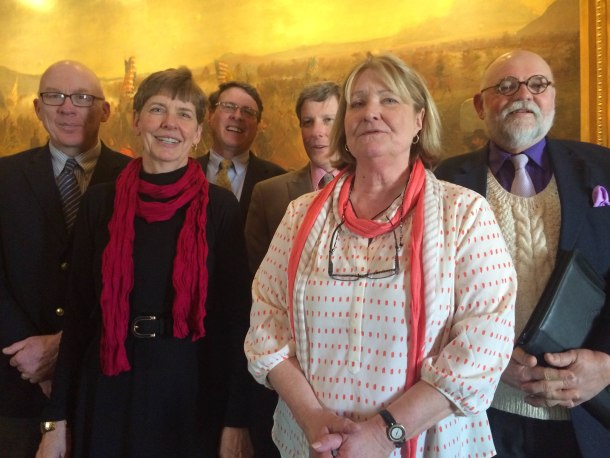
Bob Flint, executive director of the Springfield Regional Development Corp., joined four regional directors at the Statehouse to thank the Senate Committee on Economic Development, Housing and General Affairs for passing the bill out of committee this week.
“You’ve got to be able to have revenue-generating activities for the state’s long-term economy,” Flint said.
The bill lowers the threshold wage for companies seeking incentives through the Vermont Employment Growth Incentive. Sen. Kevin Mullin, R-Rutland, said the change would make it easier for manufacturing companies to hire people in Vermont. The legislation also creates “enterprise zones” to help foster economic growth in rural areas.
S.183 would lower the wage threshold for the Vermont Employment Growth Incentive program from 160 percent of the minimum wage, or $14.64, to the state’s “livable wage,” which the Joint Fiscal Office suggested in a study should be $13 per hour this year.
The bill would give $500,000 in tax credits to “angel investors” who back certain risky capital ventures and establish “millennial enterprise zone” tax credits for businesses that create “new, high-paying jobs in information technology … including digital networks, robotics, and virtual worlds.”
Mullin said the bill, which he says will “promote Vermont’s tech industry,” is the result of collaboration between lawmakers and the Shumlin administration.
Employment in Vermont just last year surpassed pre-recession levels. Employment in Burlington is above the 2007 high; the number of jobs in the rest of the state is slightly lower.
“What we’re trying to say is part of the reason we’re having to make some of these cuts is we’re not getting enough revenue,” Mullin said. “Whether it’s cleaning up the water or helping people in poverty, the money’s gotta come from somewhere, and we need to make the pool of revenue bigger.”
Sen. John Campbell, D-Windsor, said he supports the bill as a way to “make sure that the foundation of business is solid” before lawmakers implement new tax policies.
“Even with paid sick leave or health insurance, those are wonderful things,” Campbell said. “Most people I know would love to offer health insurance to their employees, but at this point they just cannot afford to do so.”
Campbell said the nation’s economy is improving, but the Northeast tends to lag.
The legislation is now in the Senate Committee on Natural Resources, which has been hearing testimony on the bill’s compliance with Act 250. The committee is scheduled to vote out an amended bill on Friday morning.
Sen. Chris Bray, D-Addison, chair of Natural Resources, said he has long-term concerns about creating “enterprise zones.”
Bray said lawmakers have carved out exceptions to Act 250 for downtowns, village centers, and other designated areas.
“People want to be able to develop more quickly and [have it] be less costly to do so,” Bray said. “I’m sympathetic to that as a business owner, but I’m not willing to sacrifice the long-term health of our communities for some kind of short-term gains.”
Bray said Act 250 was created in 1970, after a study commission met 18 times in one year and brought recommendations to then-Gov. Deane Davis. He suggested the proposed changes to Act 250 should go through a similar process.

