

Vermont Businesses for Social Responsibility endorsed Gov. Peter Shumlin’s plan to use a payroll tax to raise reimbursement rates for doctors who see Medicaid patients.
Under Shumlin’s plan, a 0.7 percent payroll tax would be assessed on employers in order to bring Medicaid reimbursements up to the same rate that Medicare pays providers.
The Green Mountain Care Board says Medicaid pays about 60 percent of what medical services cost, while Medicare pays closer to 80 percent. That causes the phenomenon known as the Medicaid cost shift, in which providers make so little money on Medicaid that they have to charge more to private insurance companies.
The Shumlin administration estimates that their plan to increase the Medicaid reimbursement through the payroll tax would be a modest cost with a large benefit — the administration estimates a 5 percent reduction in the growth of aggregate private health insurance costs while about 60 percent of businesses pay less than $1,000 per year.
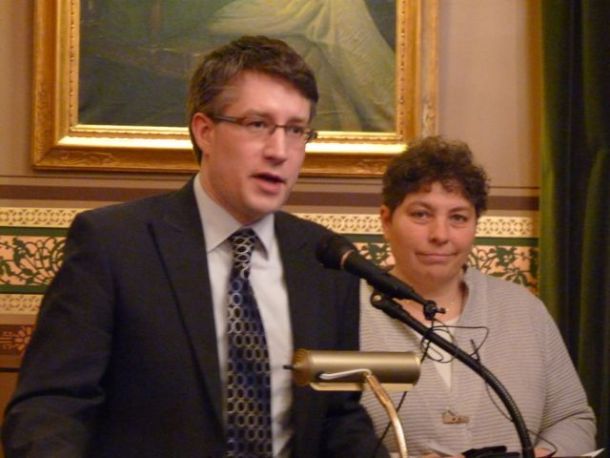
Members of VBSR said at a press conference Thursday that the Medicaid cost shift should be addressed because it amounts to a “hidden tax” on some employers while rewarding businesses who do not give their workers adequate pay or health insurance.
Members said a new tax would help doctors afford to see Medicaid patients, penalize employers who don’t offer health insurance to their workers, and reduce health care costs for employers who do provide health insurance to their workers.
Jennifer Chiodo, a VBSR board member, called the cost shift “a hidden tax for employers who are paying for their employees’ health care.” Chiodo said the cost shift is “inequitable.”
Chiodo said fewer and fewer doctors can afford to see Medicaid patients, making it more difficult for friends of hers who need the “Medicaid safety net” to see a doctor.
Leslie Nulty, a business owner in Burlington, said the cost shift is “imposing a tax on those employers who are adequately providing insurance to their employees.” Nulty said the payroll tax is the best option because, “It’s quick. It’s simple. It’s easy to administer.”
The VBSR members did not say that a payroll tax was the only way to address the cost shift, but said the cost shift should be addressed immediately to slow the increase in premium costs.
“The Legislature has the opportunity to leverage substantial federal dollars to help make a dent in this structural problem,” Nulty said. “It’s quick. It’s simple. It’s easy to administer,” Nulty said of a payroll tax.
Rep. Avram Patt, D-Worcester, a member of the Committee on Health Care, said that people are paying for the cost shift without the payroll tax.
“That cost is in your premiums, it’s in your deductible, and it’s in your co-pay,” Patt said. “Business owners and managers don’t understand it because it’s not a line item.”
Dr. Joseph Haddock, a family practice physician in Williston, said Medicaid reimbursement rates are so low that “primary care is in deep trouble.”
Haddock said seeing Medicaid patients at his practice costs the firm between $125,000 and $150,000 per year.
For pediatricians, Haddock said, up to half of patients are on Medicaid. “They’re in trouble this year — not in January of 2016 or 2017,” Haddock said.
