

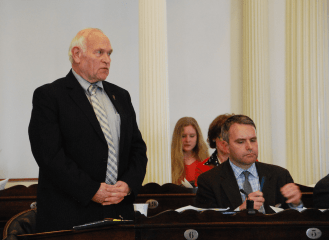
[T]he Senate gave preliminary approval to a hefty child protection reform package, 28-0, in a roll call vote Wednesday.
“To say that this is an important bill would be a tremendous understatement,” Sen. Dick Sears, D-Bennington, said as he introduced the bill, reminding lawmakers that Dezirae Sheldon, a 2-year-old who had been in DCF custody before being returned to her home, died about a year ago. “A child’s life should mean something, Mr. President.”
S.9 aims to address inconsistencies in the child protection system between counties and improve communication around child protection cases. The bill includes a 10-year penalty for the crime of failing to protect a child.
The bill has loomed large on the Senate’s agenda since the beginning of the session and followed a lengthy summer study.
All told, the reform package crossed over the tables of four of the Senate’s 12 committees.
Witnesses familiar with aspects of the state’s child protection system have crowded into the Judiciary Committee room since S.9 was introduced at the beginning of the session. The bill was among the committee’s top priorities for the session, with testimony on other bills in recent week postponed and rescheduled in order to wrap up work on S.9.
The Health and Welfare Committee took extensive testimony on some sections of S.9, making recommendations to and hammering out language with the Judiciary Committee.
The Government Operations Committee, chaired by Sen. Jeanette White, D-Windham, who also serves on the Judiciary Committee, made recommendations on parts of the bill, and last week, Appropriations had the final say, approving funding for a child protection oversight committee.

The bill that Sears reported to the Senate on Wednesday is a much-revised version of the bill as originally proposed. Some sections, including one that empowered social workers to remove a child from a home when there is imminent risk of harm and another that established a child protection advocate position, were removed due to budgetary constraints or popular opinion.
The words “illness” and “pain” were also struck from a section of the bill that defined risk of harm after they sparked public outcry that parents that choose not to vaccinate their children could face charges.
After Sears’ half-hour report on the bill, senators from the three other committees reported as well.
A vote was originally schedule to take place Tuesday, but was delayed so that Senate Democrats could caucus on it. During the lunchtime meeting, senators reported hearing from constituents with concerns about the scope and constitutionality of the bill.
Sen. Peg Flory, R-Rutland, an attorney with experience in family court cases, introduced an amendment to the Judiciary Committee’s bill. The amendment expands the number of people who will have access to redacted DCF investigation records to include the parents of a child and a family court that is working on proceedings involving a child who is the subject of custody proceedings.
During floor discussion, Sen. David Zuckerman, P/D-Chittenden, raised the issue of waitlists for substance abuse treatment. During testimonies on child protection, lawmakers heard that substance abuse is a factor in a large portion of DCF cases.
The delay for treatment could be an issue in cases where parents are required to be in treatment in order for custody to be restored.
Zuckerman warned that in a tough budget year, when it comes to saving money with regard to substance abuse treatment, “we may be creating more problems than we’re solving.”
After the vote, Sears said that treatment for opiates and other substances remains a challenge for the state’s child protection system.
“We’re moving toward a system where we can provide treatment on demand, but we aren’t there yet,” Sears said after the vote.
Defender General Matt Valerio, who testified several times on S.9, said after the vote that the bill is still in early stages.
“This is so far from done,” Valerio said. “We’ve just mixed the batter, we haven’t even stuck it in the oven yet.”
Some parts of the bill still need more scrutiny, he said, pointing to sections two and three, which establish the crime of failure to protect a child and imposes a 30-year sentence and $1.5 million fine for exposing a child to a place where methamphetamines are made.
The penalties for exposing a child to a meth lab, he said, are steeper than they are in some cases of homicide.
In general, Valerio thinks the child protection system needs adequate funding and reasonable caseload sizes for social workers.
