

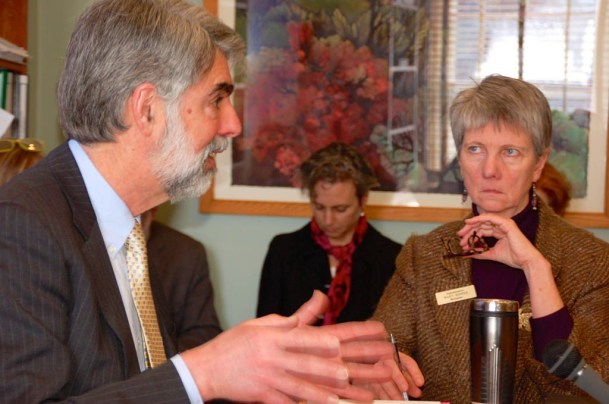
Jeb Spaulding, the new chancellor of the Vermont State Colleges system, called for a 3 percent increase in funding Tuesday.
Spaulding and University of Vermont President Tom Sullivan were in Montpelier to address the House Appropriations Committee on the governor’s proposed Fiscal Year 2016 budget.
What the state colleges, UVM and the Vermont Student Assistance Corp. (VSAC) are seeking is an increase equivalent to the increase in the General Fund budget — projected at 1.9 percent — plus one percent.
The former secretary of administration and state treasurer, Spaulding was in the Statehouse Tuesday, asking for more money. In his previous role, he stood beside the governor and called for austere budgeting.
“We need to figure out how to get the funding for public education back to where it was in the 1980s,” Spaulding said. “We didn’t get to where we are overnight.”
Spaulding said the level of state support has gone down from about 50 percent to about 15 percent of the system’s budget.
Spaulding had two specific ideas for helping to raise the 3 percent without what he called, “any economic dislocation at all.”
A tax on candy bars was his first proposal, which he said 29 other states already impose. He also proposed a tax on electronic cigarettes, which are gaining in popularity. Spaulding said regardless of people’s position on electronic cigarettes, he believes they should be taxed just as regular cigarettes are.
Like the K-12 school systems in Vermont, the VSC system is also seeing declining student enrollments, and the system is tuition-dependent, he said, with about 85 percent of the VSC budget coming from tuition.
With fewer students and less tuition, “You can see what happens. At some point in the not too distant future,” the budget crunch will affect the quality of education in the state college system.
At the same time, the Vermont State Colleges system is the entry point for many first-in-family college students, who come in at different levels, part-time, for an associate’s degree, a bachelor’s, to transfer credits to another school, for credential and technical programs and more. The system is the most affordable, open door option for Vermonters, and is a way in to post-secondary education at many levels, Spaulding testified.
Rep. Kitty Toll, D-Danville, asked about efforts to market to out-of-state students, and Spaulding said they do; Lyndon State College is almost half out-of-state students, he said.
Toll also asked about readiness for college, and whether students arrive ready for college-level work, which Spaulding said is an issue around which the VSC needs to better connect with the Vermont Agency of Education.
“We’re dealing with a significant portion of the population that are in some pretty challenging times in their home lives,” he said. “We can’t just throw up our hands and say, ‘We’re not going to deal with you.’ We need to take people from where they are and (get them) to where they need to be.”
Rep. Mary Hooper, D-Montpelier, pointed out that among the five colleges in the VSC system and especially in the case of the Community College of Vermont, that “there are 10,000 or a few more students, and huge overhead costs … what are you doing to manage that and consolidate those costs?”
Hooper, who called herself a fan of the state college system, said there must be room for savings and efficiencies.
Spaulding said the college system is engaged in belt-tightening in all areas of spending from purchasing and payroll to programming.
“All of the colleges are looking to economize and save resources,” Spaulding said. “We’re hoping to do more of that.”
Hooper said with about 10,000 students, for example, there are five presidents, five organizations “the size of a small university.” Delivering more to students should mean a hard look at some of those systems and duplicative administrative costs.
Spaulding said any increase in the VSC system would be invested directly in student scholarships and financial aid.

