

Editor’s note: This article is by Tommy Gardner, of the Stowe Reporter, in which it was first published Feb. 12, 2015.
[V]ermont ski resorts have a message to officials who want them to reconsider their leases on state land: Get back to us in about 40 years.
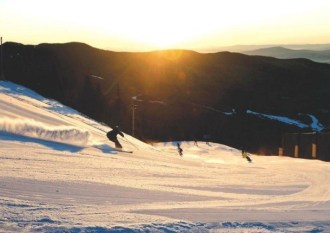
Last month, state Auditor Doug Hoffer issued a study that found the 50- to 100-year leases the state penned with ski resorts in the mid and late 1900s are dated, inconsistent, and benefit the resorts more financially than they benefit the state.
Hoffer said the original leases to seven Vermont ski resorts — including Stowe — cover roughly 8,500 acres of public land, and were meant to help the resorts grow while bringing in money for the state parks and forests.
But now ski resorts have grown into four-season playgrounds, lift prices top $100 a day at some places, and add-ons such as restaurants and golf courses and acres of lodges and condos bring more and more money into resorts, Hoffer noted, and some — such as Stowe Mountain Resort, owned by New York-based Chartis — aren’t even locally owned anymore.
“The dramatic changes in the resort industry over the past half-century suggest the need to review the current leases, which stretch back to the presidency of Dwight D. Eisenhower,” Hoffer said on Jan. 20.
Sen. Tim Ashe, a Chittenden County Progressive who chairs the Senate Finance Committee, threw more fuel on the fire when he wrote a letter to the seven Vermont ski resorts with long-term leases, demanding that the companies renegotiate their agreements with the state. Ashe alluded to options for increasing taxes on ski areas, such as eliminating the tax exemption on snowmaking equipment, as an alternative. Some lawmakers were perturbed by the letter, perceiving it as a threat to come down harder in taxing the resorts if they don’t voluntarily renegotiate their leases.
Rep. Heidi Scheuermann, R-Stowe, who grew up in the shadow of Mount Mansfield, was not impressed with Ashe’s letter, and called Hoffer’s report flawed.
“The income generated by ski resorts isn’t just for forests and parks, but all through the state of Vermont,” Scheuermann said Monday. The auditor, she said, “had a belief that tourism isn’t the economic driver we think it is.”
Parker Riehle, the association’s president, told the Vermont Press Bureau last week that the leases are a “very good deal for both parties and very favorable” to the state.
“In light of the numerous revenue benefits to the state, we certainly don’t see a need to look for any additional tax burden on the ski areas,” Riehle said. “We certainly don’t want to see anything like that hanging over our heads.”
No traction, slippery slope
Bill Stritzler, a local from Cambridge who has owned Smugglers’ Notch Ski Resort since the 1980s, said Hoffer’s and Ashe’s requests came as a surprise.
He said the state gets twice as much money from the ski resort leases as the federal government would receive in similar arrangements, 5 percent versus 2 percent.
“As stewards of the land, we have several responsibilities that go beyond just paying that fee,” Stritzler said. He added, “We’re in direct competition with Western resorts.”
While Hoffer and Ashe gripe that the 5 percent of lift ticket sales, and 2.5 to 3 percent of restaurant and retail receipts, bring the state only about $3 million a year, others say it’s $3 million a year in revenue the state wouldn’t otherwise generate.
“The forests, parks and recreation department is basically funded by those leases,” said state Sen. Rich Westman, R-Lamoille County. “Those leases have done exactly what they were meant to do.”
Westman also sits on the Senate Finance Committee.
“Nothing’s going through the finance committee, and I do sit at that table,” he said.
Stritzler offered another option: Sure, open the leases, but allow Smuggs to bypass Act 250 environmental requirements for future development projects.
“That’s not gonna happen,” Stritzler said.
