

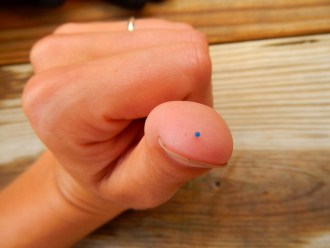
[T]he Vermont House voted Tuesday to ban the sale and manufacture of microbeads in personal care products and over-the-counter drugs.
In one of the first acts of the legislative session, the House gave preliminary approval on a voice vote to H.4, a bill intended to outlaw barely visible plastic scrubbing components found in personal care products such as soap and facial exfoliants due to environmental and potential health concerns.
The manufacture of these beads would be banned by Dec. 31, 2017. The following year, the bill bans the sale of personal care products containing microbeads. The bill still needs final House and Senate approval.
Products containing the plastics are often labeled polyethylene and polypropylene. They are not biodegradable, and when washed down the drain, flow through nearly all the state’s wastewater treatment plants into public water bodies.
Water scientists say the beads pollute waterways and can be found along Lake Champlain. Manufacturers are already seeking biodegradable alternatives to the products, such as oatmeal, pumice and ground nut shells.
The non-biodegradable beads are so small that flow through nearly all of the state’s wastewater treatment plants. Once they are released into the water, they cannot be removed, according to Lori Fisher, executive director of the Lake Champlain Committee.
“We need to keep them out of the water in the first place,” Fisher said.
Fish feed on the beads mistaking them for fish eggs, scientists say, and the plastics attract waterborne toxins that can attach themselves to fish tissue when consumed. This may contaminate food consumed by humans, though there is no definitive scientific evidence, according to Rachael Miller, executive director of the Granville-based nonprofit Rozalia Project.
Not all microbeads end up in the water. There are at least five wastewater treatment facilities in the Burlington area that use a cloth filtration system capable of removing microbeads from wastewater, according to Robert Fischer of the Green Mountain Water Environment Association.
The sludge that is extracted from the filters is sent to the state’s landfill or applied to land. Nearly 17 percent of sludge generated in Vermont is treated to remove pathogens and bacteria and then applied to land, according to the Department of Environmental Conservation.
Illinois was the first state to ban the plastic particles. But that bill still allows for some plastics to be use if they can biodegrade, usually at high temperatures.
Vermont’s bill goes one step further to define biodegradable, according to Taylor Johnson of the Vermont Public Interest Research Group, an environmental advocacy group backing the bill.
He said Vermont’s bill only allows beads that biodegrade in the environment they encounter when washed down the drain. As a result, the Legislature may not need to return to the issue in the future, he said.
VPIRG collected more than 1,000 signatures in support of the ban.
The personal care products industry recommended that the House Fish and Wildlife Committee delay the bill’s enactment by one year. Advocates agreed to the change.
Daniel Barlow of Vermont Businesses for Social Responsibility supported the bill. He said Vermonters should not be responsible for companies that pollute Vermont’s waterways. He said companies like Seventh Generation are already using alternatives.
By Dec. 31, 2019, the sale and manufacture of over-the-counter drugs containing microbeads would also be prohibited.

