



It was a Phil Scott party on Election Night at the South Burlington Sheraton. After cruising to an easy re-election, Vermont’s two-term Lieutenant Governor floated into the room like a rock star, cameras flashing.
But after Scott delivered a rousing speech, summoned his 12-member team to the stage and the GOP hooted and hollered over victories in the Legislature, the room deflated.
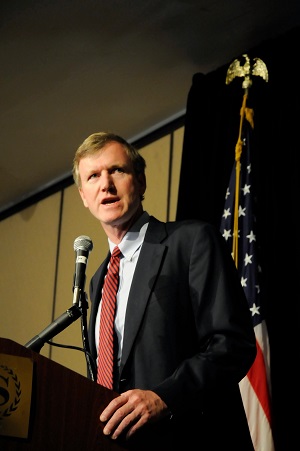
Left alone on-stage, facing an uncertain room and a less certain future, was the man who had nearly achieved a miracle.
Scott Milne was a political unknown who made a last-minute bid for governor in June. Despite a number of rookie mistakes over the course of his campaign, he nearly unseated Gov. Peter Shumlin, a two-term incumbent who outspent Milne by $700,000 and had the superior Democratic Party machine behind him.
By 11:30 p.m., even as Shumlin announced to his own supporters that the election was still too close to call, the GOP watch party was over. The dimly lit ballroom had quickly turned from celebratory to cavernous, the sound of bluster and gleeful surprise replaced by the tinkling of empty cocktail glasses as hotel staff cleared the room for another day.
From the moment precincts starting reporting election results to the Secretary of State at 7 p.m., the watch party tuned in to live newscasts on either side of the stage. In a back corner, one political junkie after another controlled a projector from a laptop computer, constantly refreshing the official results Web page as revelers stood behind, necks crooked to read the screen where bar graphs and vote tallies shone.
Almost all the talk was about down-ballot races. Dave Sunderland, GOP party chairman, took the stage from time to time to keep the crowd amped with news of House seats that Republicans had retained or flipped from Democratic control.
But not once did he mention the gubernatorial race — much less rally the room around the fact that the party’s candidate for Vermont’s top office had been neck-and-neck with Shumlin from the moment voters’ choices began to register.
After Scott’s victory speech, the audience of a few hundred waited in anticipation for more and Sunderland invited Milne to the stage, almost as an afterthought. When he took the microphone, Milne stood alone.
He told a joke. It fell flat; no one laughed. The atmosphere of suspenseful anticipation turned muted. Within minutes of his final words, the room had all but cleared. Even as Republicans were at last on the cusp of taking back the governorship, something believed impossible by almost every politico, pundit, and voter, no one was there to celebrate.
Surrounded by his children and a few reporters, Milne clutched a crinkled print-out that showed him just 2,600 votes behind Shumlin, with 11 percent more votes to count.
The glaringly obvious secret in that dark room Tuesday night – and today – is that Milne was not expected to win. His own party had, perhaps unwisely, written him off, and was caught off guard by his success.
The next day, the accidental contender, who admitted during the general election campaign that he had run in the primary as a lark, quietly slipped out of the hotel, unnoticed. There was no press conference. No party rally celebrating his stunning, unexpected performance in the state’s most important race.
The solitary candidate
“Nobody wins alone,” Scott said Tuesday during his speech. Yet Milne was a loner.
He was not part of the door-knocking “freedom and unity plan” campaign machine that scored the party’s first net gain in legislative seats in 14 years. Scott said he had strategized with party leaders to focus on the Legislature, not the top office, because “that’s where the work gets done.”
Shumlin wasn’t the only one who didn’t see Milne as a threat. And even now, operatives of all political stripes are trying to figure out what to make of his near success.
Since Tuesday, the state’s Republican party has continued to act as if their gubernatorial candidate does not exist.
Republican leaders Friday puffed their chests at a press conference held to tout legislative victories, but didn’t mention Milne until prompted by reporters. Scott told the press that if he were a lawmaker faced with the choice of who should be the next governor, he would vote for Shumlin because he finished in first place.
Yet Milne’s statewide vote tally is arguably more impressive than legislative gains in traditionally Republican districts. The record low voter turnout Tuesday, more than any legislative victory, expresses the magnitude of Vermonters’ unhappiness with Shumlin’s tenure as governor.
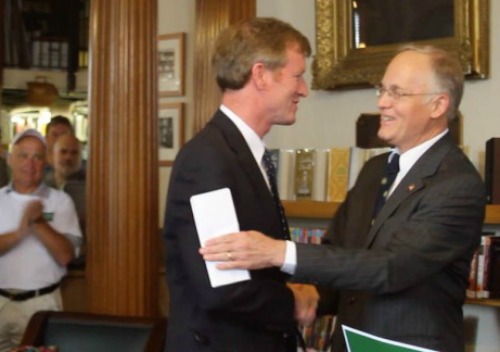
So alone, Milne soldiers on. He has not addressed the public since he left that dark ballroom in the wee hours of Wednesday, but he has signaled that he won’t go away.
Vermonters reportedly are barraging Milne with phone calls and emails urging him not to give up. He has not conceded. He may ask for a recount. He is said to be lobbying lawmakers, who will ultimately choose the next governor, to vote for him.
Milne dismisses the idea that the state GOP ostracized him.
“I get along great with them,” he said in an interview. Party chairman David Sunderland said the group backed Milne 100 percent after he won the primary, offering support and what resources they had.
But Scott Friday said Republicans thought Milne’s chances were too slim. “We’re all guilty. I mean, guilty of knowing it was an uphill battle,” Scott said.
Asked whether Milne would make a good governor, Scott said: “I think he’s a bright, bright guy. I don’t know. I mean, hard to tell until somebody’s put in that position. I think he’s a breath of fresh air.”
Yet he insisted the party did all it could to help.
’Lukewarm assistance’
Much earlier on Election Day, before the polls closed, Milne reflected on what he learned during the race.
“The Republican party is going through an identity crisis,” Milne said.
He spoke those words as he stood alone, waving to drivers from a traffic island in Barre City, where he grew up.
It was hard, Milne said, to gain the support of the entire Republican party, even though none of them would run for governor. Some Republicans wrote him off as too moderate, he said. Others thought he was too conservative.
Randy Brock, a Republican who lost to Shumlin in 2012, said Milne was “embraced by some of the party and not embraced by other parts of the party.”
Some in Milne’s campaign have told their own stories of “lukewarm assistance.” No Republicans would flank Milne, for example, at his press conference to announce his education plan at Spaulding High School in Barre.
It was surprisingly hard to fundraise, Milne said. The national Republican party called the race a lost cause. A fundraising letter from Brian Dubie, Shumlin’s Republican challenger in 2010, was most successful in raising funds, Milne said.
It also was a challenge to hold his party’s attention. Speaking to the watch party on Election Night, Milne had to pause while someone quieted a man in the back of the room.
As he got back on track, Milne echoed his constant message that state government should “slow down.”
Whether Republicans in the room that night paid attention is anyone’s guess. But it’s likely the one person most attuned to Milne’s message was the only person in Burlington on Tuesday night who was watching the returns as closely.
In a humble yet presumptive victory speech Wednesday, the incumbent governor uttered a message oddly similar to that of his opponent.
“I am obviously going to, on all of the major priorities of my administration, reflect, talk to folks, be inclusive, and make sure we get it right,” Shumlin said.
Had the GOP thrown more weight behind Milne — or not underestimated popular dissatisfaction with the incumbent — Shumlin might not be getting a third chance to get things right.
