Shumlin presser Part 1

Shumlin presser Part 2

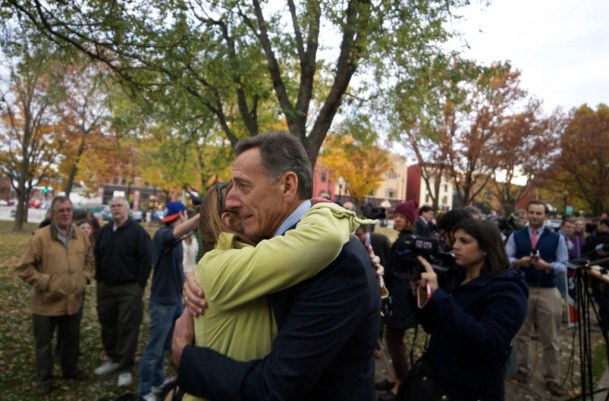
Shumlin called a news conference in Burlington on Wednesday afternoon, shortly after the Associated Press announced unofficial results in which he beat out Scott Milne, his Republican opponent, by a mere 2,033 votes. Milne has not yet conceded the race. The vote difference is less than 2 percent, which means he could call for a recount.
The governor’s narrow victory is widely seen as a referendum on his tenure in office, as his political opponent, Milne, is a neophyte Republican challenger. Shumlin acknowledged in remarks to the media that the results represent a political defeat he must work to overcome. In a brief speech, Shumlin told reporters that he would recalibrate his agenda in order to address voters’ deep dissatisfaction with his performance.
“We have faced our share of setbacks in the past couple of years, and I know people are disappointed in how I have handled some issues,” Shumlin said. “I recognize I have work to do to regain the confidence of many Vermonters in the coming weeks and months. I will work with my team as well as legislators from all political parties to assess our coming legislative agenda to ensure that we are representing the will of Vermont voters.”
The speech appeared to signal a departure in approach for the governor. In the past, Shumlin has developed initiatives for the legislative session without input from key lawmakers.
Shumlin looked haggard and told reporters he didn’t sleep on election night. Standing in City Park outside Burlington City Hall, he answered reporters’ questions without his usual dismissive tone and refrained (for the most part) from lapsing into rhetoric.
He said he went into the election with his “eyes wide open” and he said he “wasn’t surprised” by the results because he “listens every day to Vermonters.” His campaign conducted polls that “reflected that it’s a very tough time to run as an incumbent in Vermont.”
Shumlin said he was “personally humbled” by the election results, but he was also “proud that we won.”
“I’m disappointed that we didn’t receive a wider margin, but I’m grateful that we received the most votes passed,” Shumlin said. “I’m also proud of the fact that we ran a positive campaign that focused on the issues.”
In a question and answer session, reporters homed in on the election results, whether Shumlin would run a fourth term and what he thought voters were saying.
When asked if he made any mistakes during his campaign, he said he’d “leave that to political pundits.”
Another reporter asked if his narrow victory eliminated the possibility of a fourth term.
Without hesitation, Shumlin replied: “Definitely not.”
“I take it election by election, but I would say definitely not,” Shumlin said. “A week in politics is a long time. Two weeks is even longer, and we won’t focus too much on 2016. What I’m going to focus on is the job I’ve just been rehired to do, which is to grow jobs and economic opportunity.”
The governor placed the blame for his defeat on the national economy and said his near defeat was part of a wave of anti-incumbent fever that swept the nation. He believes the results were related to voters’ anxiety about stagnant wages. Democrats nationally took a hit, he said, because middle class and low-income Americans are not seeing their incomes rise even as Wall Street and large corporations see gains.
“You would have to be tone deaf not to be hearing Vermonters’ concerns in this election, and I heard it from the last several months going from one end of the state to the other, and it is like the rest of America, there’s tremendous frustration,” Shumlin said. “They’re worried about filling up their oil cans, putting food on the table, paying kids college tuition, paying college debt, and making progress economically. There is no question that this election was about frustration from working Vermonters about the lack of progress on the economy.”
Whether the governor can do much about the impact of the national economic situation on the tiny state of Vermont, however, is an open question.
While the governor lapsed back into his campaign rhetoric around “creating jobs and economic prosperity” for all Vermonters, he also said the state must address education spending and health care costs — two pocketbook issues the Legislature and the Shumlin administration can take responsibility for shaping.
“We all know that the two biggest obstacles to prosperity are rising property taxes and rising health care costs that rise faster than our incomes,” Shumlin said. “We need to stem the growth of property taxes and continue to push for affordable quality accessible health care for all Vermonters.”
Reporters repeatedly asked Shumlin if he would move ahead with his signature single payer health care initiative, but his response was unclear. He talked about creating an “affordable” health care system, but he did not use the term “single payer” once. When asked if he would release a financing plan in January, the answer was yes, but he sidestepped a direct answer about whether he would continue to pursue the initiative, which would shift $2 billion in premiums to payroll and other taxes. He focused instead on health care costs.
“The answer is, we must continue to work very hard on having a health care system that covers more people for less cost than we otherwise would have paid or we will continue not to have enough money in our pockets to pay our bills,” he said. “Having said that, I’m taking lessons from this election. I’ve listened to the voters, and I am obviously going to — on all the major priorities of my administration — reflect, talk to folks, be inclusive and make sure we’re getting it right.”
Editor’s note: This story was updated 6:25 a.m. Nov. 6.